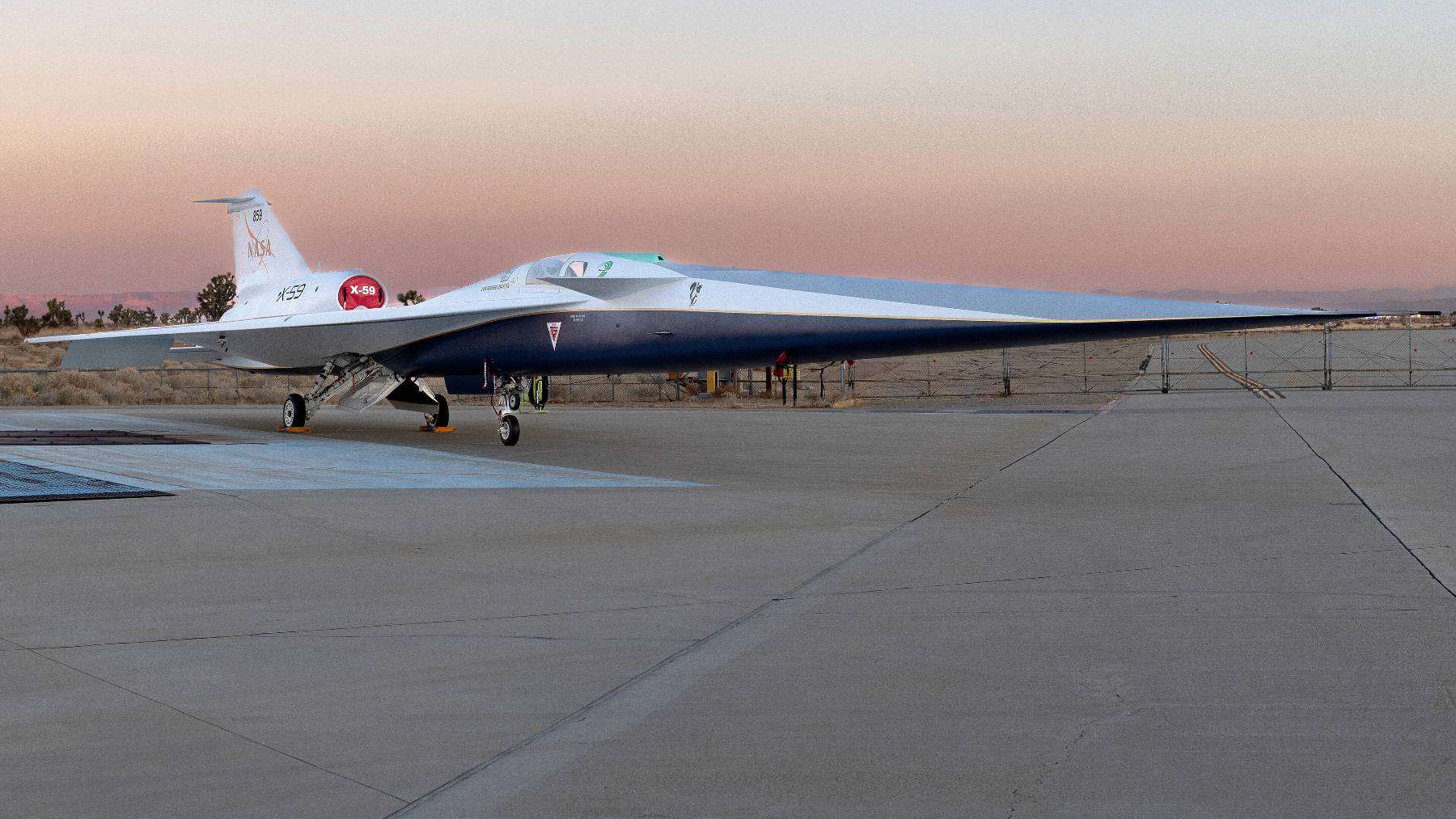
Somewhere over the Mojave Desert, a needle-nosed aircraft with no front windshield is preparing to do something no experimental jet has attempted in decades: quietly shatter the sound barrier.
After 14 subsonic test flights, NASA’s X-59 — built with a nose longer than most living rooms and a cockpit that relies on cameras instead of glass — is days away from its first supersonic run. What happens next could begin to unravel a rule that has kept commercial jets below the speed of sound over American soil since 1973.
A milestone 50 years in the making
The United States banned supersonic flight over land in 1973. The reason was simple and loud: sonic booms. When a jet crosses Mach 1, it generates a shockwave that rolls across the ground like a thunderclap, rattling windows and startling anyone below. That regulation has held ever since, effectively freezing commercial aviation at subsonic speeds over American soil for more than half a century.
NASA built the X-59 Low Boom Flight Demonstrator specifically to challenge that restriction. It is not designed to carry passengers. It is designed to carry a question: can supersonic flight be made quiet enough to coexist with life on the ground?
If the answer is yes, the 1973 rule could eventually be revised — reopening the door to commercial supersonic travel over land. Colorado-based Boom Supersonic is also developing quieter supersonic aircraft and has already achieved a supersonic flight over the continental United States. The X-59, though, remains the dedicated scientific instrument at the center of the regulatory argument.

What makes the X-59 unlike any aircraft before it
The X-59’s most distinctive feature is its nose, which extends far beyond what you would find on any conventional jet. That elongated geometry is not aesthetic. It is the core of the aircraft’s noise-reduction strategy — by reshaping the fuselage, engineers aimed to spread and soften the shockwaves the aircraft produces, reducing the boom that reaches the ground.
There is no front windshield. This is not a design oversight but a deliberate consequence of that long nose, which blocks any forward view entirely. NASA’s solution was the eXternal Vision System, or XVS: a network of cameras feeding real-time imagery into an augmented reality cockpit display, giving pilots a full forward view with the nose digitally removed. Every unusual feature on this aircraft traces back to the same objective — change how a sonic boom forms, travels, and lands on the ears of people below.
Fourteen flights to get here: what Phase 1 tested
Phase 1 had a focused purpose. NASA needed to confirm the aircraft was airworthy, understand its behavior at lower speeds, and validate the instruments that will measure shockwaves during supersonic flight. The X-59 retracted its landing gear in flight for the first time, engineers pushed the jet to Mach 0.95, and the team completed two test flights in a single day — all markers of a phase coming to a close.
Those fourteen flights gave the team something harder to measure than speed: deep familiarity with a one-of-a-kind machine. Project manager Cathy Bahm described it plainly. “Completing the first mission-conditions flight is especially meaningful,” she said. “It’s the moment where we begin validating the aircraft in the environment it was designed for.”
The supersonic moment: Mach 1.4 at 55,000 feet
The planned first supersonic flight will take the X-59 to Mach 1.4 — approximately 925 miles per hour — at an altitude of roughly 55,000 feet. At that speed and height, NASA will begin measuring how shockwaves actually behave in supersonic conditions. It is a fundamental shift in what the program is trying to prove.
Phase 1 was about demonstrating the aircraft could fly safely. This next flight begins proving it can do what it was built to do. Phase 2, scheduled for later in 2026, will measure how the boom is perceived at ground level, gathering the data regulators will need to evaluate whether the 1973 restrictions should be revised.
Beyond speed: what success could mean for travelers and emergency response
The X-59 will never carry a single paying passenger. Its role is to generate rigorous, peer-reviewed evidence that could persuade regulators to revisit rules written before many of today’s engineers were born.
If that data supports lifting the supersonic ban over land, the effects could reach well beyond business travelers hoping to cut a transatlantic crossing in half. Disaster relief operations depend on speed. So does medical transport. Time-critical cargo — organs for transplant, emergency equipment, urgent supplies — moves faster when aircraft are not constrained to subsonic speeds over populated areas. Commercial aviation would look different too, with faster transcontinental and transatlantic routes reshaping how airlines plan networks.
None of that happens because of the X-59 alone. Bahm put it plainly: “Flying supersonic and reaching these milestones isn’t just progress; it’s the realization of years of perseverance, innovation, and teamwork. Each step brings us closer to Phase 2, and to the future of commercial supersonic flight.” The aircraft over the Mojave is a proof-of-concept. What comes next depends entirely on what it finds.
Read the whole thing?
Get the week's signal, not the noise
Our sharpest reporting on energy, climate and nature — free, once a week.