You’ve seen breathtaking space photos before. But what if you were looking at the exact moment a planet begins to form?
Scientists have just captured sharper imagery of a region where new worlds are taking shape — using one of the most iconic telescopes ever built.
This is s a glimpse into the process that once created Earth itself. What those images reveal could change how you think about where planets — and maybe even life — actually begin.
Outer space is one of the most magnificent places
When you look up at the night sky, it feels endless. But what are you actually seeing? It’s just a tiny slice of what’s out there.
And here’s the wild part. The universe is expanding right now. As you’re reading this, distant galaxies are moving farther away. Some regions are drifting beyond what we’ll ever be able to observe.
Using the powerful eyes of the Hubble Space Telescope, scientists have zoomed in on one of those cosmic nurseries. And what they’re seeing inside isn’t just beautiful. It’s strange.
Something is glowing where it shouldn’t be. And that’s where the story really begins.
We can finally see the place where planets are born
At first, it looks like just another stunning space image.
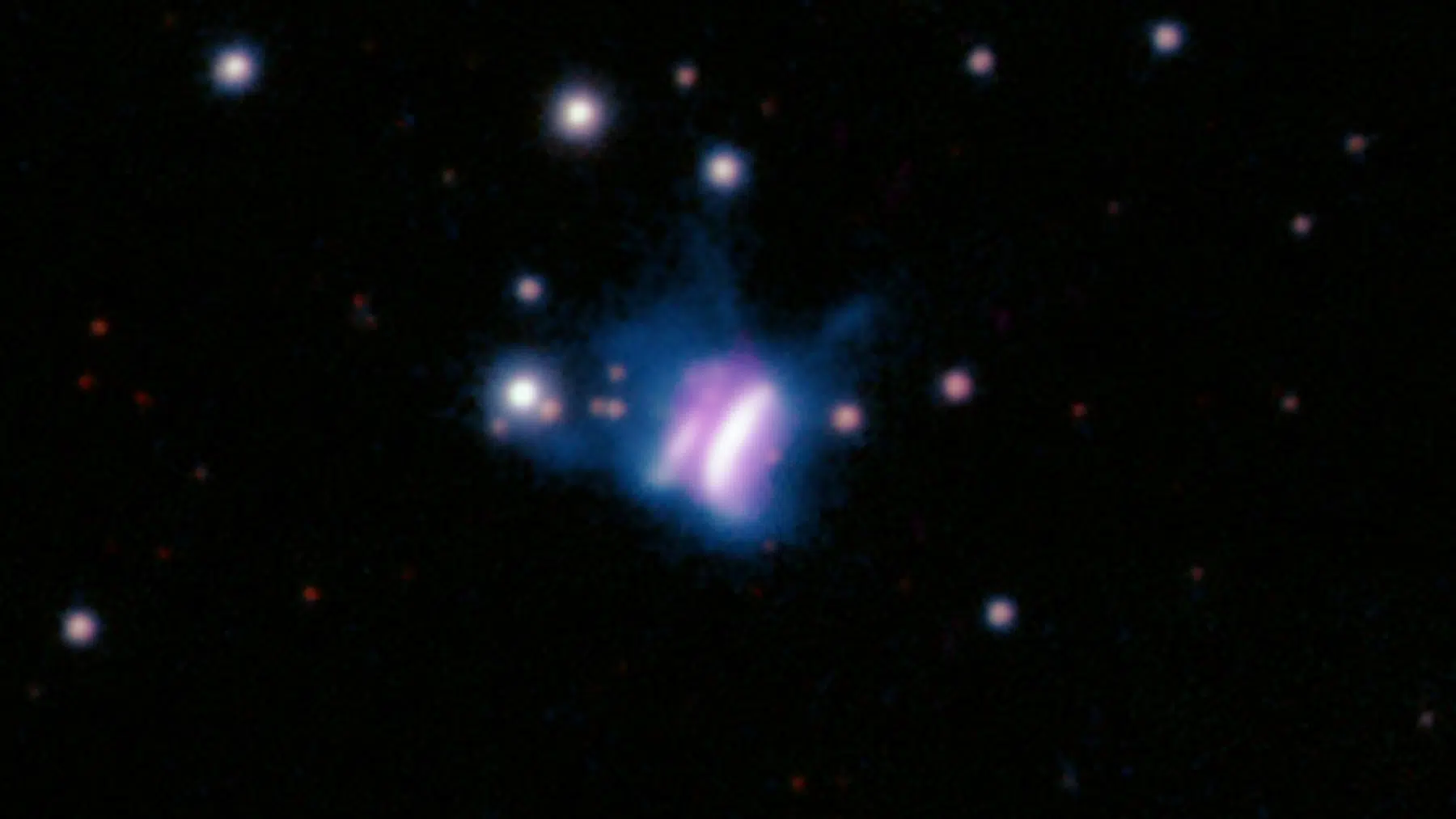
But then you realize what you’re actually looking at. A protoplanetary disk — the swirling mix of gas and dust that forms around a young star after it’s born. The kind of structure that eventually gives rise to planets. And this one isn’t small.
Nicknamed “Dracula’s Chivito,” the disk formally known as IRAS 23077+6707 stretches about 40 times wider than the diameter of our entire solar system. It sits roughly 1,000 light-years away, but its scale is hard to ignore.
Forty times. That’s not a subtle difference. That’s enormous.
It’s more than just a planet-factory. It’s a true monster
Hubble has captured spectacular cosmic scenes before — glowing nebulae, jets of gas blasting from dying stars, and intricate interstellar clouds. But this disk stands out for a different reason. Its size alone would be impressive.
Yet astronomers say that’s not the most unusual part.
Recent findings suggest that IRAS 23077+6707 doesn’t behave quite like other protoplanetary disks. There’s something about its structure, its composition, or the way it’s evolving that makes researchers pause.
Which raises an intriguing question. If most planetary systems start from similar spinning disks, why does this one look so different?
Because once you realize how massive it is — and how unusual it appears — you start to wonder what kind of planetary system could possibly emerge from something like this. And that’s where things get interesting.
According to NASA:
“The disk is unexpectedly chaotic and turbulent, with wisps of material stretching much farther above and below the disk than astronomers have seen in any similar system.”
So what is glowing inside this enormous disk?
On paper, this disk sounds familiar. Gas. Dust. A young star at the center. That’s how planetary systems begin. But when you look closer, it’s not that simple.
The star inside IRAS 23077+6707 isn’t shining clearly into space the way our Sun does. It’s still forming, still wrapped in thick material. The gas around it is so dense that the star’s direct glow is largely hidden.
What Hubble detects isn’t straightforward starlight. It’s radiation that’s been absorbed and re-emitted by the surrounding gas. Light that’s been processed, scattered, and reshaped before it ever reaches the telescope. In other words, you’re not seeing the star clearly.
You’re seeing the effect of everything wrapped around it. And that dense envelope of material matters.
Is it simply a scaled-up version of a typical planetary nursery? Or is something fundamentally different taking shape inside that thick cocoon of gas? Because until the dust clears — literally — the full picture remains just out of reach. Just as our understanding of the universe around us is.
Read the whole thing?
Get the week's signal, not the noise
Our sharpest reporting on energy, climate and nature — free, once a week.