NASA’s spacecraft has just completed a major turning point in its deep-space journey.
After several years of travel time, the spacecraft passed near Mars and used the planet’s gravitational pull to propel itself deeper into our solar system.
This gravity assist (also referred to as a gravity “slingshot”) was not done merely to capture images of Mars nor test equipment.
This precise maneuver aimed the spacecraft at a unique target.
Scientists believe that target may hold clues to the hidden interiors of planets like Earth.
Why did NASA need to use Mars’ gravity to get to this location and what awaits at the end of this journey?
The journey toward an unusual destination
Psyche is a spacecraft that launched in Oct. 2023.
The spacecraft is now traveling approximately a 2.2-billion-mile trajectory through our solar system.
According to NASA Science, the recent Mars flyby brought Psyche within 2,800 miles of the Martian surface. Mars gravity then accelerated the spacecraft and bent its path toward the asteroid belt.

NASA used a gravity assist, or slingshot, to save fuel. The maneuver preserved propellant needed for the rest of the mission.
Although thousands of images were captured during the fly-by, this encounter served as little more than a stepping stone.
The true destination lies well beyond Mars in the asteroid belt between Mars and Jupiter.
Why reaching this object matters
A primary reason why this mission is distinct from all others in its field of study is what Psyche plans to investigate.
Most of the other space missions that explore various types of celestial bodies are focused primarily on studying rocks or ice.
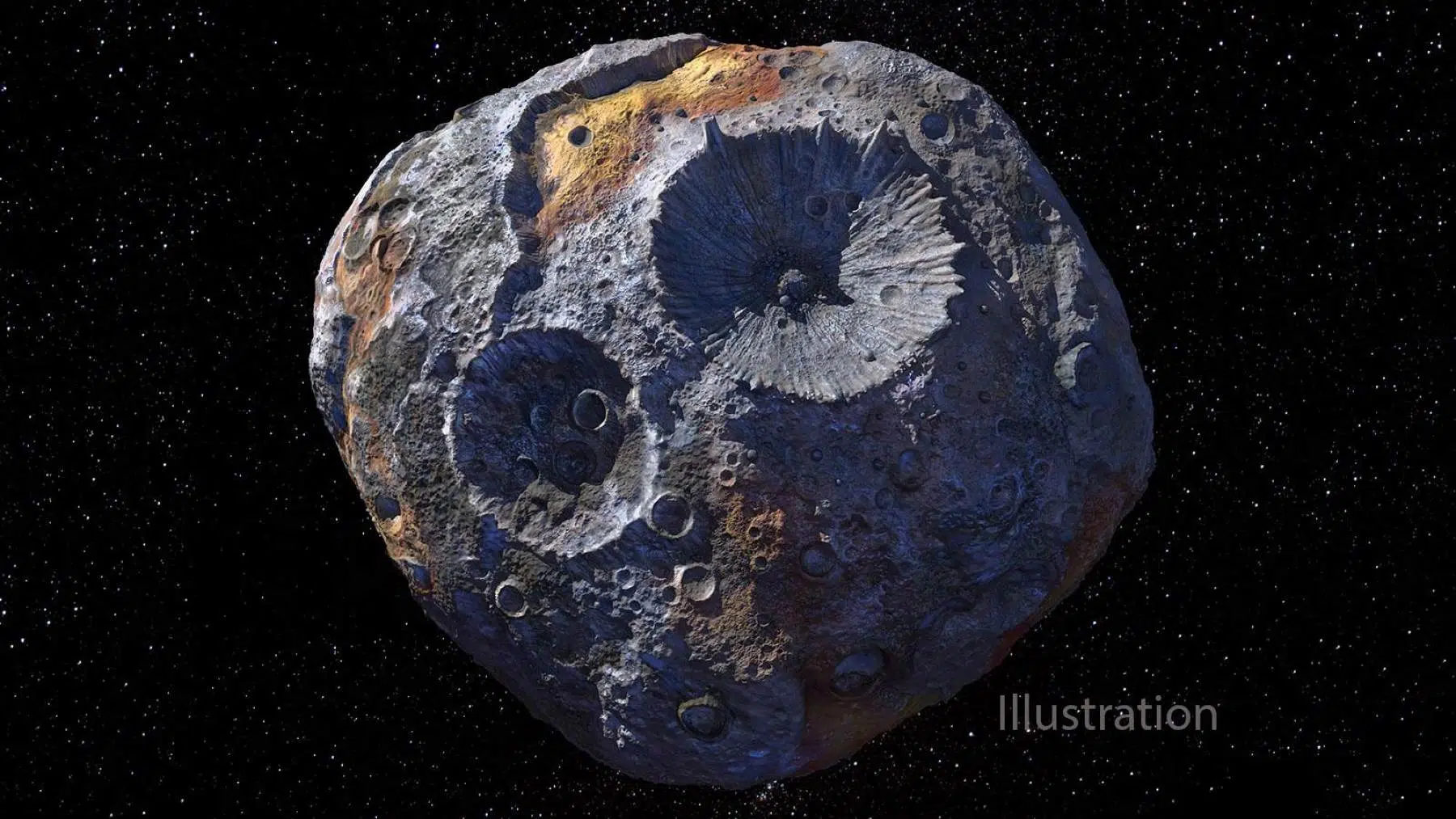
However, Psyche is actually headed to an object composed mostly of metal.
Psyche will enter orbit in 2029. It will then map the surface and measure what this metal world is made of.
These results are significant and extend well beyond a singular asteroid.
If this object truly is representative of a portion of a planetary core, then studying it may significantly impact scientists’ understanding of planetary formation.
Additionally, it may offer clues regarding processes that cannot be observed on Earth due to the fact that we do not have access to planetary cores.
How an ancient metal object may reveal our deepest past
What is this “bizarre metal world” and what secrets does it hold?
The final destination is asteroid number 16 Psyche, a massive object situated in the asteroid belt between Mars and Jupiter.
What distinguishes Psyche from most asteroids is its chemical composition.
Most asteroids are made of rock and ice. Psyche is different, its metal may be the exposed core of an ancient protoplanet.
NASA used a gravity assist, or slingshot, to save fuel. The maneuver preserved propellant needed for the rest of the mission.
If this concept proves valid, Psyche provides something never seen previously.
It allows scientists to view the type of materials that exist beneath thousands of km below the surfaces of planets similar to Earth.
Researchers hope to learn how planetary cores form and evolve. They will study Psyche’s composition, structure, and magnetic properties.
Therefore, this mission extends well beyond a single asteroid. It is an attempt to find pieces of planetary history that remain unexplored today.
What this means for planetary science
NASA’s trip to Psyche is greater than a remote space mission.
It presents a rare chance for researchers to examine the building blocks of planets and the unknown processes that formed them millions of years ago.
With NASA awaiting Psyche’s arrival, there still remains uncertainty as to how much will be learned about the origins of planets from examining the metal world of Psyche.
Read the whole thing?
Get the week's signal, not the noise
Our sharpest reporting on energy, climate and nature — free, once a week.