
NASA has a new cosmic event to report on, and this one is rarer than most.
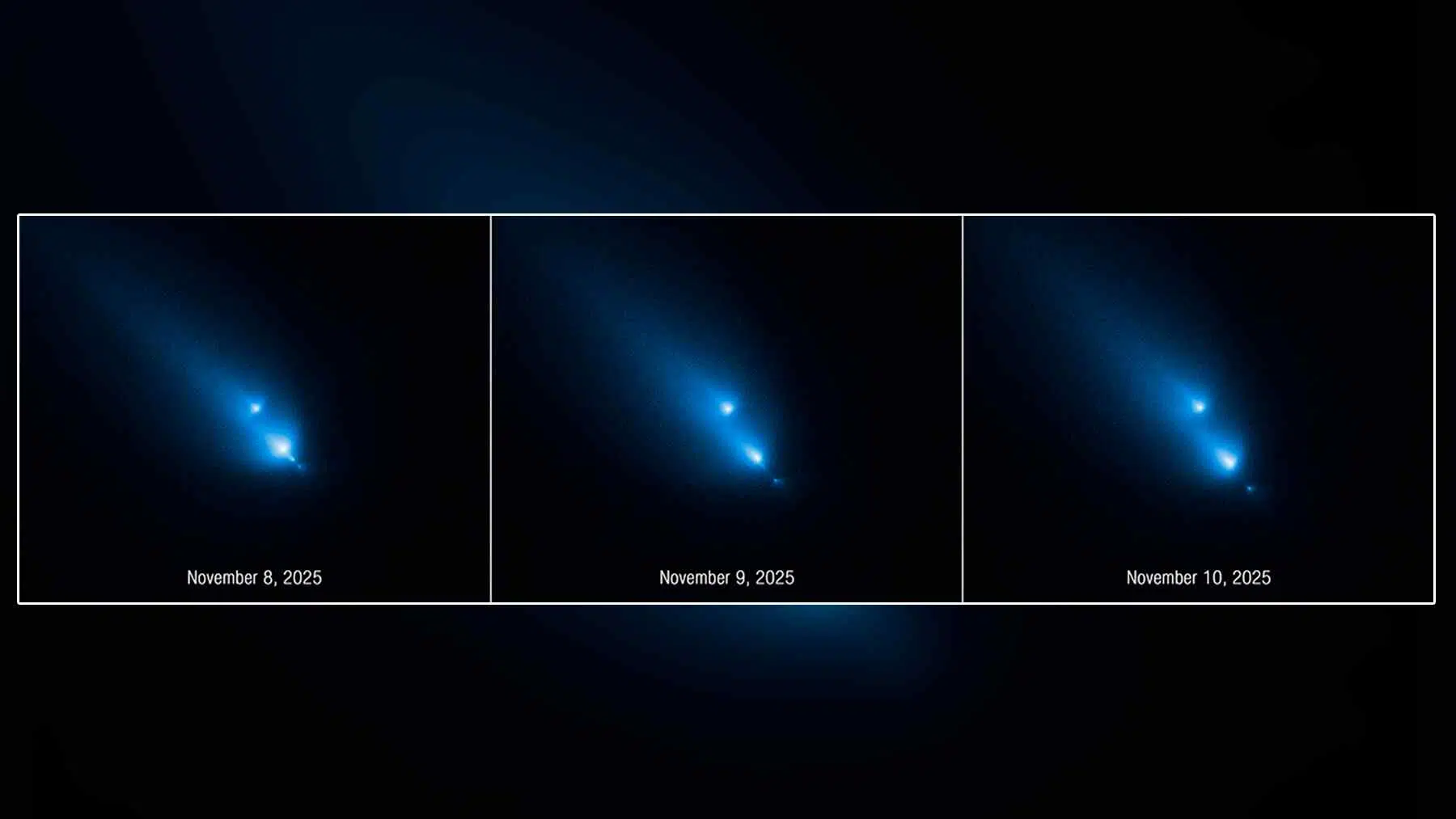
An odd cosmic object near the Sun was breaking into pieces in real time. Instead of one brightly burning body, they saw several space fragments splitting apart.
The experts expected a sudden and bright explosion. But their expectations were dashed. Instead, the object just silently split apart.
What exactly had they witnessed, and why did it not explode as expected?
A ghostly discovery in the deep
NASA astronomers just witnessed a rare, accidental spectacle.
Their original study target was blocked by sudden technical constraints, so they had to focus on something new.
This happy accident led to a once-in-a-career discovery.
The body had just completed a brutal pass near the Sun. Its path took it deep inside Mercury’s orbit. This is only one-third of the distance between the Earth and the Sun.
During this “drive-by,” the object faced extreme thermal stress.
Hubble watched the “survivor” as it moved toward the constellation Pisces.
Scientists expected to see a single, solid body. Instead, the images revealed four distinct fragments. Each piece had its own fuzzy envelope of gas and dust.
This five-mile-wide relic was crumbling in the silence of the void.
What was this mysterious cosmic object, and why did it split apart without exploding first?
A silent breakup that confounded the best minds
Comets actually break apart at much more regular intervals than we think.
They have been dubbed ancient leftovers from our Solar System’s birth. Some from NASA and the ESA call them dirty snowballs. But when a comet passes by our Sun, things start to change.
Comets can take years, even decades, to navigate space and make a return to us on Earth.
Comet C/2025 K1 (ATLAS) contains ice, dust, and rocky space material from eons ago. But when it passed relatively close to our sun, things changed rapidly.
Solar heat created intense pressure inside it.
Like a poorly planned war, cracks start to form. Gas started to escape.
Sometimes, the entire nucleus fractures into pieces. NASA recently spotted a similar space object.
But that one was vaporized by the Sun in an instant. The comet, which has been named K1 by researchers, was roughly five miles wide.

This made it larger than average.
Under normal conditions, a comet lights up the night sky as fresh ice is exposed to space. Ground telescopes should have detected a sudden outburst of energy from K1.
NASA quickly realized something else was taking place.
The European Space Agency also scratched its head in confusion. So what exactly caused K1 to rip apart before it sent out a flash of light?
Sometimes, our worst enemy comes from within
NASA and the ESA quickly realized that K1 was cracking open from the inside.
Earth-based telescopes struggled to accurately see K1. NASA states that K1 emerged from the distant outer solar system.
It most likely spent a large portion of its life beyond Neptune.
A cosmic time capsule from planetary formation
Deep inside it, the matter it holds is most likely older than the Earth itself. As it propelled itself towards our Sun, its outer layers melted away, but the ice deep inside it remained.
That is what Hubble saw, the first step in a comet’s death.
This comet first started to break apart. Then came the explosion of light as the internal ice shot outwards.
Fresh ice could not do this on its own. Space dust needs to form an outer layer first, then slowly build up.
Spotting odd objects that light up the sky is a normal occurrence. Some shine for days, but this one proved that even NASA has a few things to learn.
As this ancient relic vanishes into the deep, we are left to wonder how many other primordial secrets are currently cracking open in the silent reaches of our solar system.
Read the whole thing?
Get the week's signal, not the noise
Our sharpest reporting on energy, climate and nature — free, once a week.


