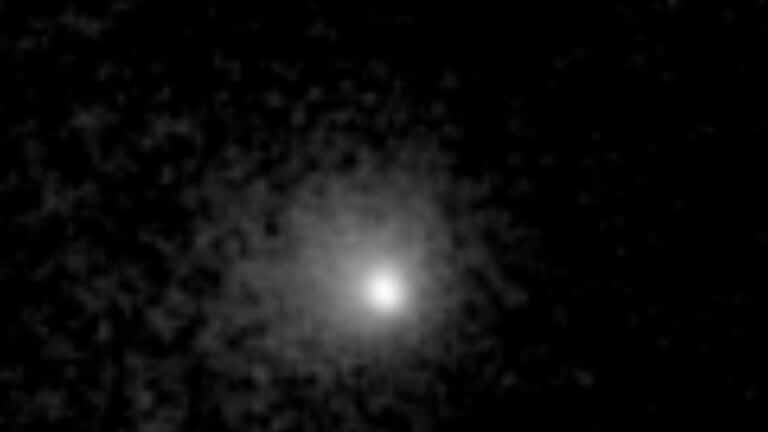
Credits: Image of the 3I/ATLAS comet, one of the objects seen by the Vera Rubin Observatory. Note that this particular image was taken by another telescope: International Gemini Observatory/NOIRLab/NSF/AURA/K. Meech (IfA/U. Hawaii)Image Processing: Jen Miller & Mahdi Zamani (NSF NOIRLab)
Moving silently through space, crossing paths with planets, drifting through the same cosmic neighborhood as Earth.
But until now, most of them have gone unnoticed.
Too small. Too fast. Too faint to track with older technology.
That’s about to change.
Because a new observatory is preparing to reveal something hidden in plain sight—so what exactly are these objects that scientists are suddenly able to see?
How space observation is entering a completely new phase
For decades, studying space has come with limits.
Even the most advanced telescopes could only capture fragments of what was out there. Slow-moving objects were easier to track. Bright events stood out.
But anything small and fast?
That was a different story.
These objects don’t stay in one place long enough to be easily observed. They move quickly across the sky, often blending into the background before they can be properly identified.
So for years, astronomers knew they existed.
They just couldn’t see most of them.
That’s where the Vera C. Rubin Observatory comes in.
Built through a global collaboration involving dozens of countries, this facility represents a shift in how space is studied—not by looking deeper in one direction, but by scanning everything, constantly.
And that approach is already changing what we know.
A sky that looks empty—but isn’t
When you look up at the night sky, it appears calm.
Stars hold their positions. Constellations remain steady. Nothing seems to move.
But that stillness is an illusion.
Between those fixed points, countless objects are in motion.
Some are fragments left over from the formation of the solar system. Others are remnants of collisions or gravitational interactions that happened millions of years ago.
They don’t shine like stars.
They don’t announce themselves.
They just move.
And because of their size and speed, they’ve been incredibly difficult to detect—until now.
The Rubin Observatory uses a massive 3.2-gigapixel camera, capable of capturing wide sections of the sky in rapid succession.
Instead of taking a single image, it takes many.
Then compares them.
And that’s when movement appears.
Image of the Vera Rubin Observatory – Rubin Observatory/NSF/AURA/B. Quint, CC BY 4.0, no changes made
The objects hiding in plain sight
According to Eos, what the observatory is beginning to uncover are asteroids.
Millions of them.
Not just the large ones that have already been cataloged, but smaller, faster-moving bodies that were previously invisible to us.
These asteroids travel through space at high speeds, often crossing orbital paths within the solar system.
Many are harmless.
Some pass far from Earth.
But the key point is this: we didn’t know how many there were.
Now we’re starting to find out.
By detecting subtle changes between images, the Rubin Observatory can identify these moving points of light and track their trajectories in real time.
What once looked like empty space is now revealing structure, motion, and density.
A hidden layer of activity.
Why this discovery matters more than it seems
At first, finding more asteroids might not sound surprising.
After all, we already knew they existed.
But scale changes everything.
Discovering millions of new objects reshapes how scientists understand the solar system—its history, its formation, and its current dynamics.
The more we look, the more we realize how much has been there all along—unseen, unnoticed, and waiting for the right technology to bring it into view.
To learn more about this discovery, you can check the full study here: “Cartier, K. M. S. (2026), Small, faint, or fast, Rubin will find it.” Eos, 107, https://doi.org/10.1029/2026EO260056. Published on 1 April 2026.
Read the whole thing?
Get the week's signal, not the noise
Our sharpest reporting on energy, climate and nature — free, once a week.
Warren van der Sandt is a skilled editor known for his clean, precise writing and strong background in science. Combining clarity with depth, he brings complex ideas to life in an accessible way, always with a friendly and approachable touch.