The Pulse
  • Climate
  • Earth
  • Human Science
  • Space
  • Energy
  • Technology
  • Mobility
  • Ecoportal
  • Climate
  • Earth
  • Human Science
  • Space
  • Energy
  • Technology
  • Mobility
  • Ecoportal
No Result
View All Result
The Pulse
No Result
View All Result

NASA found an enigmatic object that appeared, brightened for 100 days… and then vanished with no trace

Warren van der Sandt by Warren van der Sandt
April 25, 2026
in Space
NASA mystified by enigmatic object

Credits: File image

It appeared without warning.

A distant point of light, faint at first, suddenly began to intensify—growing brighter and brighter in the depths of space.

For nearly 100 days, it held its glow. And then, just as abruptly, it vanished.

Astronomers thought they had found a ‘cosmic fossil’ until it began shining in an ‘impossible’ color invisible to the human eye

A planet is being pulled into a wildly distorted orbit by a gas structure 11 times larger than Earth

Cygnus X-1, the first black hole ever confirmed, has jets that shine with the energy of 10,000 suns

No explosion. No debris. No trace.

Even NASA couldn’t immediately explain it—so what exactly did they find?

What astronomers saw when the object first appeared

The discovery came from deep-space observations, where telescopes constantly scan for subtle changes in light.

Most of the time, these changes are predictable.

Stars brighten and dim. Supernovae explode and fade. Galaxies shift slowly over time.

But this was different.

The object didn’t match any known pattern.

It appeared as a bright optical signal, steadily increasing in intensity over weeks. Then it held that brightness, almost unnaturally stable, before fading away in roughly the same amount of time.

About 100 days in total.

That symmetry alone raised questions.

Because in space, events are rarely that balanced.

And the more scientists looked at the data, the stranger it became.

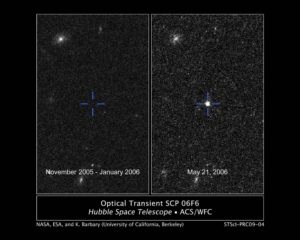
STScI 01EVT5VPE6GWM6J3VDHA2C46Z5 1
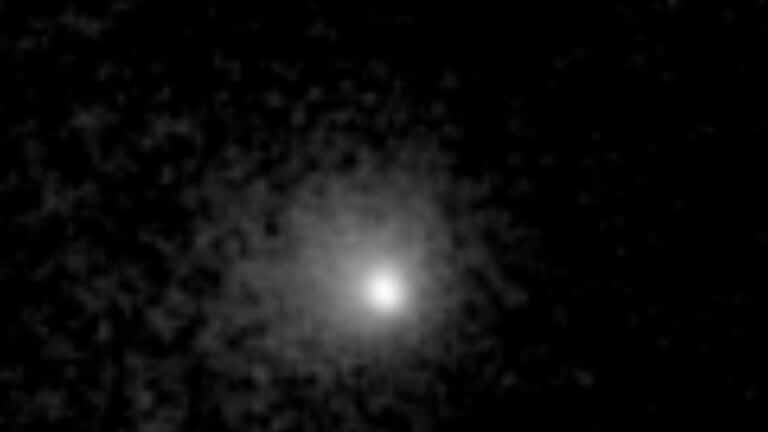
Image of the optical transient SCP 06F6 – NASA, ESA, and K. Barbary (University of California, Berkeley/Lawrence Berkeley National Lab, Supernova Cosmology Project)

A signal that didn’t behave like anything familiar

At first, researchers tried to classify the event using known cosmic phenomena.

Could it be a supernova?

Unlikely. The light signature didn’t match.

A collision between massive objects?

Again, the data didn’t align.

The spectrum of light—the unique fingerprint that reveals what something is made of—was unlike anything previously recorded.

Even more puzzling, the object emitted unusually strong X-rays, suggesting an enormous release of energy.

And yet, there was no visible aftermath.

No expanding cloud of debris. No lingering radiation pattern.

Just… silence.

This event was later labeled SCP 06F6, and for years, it remained one of the most baffling observations in modern astronomy.

Because it didn’t just challenge expectations.

It seemed to ignore them entirely.

The real explanation scientists are now considering

Over time, with better tools and more advanced analysis, scientists began to narrow down the possibilities.

The leading explanation points to a rare and extreme type of cosmic event known as a Fast Blue Optical Transient.

These events are short-lived but incredibly energetic bursts of light, often linked to catastrophic processes involving massive stars or black holes.

In this case, SCP 06F6 may have been the result of a star being torn apart.

Not by an explosion—but by gravity.

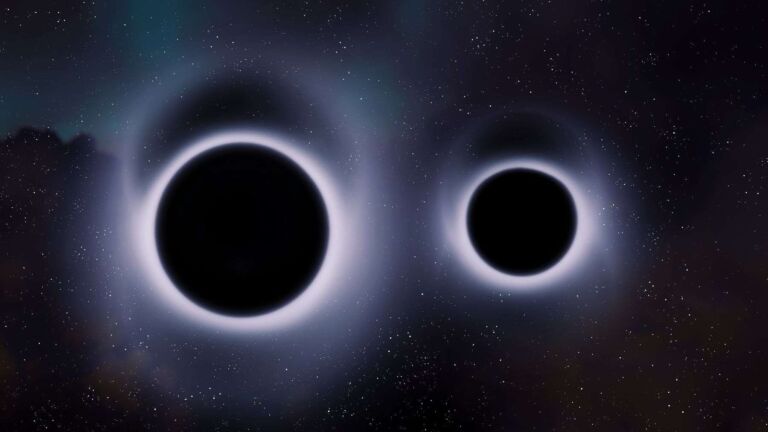
One theory suggests that a black hole pulled a star inward, stretching and compressing it in a process known as a tidal disruption event.

NASA Science says that as the star was consumed, it released a burst of energy that appeared as a bright, sustained glow.

That would explain the intensity.

It would also explain the sudden disappearance.

Once the star was fully consumed, the light source would vanish.

No debris drifting into space.

No visible remains.

Just darkness again.

Why this mystery is still not fully solved

Even with this explanation, SCP 06F6 does not fit perfectly into existing models.

Its light curve—the way its brightness changed over time—remains unusually symmetrical.

Its spectrum still shows features that scientists struggle to interpret.

And while Fast Blue Optical Transients are now better understood, this event was one of the first ever detected.

In many ways, it arrived before scientists had the framework to explain it.

That’s why it continues to be studied today.

With new observatories like the Vera C. Rubin Observatory and AI-driven sky surveys, astronomers are beginning to detect more events like this.

Each one adds a piece to the puzzle.

Each one brings us closer to understanding what really happened during those 100 days.

Because the truth is, this wasn’t just a strange object.

It was a glimpse into a type of cosmic event we are only now beginning to recognize.

And somewhere out there, it may already be happening again.

The Pulse

© 2026 by Ecoportal

  • About us
  • Contact
  • Privacy Policy
  • The Pulse – American Newspaper about Science and more

No Result
View All Result
  • Climate
  • Earth
  • Human Science
  • Space
  • Energy
  • Technology
  • Mobility
  • Ecoportal

© 2026 by Ecoportal