NASA’s exploration of Mars is far from over, but its interest in water now extends well beyond the Red Planet. Across the solar system, ice has been discovered in many places — often near the southern poles of planets and frozen into the surfaces of numerous moons. A few of Jupiter’s moons have been raising eyebrows. Some of them show hints that liquid water could be hiding below their frozen crusts — and, based on recent signs, that water might even be making its way to the surface soon.
Studying the moons was never the focus for NASA
They might not be the main goal of current missions, but they still play an important role in a much bigger picture: figuring out how key elements — like helium, carbon, and oxygen — behave beyond Earth. These fundamental ingredients for life are scattered across the cosmos.
NASA’s Juno probe, designed to study Jupiter itself, is taking a closer look at the planet’s water content by searching for chemical clues in its thick atmosphere — particularly hydrogen and oxygen. Although Jupiter is mostly made of hydrogen and helium, earlier missions found other compounds too, including ammonia and methane.
When the Galileo spacecraft entered Jupiter’s atmosphere back in 1995, scientists were surprised to learn that the giant planet was warmer and drier than expected. Since then, researchers have expanded their focus to Jupiter’s 95 moons — especially Io, whose extreme volcanic eruptions make it a standout target for future investigation.
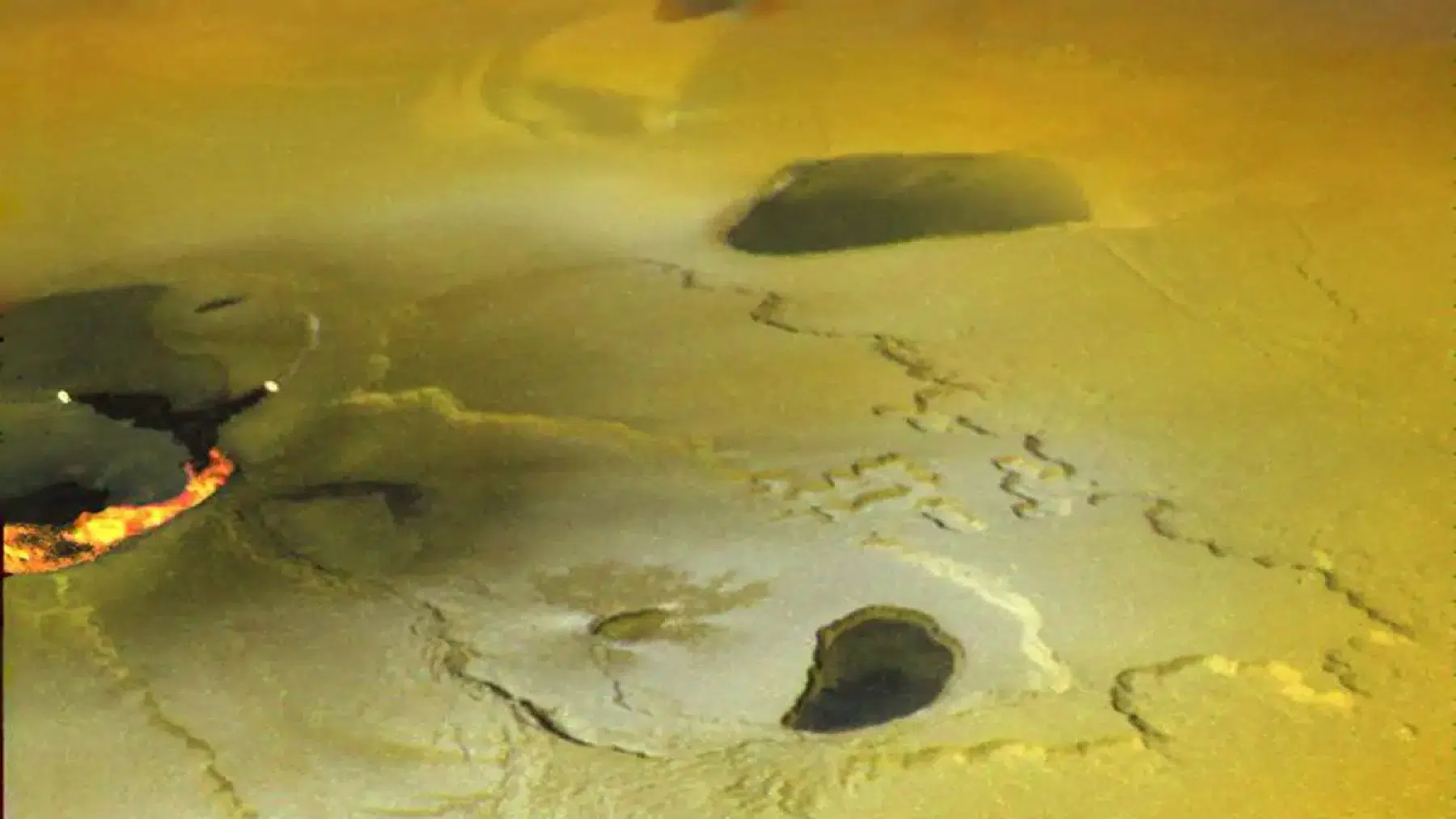
At the end of 2024, NASA’s Juno spacecraft made a close approach to Jupiter’s moon Io — and what it found may rank as the strongest volcanic eruption ever caught in the act, anywhere in the solar system.
A moon under pressure
Io is known for being hyperactive, volcanically speaking. However, this event was in a league of its own. Using its infrared sensor, NASA’s Juno spotted a blazing-hot region in Io’s southern half. The hotspot was huge — larger than Lake Superior — and gave off an incredible amount of heat: over 80 trillion watts.
Although Io is close in size to our Moon, its insides are far more chaotic. It does not follow a perfect orbit, so it is constantly being stretched and squeezed as it orbits Jupiter. The internal friction heats the moon from within and fuels its volcanic behavior.
What Juno detected was not likely a single eruption, but a group of extremely hot areas — possibly tied to a vast underground magma system. The total area is approximately 40,000 square miles. That makes it even larger than Loki Patera, Io’s most famous lava lake.
More than just Jupiter
NASA didn’t originally build Juno to study moons. Its job was to examine Jupiter’s atmosphere and magnetic field. However, over time, the mission expanded. Now, Juno regularly passes close to some of Jupiter’s biggest moons — including Europa, Ganymede, and especially Io.
During flybys in 2023 and early 2024, the probe came within 930 miles of Io’s surface. The December flyby was not as close — more than 46,000 miles out — yet the volcanic heat was still intense enough to trigger its instruments.
Surface shifts caught on camera
NASA’s Juno visible-light camera picked up more than just heat. Comparing new photos to older ones, scientists noticed clear changes in the terrain. Discoloration around the eruption zone hinted at fresh material, likely new lava or sulfur deposits. These marks remain in place for a while, giving scientists a way to study how Io changes over time. And with Juno still active, more up-close looks at the most explosive place in the solar system are on the way.
Read the whole thing?
Get the week's signal, not the noise
Our sharpest reporting on energy, climate and nature — free, once a week.