
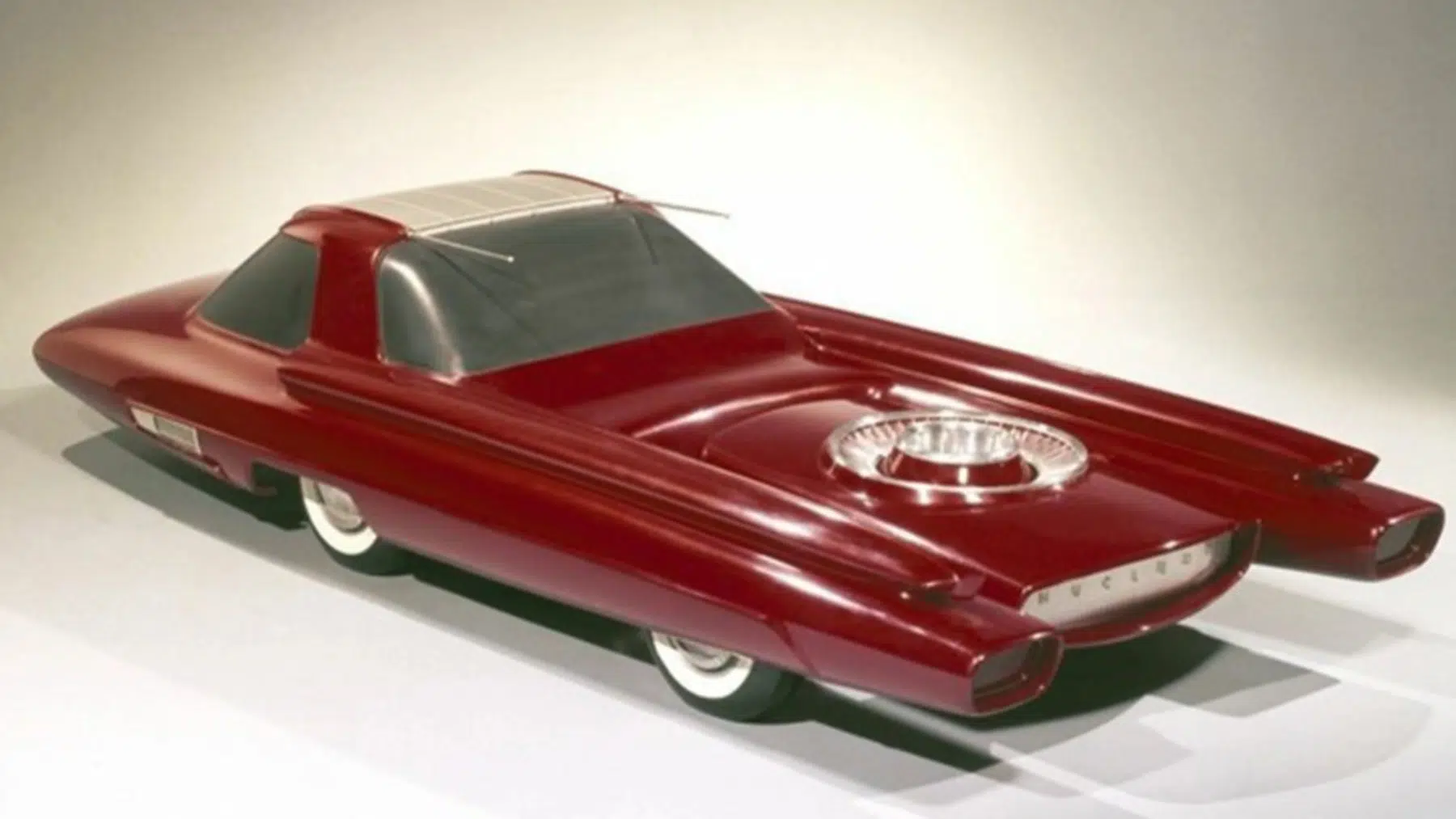
Did you know that decades ago there was a nuclear-powered car that remained a concept and never reached the public roads? When the Ford Nucleon was first unveiled in 1957, its nuclear engine was supposed to allow it to go 8,000 km without refuelling. This was a game-changer in the automotive industry. Although the car never went far in terms of production and execution, it promised to have an impact on sustainability.
What is this nuclear-powered car all about and what is its history?
The world saw a technological revolution in the 1950s. But this period also saw the development of technologies that, despite their inventiveness, were dangerous and unworkable. One of the most talked-about technologies at the time was nuclear energy, which was renowned for being cleaner and more efficient than fossil fuels.
Ford unveiled the Nucleon, a nuclear-powered vehicle, in 1958. With its small nuclear reactor at the rear, this car was supposed to be able to travel up to 8,000 kilometres without emitting any CO2. The futuristic design used heat to convert water into steam, with the power train being steam-driven. To manage the heat released, the nuclear reactor needed a strong cooling system, which was challenging to regulate in a small car.
The Ford Nucleon: A groundbreaking idea inspired by atomic dreams
In the 1950s, “atomic” fever spread across America, influencing people’s concerns and hopes while igniting bold new aspirations. When nuclear energy started to power the country’s cities and the promise of nuclear medicine started to materialise, the “atomic” future appeared to have no limits. Few facets of the American environment remained unaffected by the alluring promises of the atomic age, from comic books to automobiles.
Ford Motor Company developed its futuristic Nucleon design study automobile in 1957. The car’s futuristic spacecraft-like design reflected the time’s interest in atomic energy and space travel. Similar to battery swaps in contemporary electric vehicles, engineers envisioned a network of nuclear refuelling stations where depleted reactors could be exchanged for new ones.
The reason the Nucleon didn’t roll off the production line
Despite its groundbreaking features, certain challenges came with this invention. The idea of a nuclear automobile failed. Only mock-ups at various scales were created; no actual Nucleon prototype was constructed. The most significant of these was the difficulty of safely reducing nuclear reactors to fit into automobile chassis. Reactor technology was too big and unreliable for regular usage in consumer cars at the time.
The concept was also unfeasible because of public safety worries about radiation exposure and nuclear accidents. There was no specialised refuelling station or other infrastructure needed to handle nuclear-powered vehicles. The Nucleon was abandoned before it reached the prototype stage due to these obstacles and the hefty research expenses.
The Ford Nucleon has been relegated to the past more than 60 years after it was first introduced. Electric vehicles and biofuel engines that can move heavy loads without releasing CO2 are examples of how far automotive technology has come in recent years. Hydrogen technology is becoming more and more relevant in the future of sustainable mobility as it produces engines that are more efficient and have a longer range.
A tradition of creativity and impact
Although the Ford Nucleon never came to production and execution, its legacy still lives on. It inspired future generations and automakers to look further into sustainable fuels that will positively impact the future. Although today we have electric vehicles (EVs) and hydrogen-powered vehicles, nuclear is also part of the family, with one goal: eco-friendliness when we drive our vehicles.
Read the whole thing?
Get the week's signal, not the noise
Our sharpest reporting on energy, climate and nature — free, once a week.


