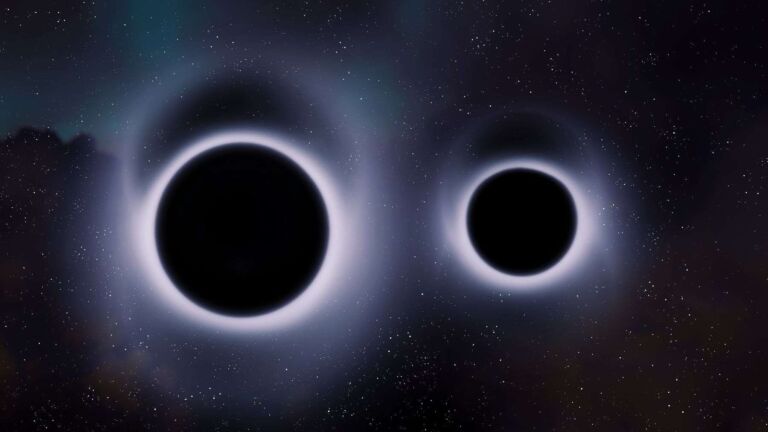
Gravitational wave detectors are now “hearing” the universe collide three to four times a week. On May 26, astronomers released GWTC-5 — a single catalog containing 161 new black hole merger signals, pushing the total number of detected collisions to 390.
The sheer volume is changing what scientists can see. They are no longer cataloging isolated events. They are beginning to trace the outline of an entire hidden population of black holes — and some findings suggest the universe builds these objects in ways no one fully anticipated.
A catalog unlike any before it
GWTC-5 covers detections made between April 2024 and the end of January 2025. Those nine months produced 161 new gravitational wave signals — all from merging black holes. Combined with previous catalogs, the total now stands at 390 confirmed collisions.
The detectors responsible — LIGO, Virgo, and KAGRA — are registering events three to four times per week during active observing runs. Daniel Williams, a research fellow at the Institute for Gravitational Research, put the shift plainly: “We’re now detecting so many of these signals that we’re not just learning about individual collisions. It’s the astronomical equivalent of uncovering an ancient civilization — revealing not just individual lives, but the structure of an entire lost world.”
What gravitational waves actually are — and how we hear them
Gravitational waves are ripples in spacetime, first predicted in 1915 as part of Albert Einstein’s general theory of relativity. His framework holds that massive objects curve spacetime, and that accelerating objects send ripples outward at the speed of light. Einstein himself doubted these waves would ever be measurable. He was wrong.
LIGO made the first confirmed detection in 2015, capturing a signal from two black holes merging roughly 1.3 billion light-years away. That event earned the Nobel Prize in Physics and cracked open an entirely new observational window on the universe. Detector sensitivity has improved with each observing run since.
Second-generation black holes: born from earlier crashes
Among the more notable findings in GWTC-5 are two signals — GW241011, detected October 11, 2024, and GW241110, detected November 11, 2024 — carrying the fingerprints of so-called second-generation black holes. In each case, the larger black hole’s rapid spin suggests it was itself the product of a prior merger: a black hole built from other black holes.
Storm Colloms of the Institute for Gravitational Research noted these signatures are not isolated anomalies. “The signatures of black holes formed from previous mergers persist in the population as a whole,” Colloms said, “indicating that GW241011 and GW241110 are not one-of-a-kind, but trace an underlying trend.” That trend points toward densely packed stellar environments as the likely birthplace of these objects.
The most precisely located merger ever — and what it means for cosmology
GW240615, detected June 15, 2024, came from a 26-solar-mass black hole merging with a 30-solar-mass black hole more than 3 billion light-years away. Its origin was pinpointed to just 6 square degrees of sky — the most precisely localized gravitational wave signal ever recorded. That precision matters.
When researchers can identify a merger’s host galaxy, they gain a direct tool for measuring the Hubble constant. Alex Papadopoulos of the Institute for Gravitational Research noted that “these additional signals significantly improve our results,” bringing gravitational wave measurements of the Hubble constant to their highest precision yet.

A signal loud enough to test Einstein — and Hawking
GW250114, detected January 14, 2025, stands out for its exceptional clarity. The signal came from a 34-solar-mass black hole colliding with a 32-solar-mass black hole about 1 billion light-years away — clean enough to support the most accurate test of general relativity ever performed using gravitational waves, and to directly confirm Stephen Hawking’s black hole area theorem.
John Veitch of the University of Glasgow explained that after the merger, the final black hole “rings like a bell, giving off gravitational waves instead of sound.” Analysis confirmed that total entropy increased, consistent with the second law of thermodynamics.
What comes next for gravitational wave astronomy
LIGO, Virgo, and KAGRA are set to begin a six-month intermediate observing run — designated IR1 — later in 2025, a bridge before Observing Run 5, scheduled from 2028 to 2031 with enhanced sensitivity. Every new run adds events to the population census, and the dataset compounds quickly.
Statistical conclusions about how black holes form, how often second-generation mergers occur, and which environments produce them will become more grounded as the numbers grow. With 390 mergers cataloged and hundreds more expected, a comprehensive map of black hole formation across cosmic history is beginning to take shape.
Read the whole thing?
Get the week's signal, not the noise
Our sharpest reporting on energy, climate and nature — free, once a week.