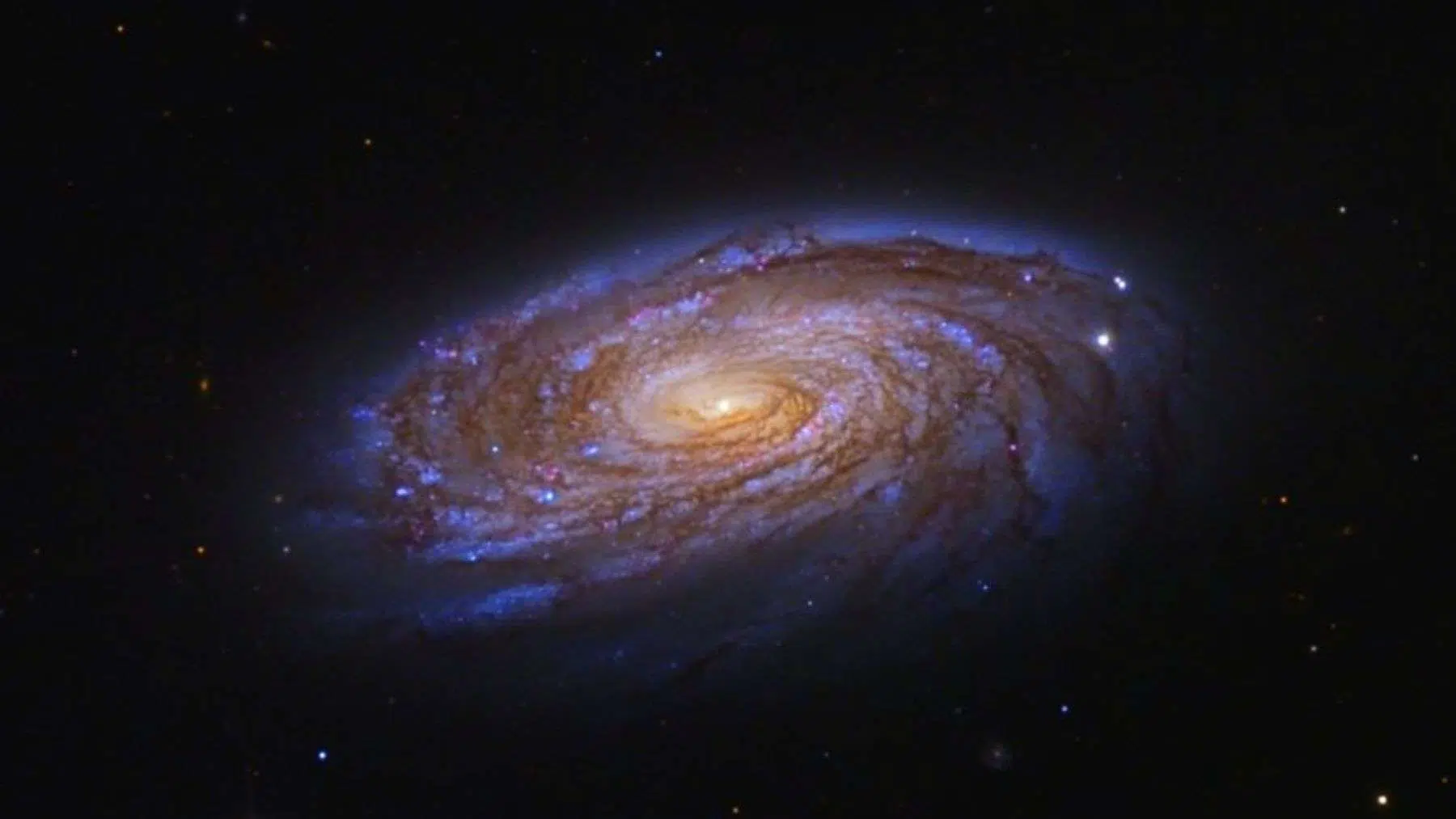
Sixty-three million light-years away, a spiral galaxy called Messier 88 glitters with young star clusters and dark dust lanes, its arms arranged in a pattern so symmetrical it looks almost engineered.
A new Hubble image captures that elegance in striking detail. But the same observations that reveal M88’s beauty also expose something quieter and more unsettling: this galaxy is already changing — and the journey it’s on may be the reason why.
A spiral galaxy in motion
M88 — also catalogued as NGC 4501 — sits about 63 million light-years from Earth in the constellation Coma Berenices. At its core lies a supermassive black hole estimated at roughly 100 million times the mass of the Sun. That black hole is actively feeding, drawing in gas and dust, and appears to push streams of material outward from the galaxy’s center.
Surrounding that active core, older reddish stars produce a warm central glow. Tightly wrapped spiral arms extend outward in a remarkably symmetrical arrangement, lined with bright pink and blue star clusters and dense dust clouds. Because we view M88 at an angle, its full spiral structure appears stretched across space — a geometry that makes its details easier to study, and difficult to look away from.
Deep inside a cosmic traffic jam
M88 is not drifting through empty space. It belongs to the Virgo Cluster, a gravitationally bound collection of more than a thousand galaxies in constant motion as they orbit a shared center of mass. That environment is anything but calm.
Right now, M88 sits about two million light-years from the cluster’s center and is moving steadily inward. Over hundreds of millions of years, that path will carry it deeper into the cluster’s densest, most hostile inner regions — a slow but irreversible journey whose consequences astronomers are only beginning to map.
A close encounter with a gravitational giant
Waiting near the cluster’s heart is Messier 87, the dominant giant elliptical galaxy that anchors the Virgo Cluster. In roughly 200 to 300 million years, M88 is expected to make its closest pass by M87. That encounter will not be gentle.
As M88 approaches M87, it will move through increasingly dense hot intergalactic gas. That gas exerts pressure on everything M88 carries with it, driving a process called ram pressure stripping — one of the most effective mechanisms by which a cluster can dismantle a spiral galaxy from the outside in.
The mechanics are intuitive once you picture them. M88 plows forward, and its own gas and dust compress along its leading edge, piling up much like snow gathering in front of a plow. Over time, that material gets swept away entirely, leaving the galaxy progressively emptier.
Signs of stripping already visible today
Here is where the story becomes urgent. Astronomers do not have to wait hundreds of millions of years to see ram pressure stripping at work on M88. The evidence is already there.
Observations show that M88’s rotating gas disk is shortened and compressed along its leading edge — precisely the signature of active ram pressure stripping. The galaxy is not approaching this process. It is already inside it.
More telling still, M88 contains significantly less cold gas than researchers would expect for a galaxy of its size, particularly in its outer regions. Cold gas is the essential raw material for building new stars. Without it, star formation slows and eventually stops. The depletion is most advanced where stripping hits hardest — at the edges — but the deficit is real and measurable across the galaxy.
These findings confirm that M88’s transformation is not a future event waiting to unfold. It is happening now, quietly, across structures too large to watch change in a human lifetime.
What Hubble’s sharp eye reveals about galaxy evolution
The new image of M88 comes from Hubble observing program #18103, led by principal investigator D. Thilker. Specifically designed to study how spiral galaxies evolve inside dense cluster environments, the program targets places where gravitational forces and intergalactic gas work together to reshape galaxies over cosmic timescales.
Hubble’s Wide Field Camera 3 makes this kind of work possible. The instrument can resolve individual star clusters and nebulae in galaxies tens of millions of light-years away, turning what would otherwise be a smear of light into a readable record of stellar history. That resolving power is what separates a beautiful picture from a scientifically useful one.
By examining M88 at this level of detail, researchers can trace exactly where star formation is being suppressed and how gas depletion is spreading through the galaxy’s disk. M88 becomes, in this sense, a real-time case study — a spiral galaxy caught mid-process, on its way to becoming something quieter and fundamentally different.
Spiral galaxies that pass through dense clusters can eventually be quenched entirely: their gas stripped away, star formation shut down, blue spiral arms fading as older, redder stars come to dominate. M88 has not reached that point. But the direction of travel is clear.
What Hubble’s image ultimately offers is not just a portrait of a striking galaxy. It is a window into a transformation already underway — a reminder that even structures billions of years old remain subject to change, shaped by the environments they move through and the long, slow physics of where they are headed.
Read the whole thing?
Get the week's signal, not the noise
Our sharpest reporting on energy, climate and nature — free, once a week.