
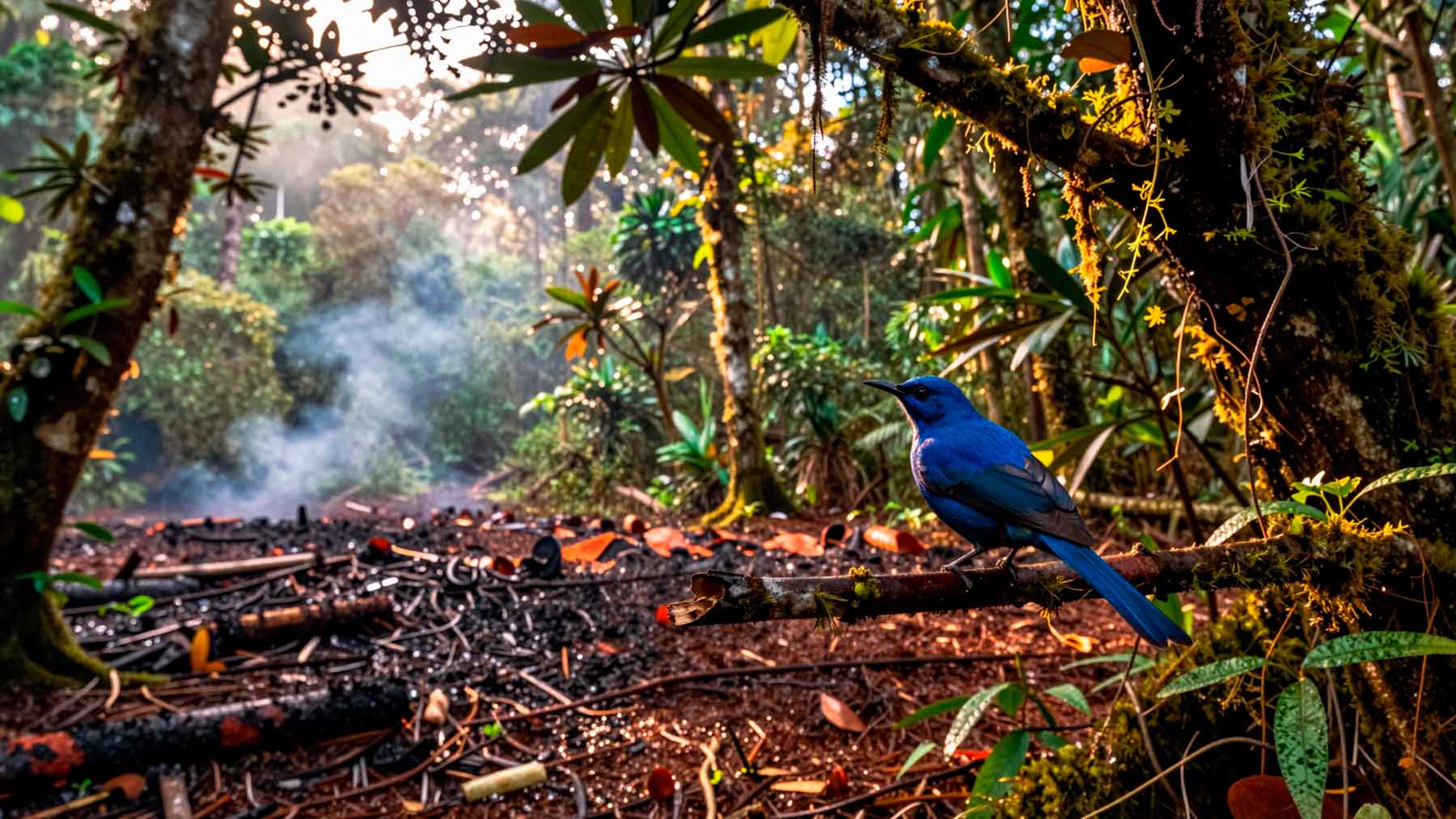
North America’s songbirds depend on five disappearing Central American forests
Every spring, Wood Thrushes and warblers return to parks and backyards across eastern North America, filling the air with the sound of the season. Most people never wonder where these birds have been.
The answer is specific — and precarious. For more than half the year, these songbirds live deep in a handful of remote Central American forests that few North Americans could name. A major new study from the Wildlife Conservation Society and the Cornell Lab of Ornithology has mapped exactly which forests matter most, and how much of each species depends on them.
Five forests, forty species, one fragile corridor
The five forests at the center of this research — Selva Maya, Moskitia, Indio Maíz-Tortuguero, La Amistad, and Darién — form a continuous ecological corridor roughly the size of Virginia, stretching from southern Mexico to northern Colombia. Together, they represent one of the most biodiverse corridors in the Western Hemisphere, sheltering not only migratory songbirds but also jaguars, tapirs, and scarlet macaws.
Published in Biological Conservation, the study drew on millions of sightings submitted to the Cornell Lab’s eBird platform to map weekly bird distributions across this entire corridor. That citizen-science dataset gave researchers an unusually detailed picture of exactly when and where birds concentrate throughout the year.
The results were unambiguous. These five forests provide habitat for between 10% and nearly 50% of the global populations of 40 migratory species — many already in steep decline — during winter and migration.
The numbers behind the birds
The species-level figures make the scale of dependence concrete. More than one-third of the world’s Kentucky Warblers winter in these forests, and nearly one-quarter of all Wood Thrushes and Golden-winged Warblers do the same.
The Cerulean Warbler numbers are particularly sobering. Over 40% of the species’ entire global population passes through these forests during spring migration — and the Cerulean Warbler has already declined more than 70% since 1970. For a bird that rare, losing even a fraction of this habitat could accelerate an already serious collapse.
The Selva Maya and the Moskitia emerged as the two most critical regions among the five. Researcher Viviana Ruiz-Gutierrez, director of Conservation Science at the Cornell Lab of Ornithology, described the density of migratory warblers, flycatchers, and vireos crowded into these forests as “astounding.” Each protected hectare, in practical terms, safeguards a disproportionately large number of birds.

Illegal cattle ranching is erasing the corridor
Despite their ecological importance, these forests are disappearing fast. A quarter of the Selva Maya and Moskitia combined has been cleared in just 15 years, largely driven by illegal cattle ranching. In the Moskitia alone, almost one-third of forest cover has vanished in only 20 years.
That pace of loss isn’t abstract for migratory birds. A Wood Thrush that winters in a patch of Moskitia forest one year may return the following season to find it gone — with no alternative destination waiting. Jeremy Radachowsky, Regional Director for WCS’s Mesoamerica Program, put the stakes plainly: “If we lose the last great forests of Central America — and we are — we lose the birds that define our eastern forests in North America.” The crisis is regional in geography but hemispheric in consequence.
Sister landscapes: how North America is connected to Central America
One of the study’s most practical contributions is a mapping tool designed to make that hemispheric connection visible. Using a framework developed by Partners in Flight and the Cornell Lab, researchers identified “stewardship connections” — North American breeding regions tied to the Five Great Forests by the same bird species.
The Five Great Forests are closely linked to the Appalachians, the Mississippi Delta, the Great Lakes, New England, and landscapes near New York City. Researchers call these paired regions “sister landscapes” because they share the same bird populations at different points in the annual cycle. It’s a straightforward concept with significant implications for how conservation funding gets directed.
The tool addresses a real obstacle. Cross-border conservation has long been hampered by a lack of shared data on where birds go and when. This mapping framework gives conservationists on both continents a common language — and a concrete reason to coordinate.
Communities on the front lines of forest protection
The research also points to something often overlooked in bird conservation: the people already doing the work. Across Central America, Indigenous and local communities are restoring damaged lands, suppressing forest fires, and reviving bird-friendly livelihoods like sustainable allspice and cacao production. These efforts frequently come at personal risk, yet they remain among the most effective forces protecting what forest remains.
Lead author Anna Lello-Smith sees an opening. “Every hectare we protect in Central America has ripple effects for birds and people across the hemisphere,” she said. Connecting North American conservation networks with these on-the-ground efforts could produce the kind of hemisphere-wide strategy that neither continent can build working alone.
What comes next depends on whether that connection gets made. The mapping tool now exists. The sister landscapes have been named. The question is whether conservation institutions and funders in the United States and Canada treat Central American forests with the same urgency they apply to breeding habitat closer to home. For the warblers and thrushes returning each spring, the two are inseparable.
The complete study is available here: Anna Lello-Smith, Viviana Ruiz-Gutierrez, Amanda D. Rodewald, Matt Strimas-Mackey, Courtney L. Davis, Andrew N. Stillman, Archie Yuchen Jiang, Roan B. McNab, Victor Hugo Ramos, Jeremy Radachowsky. Leveraging participatory science data to guide cross-border conservation of migratory birds: A case study from Mesoamerica\’s Five Great Forests. Biological Conservation, 2025; 111551 DOI: 10.1016/j.biocon.2025.111551
Read the whole thing?
Get the week's signal, not the noise
Our sharpest reporting on energy, climate and nature — free, once a week.


