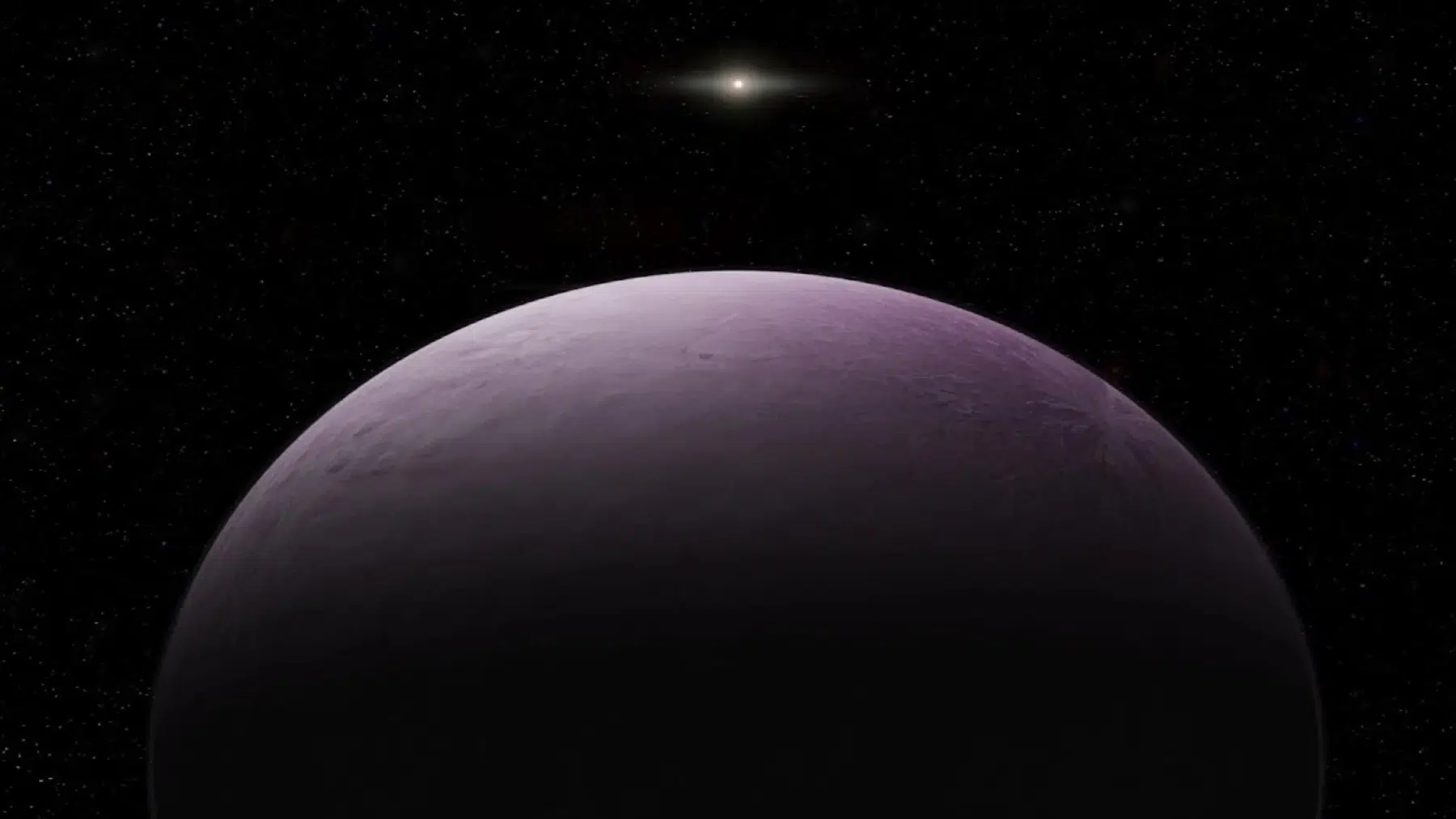
Our solar system was formed approximately 4.5 billion years ago, but humanity has been around for only a couple of thousand years. According to Carl Sagan, the Earth and humanity were born on December 31st in the cosmic calendar. A planetary system is not exclusive to the Milky Way, but the one we live in is the only one that has life inside, as far as scientists know. Now, researchers have found an object near Pluto that might hint at the presence of a ninth planet orbiting the sun.
Earth has the perfect spot in the solar system
The Earth is the only planet in the solar system to have the perfect conditions for the proliferation of life, and liquid water plays a big role in it. If it hadn’t been delivered by comets during the first couple of billion years, life as we know it wouldn’t exist. There is the possibility of liquid water being delivered to other planets, like Mars, but NASA is still trying to find any signs of it on the Red Planet.
Most of the planets were formed around the same time due to the solar nebula. The ones with the strongest gravitational field (Jupiter, Saturn, and Neptune) absorbed most of the cosmic objects into their atmosphere and grew over time. Some planets collided with others, and what was left from the collision became one huge cosmic object. The smaller ones, like Pluto, did not have the same formation and still inhabit our solar system without being considered a planet.
Researchers found a ‘planet’ smaller than Pluto
A new planetary body named 2017 OF201 was identified by a team of researchers from the Institute of Advanced Study in New Jersey and later confirmed by the International Astronomical Union’s Minor Planet Center. The object was classified as a trans-Neptunian object, which means it is a potential dwarf planet, with an estimated diameter of 700 kilometers.
The 2017 OF201 was identified by the team when they were analyzing archival images taken between 2011 and 2018 from the Victor M. Blanco Telescope in Chile and the Canada-France-Hawaii Telescope. The researcher and co-author of the study, Sihao Cheng, developed an algorithm to detect moving objects across the sky, and using the images from the telescopes, he found 19 different exposures over seven years. He also considered the object to be an “extreme ‘cousin’ of Pluto”.
The reason Pluto is not a planet
Pluto is considered a dwarf planet because it never cleared its orbit of debris – leftover rocks, ice, and other small objects from the early solar system. Pluto is smaller than some continents and countries, with an equatorial diameter of 1,477 miles (or 2,377 kilometers). The discovery of the 2017 OF201 may change the conditions for a cosmic body to be considered a “dwarf planet”.
2017 OF201’s perihelion (the closest point to the sun) is about 4.2 billion miles (or 6.7 billion kilometers), while the farthest point from the sun, the aphelion, is about 149 billion miles (or 239 billion kilometers) away from the big star, which means that the planetoid takes 24,000 Earth years to travel around the sun.
The search for the 9th planetary body in the solar system
The scientists have no clue as to how the dwarf planet ended up this far from the sun, but the team proposes that Pluto’s cousin went through a chaotic immigration due to gravitational interactions with other planets in the solar system, which led the 2017 OF201 to be pushed into the outer space, but also staying within the area of our planetary system. The discovery of the dwarf planet challenges the Planet Nine hypothesis. Since Pluto is not considered a planet, there might be another planet around the size of Earth far beyond Neptune.
Read the whole thing?
Get the week's signal, not the noise
Our sharpest reporting on energy, climate and nature — free, once a week.