
The ocean holds the essence of life on Earth, covering 71% of the planet and holding 97% of the world’s water. Throughout billions of years, it was responsible for creating and evolving millions of species that wouldn’t even be born if there weren’t the correct environment for the proliferation of life. The minerals, the temperature, the absence of light in the depths, everything works for life to be generated. On the other hand, roughly 20% of the seven seas have been studied so far, and an even smaller portion have been visited by humans.
The ocean hides the secret to organic life-forms
There are predators that swim in the water for millions of years, always hunting for the next prey, and many of what we see nowadays are the evolution of other species of apex predators, like the Megalodon. The great white shark is considered a distant relative of the Megalodon, but smaller and able to adapt to different environments, so the presence of water is important for life to proliferate.
So far, outside of Earth, water in a liquid state is yet to be found. Scientists believe that Mars may hold some water pockets underground, but no evidence has been found in decades of exploring the Red Planet. Now, it’s time to move beyond our solar system, 70 light years away, to find something that NASA has been searching for for a long time.
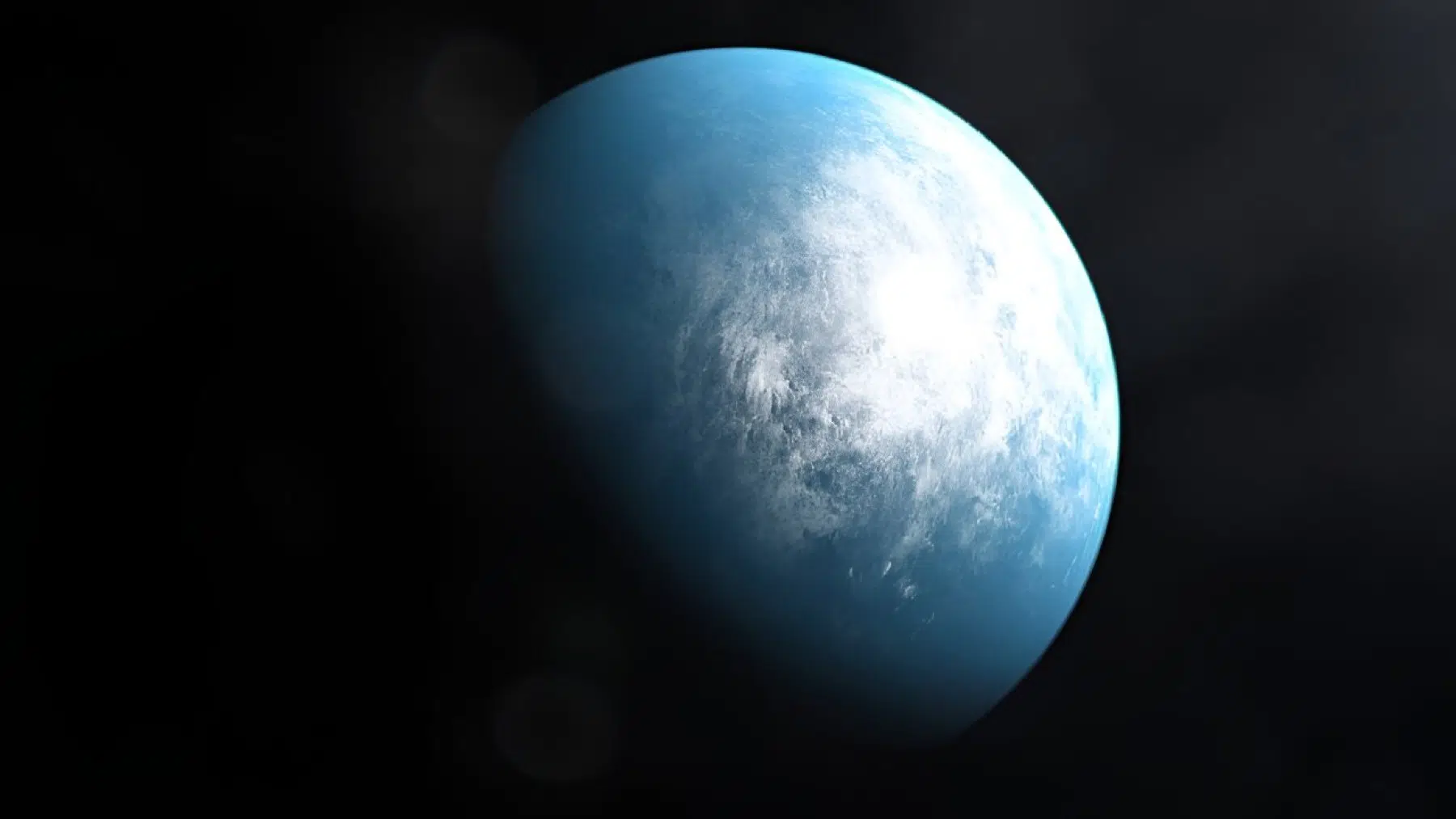
In a nearby constellation called Pictor, the James Webb Space Telescope found an exoplanet that might be entirely covered by water in a liquid state. The TOI-270 d orbits a star outside our solar system, but still relatively close. Although NASA cannot confirm if the planet is in fact covered by water, the telescope was able to capture signatures of methane and carbon dioxide, as well as water vapor.
NASA suspects an ocean is hiding on an exoplanet
The mix of these elements is consistent with a planet where the ocean would cover the entire surface. Another team led by the University of Montreal in Canada added some observations, claiming that they detected the same chemicals, but TOI-270 d would be too hot for liquid water. Instead, it would be covered by rocks and have a dense atmosphere of hydrogen and water vapor.
The suspicion on the planet that might hold a large amount of water is based on the absence of something common in a hydrogen-rich atmosphere: ammonia. The basic chemical is highly soluble in water, which means that if there aren’t high levels of it in the atmosphere, it may be in an ocean down below. Both teams have detected carbon disulfide, normally attributed to biological processes on Earth. Although it wouldn’t mean much for the TOI-270 if there was an ocean covering the planet, because the exoplanet sits still with one side facing the star and the other one in complete, cold darkness, with no rotational movement.
James Webb Space Telescope’s power is put to the test
Whichever view is right, the latest observations showcase the power of the James Webb Space Telescope. Still, it’s not able to capture actual images of the planets or stars it’s constantly discovering, but it’s able to capture the starlight filtered through the atmosphere of orbiting planets and break down in details the presence of chemical elements present in the object of study.
James Webb might lose a part of its relevance to the new SPHEREx, which was launched into space along with the SpaceX Falcon 9 spaceship. This new telescope is designed to look for the cosmos with a wider range, and search for water ice and other bodies in the universe.
Read the whole thing?
Get the week's signal, not the noise
Our sharpest reporting on energy, climate and nature — free, once a week.


