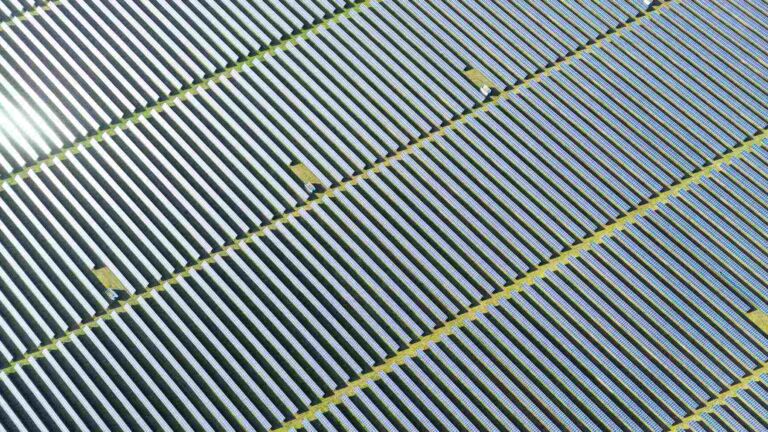
Each one is about the size of a garage door.
Two panes of glass on a steel post, a small motor on each axis, and a controller that knows where the sun is and where the target is.
Alone it is a curiosity.
Put enough of them on a desert floor and aim every one at a single point, and you have close to 600 acres of glass working as one lens.
The target is a boiler.
Everything about the design is mechanically honest, and for a decade it did more or less what the drawings said it would, which turned out not to be the question that mattered.
Why concentrating light was supposed to win
A photovoltaic panel makes electricity directly and cannot store it.
Sunlight hits silicon, electrons move, and the moment the light stops the output stops, which leaves a battery as the only way to shift any of it into the evening.
Concentrating sunlight makes heat instead.
Heat can sit in a tank of molten salt for hours and still spin a turbine after dark, which is the one thing the mirror approach could do that silicon could not.
This plant was built without that.
The mirrors here boil water directly and the steam goes straight to the turbine, so when the sun goes behind a cloud the output falls with it and nothing is banked, which surrendered the single advantage the technology had.
What is standing out there
The site covers about 3,500 acres of the California desert near the Nevada line.
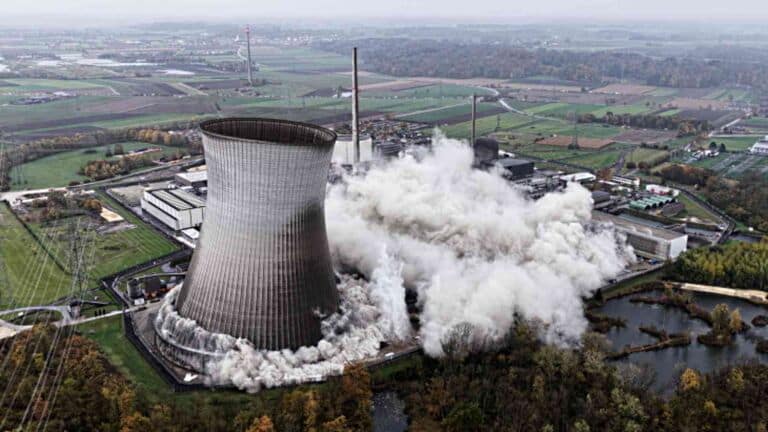
On it stand 173,500 heliostats, each carrying two mirrors, arranged in rings around three towers of roughly 459 feet.
Rated output is 392 megawatts.
That made it the largest plant of its kind anywhere when it started up in February of 2014, built for 2.2 billion dollars with a 1.6 billion dollar federal loan guarantee behind it.
The site was never quiet either.
Construction ran from late 2010 to early 2014 across ground that had to be cleared of desert tortoises first, at a scale that made the project a permitting case study before it made a single kilowatt hour.
Anyone driving to Las Vegas has seen it.
The whole field sits beside the interstate, and the towers are bright enough at midday to be uncomfortable to look at from the road.
The numbers it was measured against
The contract asked for about a million megawatt hours a year.
The best year it ever managed was 856,301 megawatt hours, in 2020, and the first year of operation delivered under 40 percent of what had been expected.
The design assumed a capacity factor of 28.5 percent.
Actual performance ran nearer 24 percent, which sounds like a small gap until it is multiplied across a thirty year contract.
Then there is the price.
The power sells at more than 13.5 cents a kilowatt hour, while unsubsidized utility scale panels now come in between 3.8 and 7.8 cents, so the panels are not half the price but closer to a third.
The regulator refused to let it close
The utility and the owners agreed to end two of the three contracts thirteen years early.
The state commission rejected that agreement on the fourth of December last year, unanimously and without prejudice, which means it can be brought back.
The reason was not sentiment.
Ratepayers have already paid, the resolution notes, more than 333 million dollars for transmission built to serve this plant, and switching it off risks stranding more than the termination would save.
Reliability did the rest of the work.
Federal policy shifts have made new project build out uncertain, demand from data centers is climbing, and the commission decided it would rather keep expensive generation than lose it with nothing named to replace it.
The Pulse covered that rejection when the regulator handed the deal back.
What is still unresolved
The loan has not been fully repaid.
An internal audit puts the outstanding figure at roughly 780 million dollars, a number neither the owners nor the department has confirmed publicly.
The birds are the other open file.
Estimates of annual mortality from collisions and from the concentrated beam itself have ranged from 3,500 to 6,000, and that toll was part of why the federal side supported closing it.
The technology itself is not the loser here.
Towers with storage do exactly what this one could not, as a Chinese field of 12,000 mirrors demonstrates by running after dark for eight hours at a stretch.
The utility can file again if a replacement is ever named, which is what the trade press reads as a technology shift rather than a retreat from solar.
Until then the field keeps tracking.
Every one of those motorized mirrors still turns through the day, aimed at a boiler nobody wants the output from, under a contract nobody is allowed to cancel.
Read the whole thing?
Get the week's signal, not the noise
Our sharpest reporting on energy, climate and nature — free, once a week.