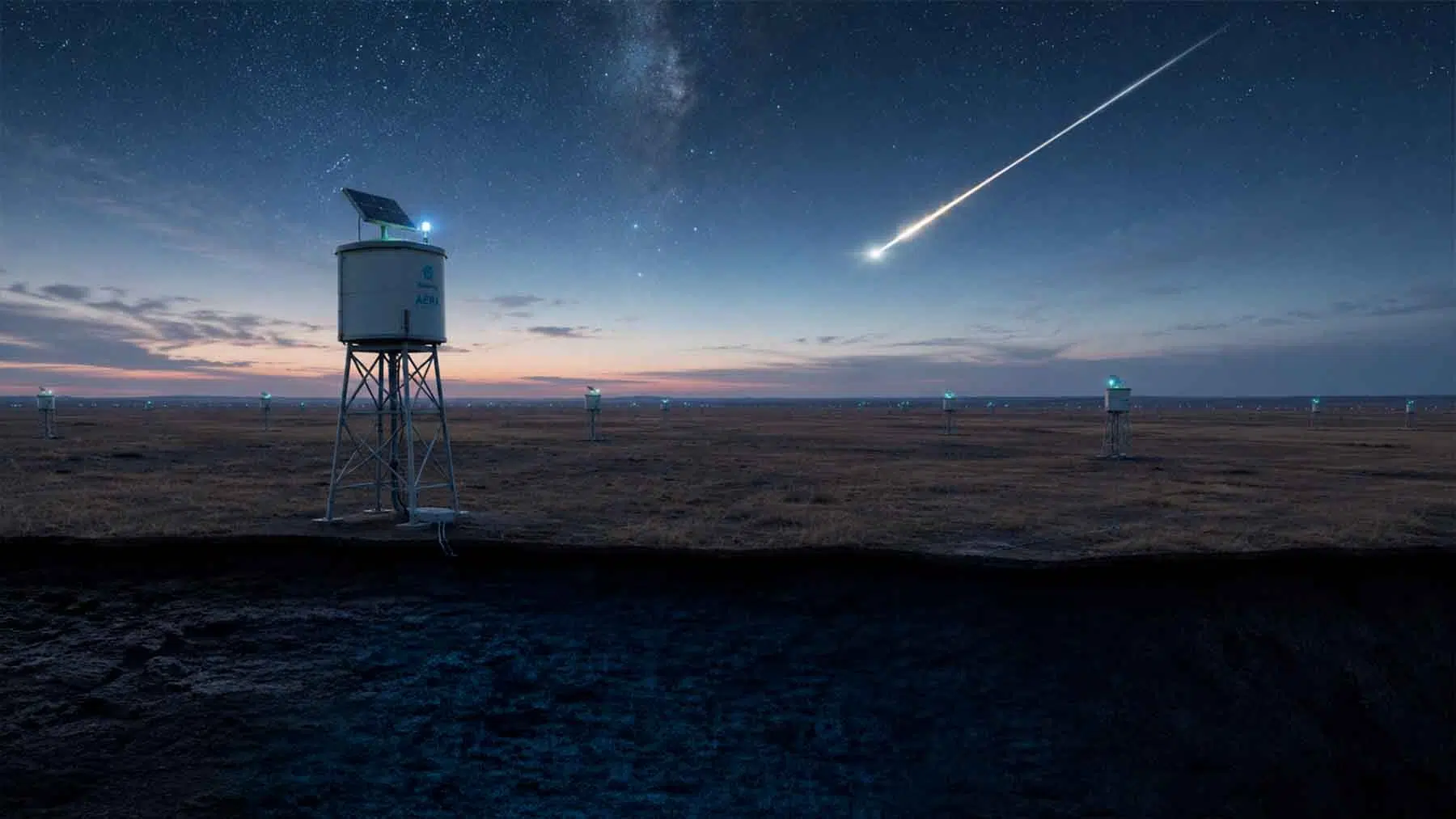
Detectors are spread across a plain in western Argentina, covering an area roughly 30 times the size of Paris. Built on this scale, the site measures some of the highest-energy particles that reach Earth.
These particles arrive from space with energies that exceed anything man has yet achieved using particle accelerators. Researchers still do not know what causes the highest-energy cosmic rays or how they reach such extreme energies.
More than 1,600 detector stations at the Pierre Auger Observatory track these rare events.
Cosmic-ray air showers passing through the area are recorded by the network.
How do these water tanks really work?
Why these particles are so difficult to investigate
Cosmic rays arrive at all times, but only rarely does one with an extremely high energy level (greater than 10^19 eV) arrive. Finding out more about the properties of these rare particles is difficult due to their scarcity. According to the project information, there is approximately 1 particle with energy > 10^19 EV that enters every km2 every year.
Because these events are so exceptionally rare, scientists need a large area to collect enough data.
The Pierre Auger Observatory was developed in an effort to obtain as much data as possible regarding these rare events.
The challenge of tracking cosmic rays
When an ultra-high-energy cosmic ray strikes Earth’s atmosphere, it produces a shower of secondary particles. The particles spread outward as they move toward the ground and can cover a large area.
Researchers track both the size of an air shower and how it develops as it moves through the atmosphere. Small differences in timing, location, and intensity can reveal details about the original cosmic ray.
According to the Pierre Auger Observatory, these events can spread across a vast area and require multiple detection methods.
Because these events often occur over thousands of square kilometers, researchers need a way to collect data across a vast area.
They also need information from both near the ground and high above the observatory.
Scientists at Instytut Fizyki Jądrowej PAN are helping study these ultra-high-energy cosmic rays and the air showers they produce.
The water tanks provide the answer
Researchers at the Pierre Auger Observatory solved this problem of detecting these rare events by developing a dual-component system. One component consists of a massive collection of water-based surface detectors covering the plains of Argentina.
Each detector container holds approximately 12 tons of ultra-pure water and serves as a particle detector. When charged particles from an air shower enter a detector tank, they move through the water faster than light can travel in water.
This produces Cherenkov light, which appears as brief flashes inside the detector tank. Each detector tank contains three photomultiplier tubes that detect these flashes and convert them into electrical signals.
GPS timing allows researchers to compare signals from multiple detectors at nearly the same moment.
The amount of light recorded by the detectors provides clues about the energy of the incoming cosmic ray.
Comparing signal timing from different detectors helps determine the path of the incoming cosmic ray.
What researchers hope to uncover
Researchers also use fluorescence telescopes to observe ultraviolet light produced by air showers higher in the atmosphere. Together, the two systems provide independent observations of the same air shower.
This provides a clearer picture of these rare events. Over the flat expanse of Argentina’s plains, water-based detector units continue recording data around the clock.
Some of nature’s most energetic events pass through the observatory each year and leave behind valuable data.
Measurements from the observatory are being used to investigate the origin of mysterious ultra-high-energy cosmic rays.
Another goal is to understand how these particles acquire such extraordinarily high energies.
Read the whole thing?
Get the week's signal, not the noise
Our sharpest reporting on energy, climate and nature — free, once a week.