The current in Grand Passage runs so fast it can push a loaded fishing boat sideways.
Below the surface, a different kind of machine was learning to live there.
It needed no divers, no barge, no submersible.
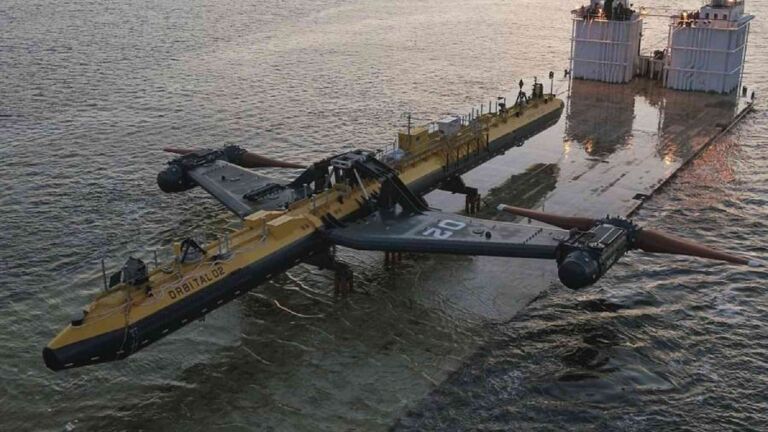
Just four rotors hanging off a floating hull, built to come up out of the water whenever something needed fixing.
Elsewhere in the Bay of Fundy, a heavy bottom mounted turbine had already failed and stayed down there.
So how do you fix a turbine without ever sending a diver down?
How do you fix a turbine without ever sending a diver down
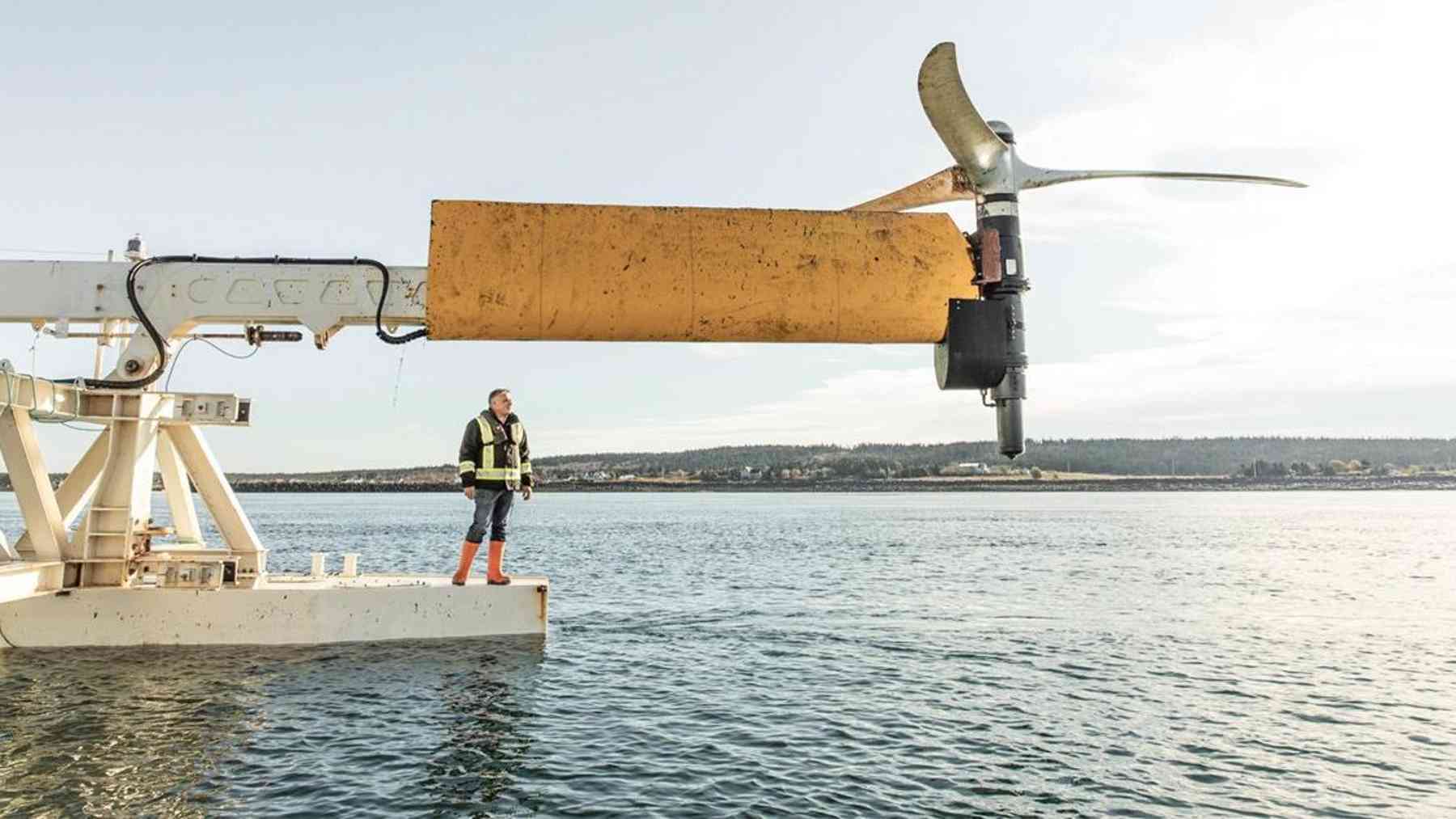
The answer sits in the hinge. Each of the platform’s four tidal rotors hangs from a swing arm on a long floating hull, and that arm can lift the whole turbine clear of the water. Instead of a machine bolted to the seabed, the platform called PLAT-I floats on the surface, held by a single mooring turret that lets it pivot freely as the tide reverses direction.
That one design choice changes who can do the repair work. Reaching a damaged device resting on the bottom can mean bringing in a submersible vehicle or a heavy barge with a lifting rig. Here the rotors were built to swing up one at a time, so a technician can work on one while the platform stays on station.
A lobster boat is the benchmark the developer itself used for that access. Visiting the site for Smithsonian magazine, a reporter was told that routine maintenance can be done at slack tide, and quoted chief executive Jason Hayman: “A visit from a lobster boat will do.”
A bay that already broke one tidal machine
Grand Passage sits between Long Island and Brier Island in Nova Scotia’s Bay of Fundy, the bay with the highest tides on Earth. The channel was picked because its bathymetry was already charted, the water runs fast and clear, and the site is easy for boats to reach.
Before the floating platform arrived, a very different approach had already failed roughly 125 miles to the northeast. A bottom mounted turbine in Minas Passage, weighing 1,300 metric tons, was left on the seabed after the parent company behind it entered liquidation.
The province later put the retrieval cost well above four million dollars, far above the million dollar bond originally posted. The same hinge that lifts a single rotor for maintenance also works as a safety release, kicking turbines up and out of the water when currents, ice or debris turn dangerous.
What the cameras actually recorded underwater
PLAT-I was first tested in western Scotland’s Connel Sound, then shipped in pieces to Nova Scotia and installed in Grand Passage in 2018. Subsea cameras were mounted on the platform to satisfy monitoring conditions, and the larger second generation platform later carried an onboard system tying together underwater cameras, hydrophones, echo sounders and acoustic fish tag receivers.
After roughly nine months of testing, the developer reported a narrow, specific result. It had seen no evidence of marine animals passing the turbines, aside from some jellyfish.
A separate camera trial on the platform, reported through the US Department of Energy’s Tethys knowledge base, found small fish and jellyfish around the structure and no larger marine fauna during the collection periods. None of the animals recorded were ever seen interacting with the turbines, though that is a limited winter dataset, not a verdict on every species in the bay.
Where the advantage runs into its limits
None of this means the floating design solved tidal power. The first platform’s four rotors measured about 21 feet across and the machine was rated at just 280 kilowatts, a fraction of what one modern onshore wind turbine produces. Reaching grid scale means building many platforms, not one.
On cost, the developer argued floating platforms are cheaper to install and remove than bottom mounted devices. The harder obstacle turned out to be permitting. In March 2023 the company’s Canadian subsidiary withdrew its application to Fisheries and Oceans Canada, citing no viable regulatory pathway, and it was placed into voluntary bankruptcy that May.
Surface access shows up in other ocean hardware too, including a wave energy buoy tested off New Jersey with its working parts kept reachable from above the waterline.
Why a lifted blade might matter more than it looks
The idea of lifting a machine instead of diving to it keeps reappearing wherever people put hardware into moving water. A similar instinct runs through solar projects designed for easy maintenance access on the ground.
What Grand Passage proved was narrower than a breakthrough. It showed that a machine designed to be reached, rather than defended against the sea, can be serviced year round in a channel where the flow hits roughly 10 feet per second, without sending anyone into it.
The platforms were pulled out in 2023 and placed into storage, with all equipment removed from the seabed at the site. But the hinge that let a lobster boat do a diver’s job remains one of the clearer answers yet to a question every ocean engineer eventually asks.
Read the whole thing?
Get the week's signal, not the noise
Our sharpest reporting on energy, climate and nature — free, once a week.