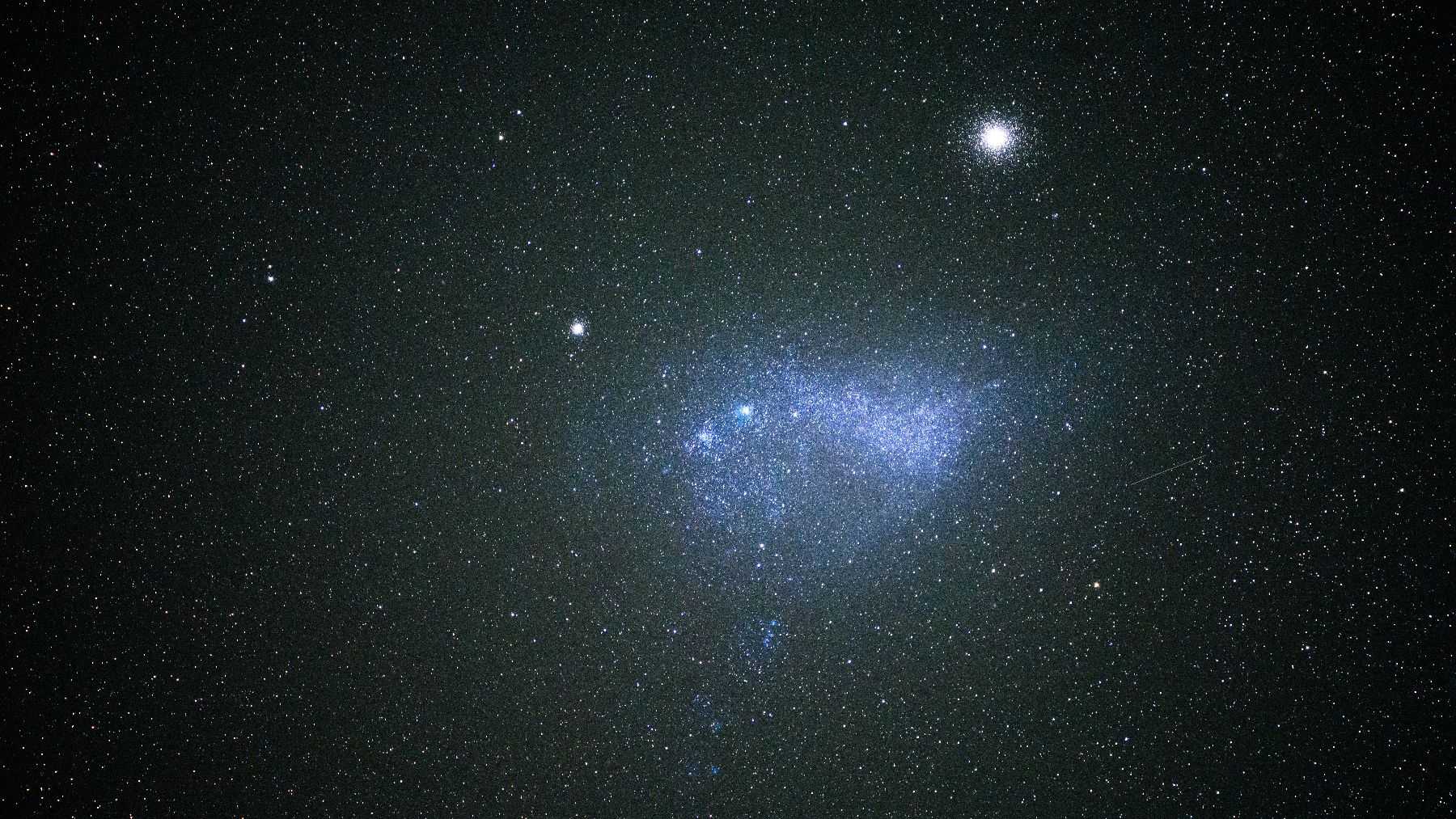
A team of researchers examined old radio data from telescopes and discovered a slowly spinning neutron star that sends out pulses once every 1.327 seconds.
This particular neutron star is situated in the Small Magellanic Cloud, which is one of the nearest galaxies to us.
When searching for pulsars in extragalactic space, it is quite hard to spot the faint and erratic pulses in the noisy data from other satellite galaxies.
Analysis of old survey data by means of new techniques made it possible for scientists to identify such periodic signals.
This discovery provides a new standard in identifying slowly rotating neutron stars in other galaxies.
Finding celestial signals in historical telescope data
Observations conducted by radio astronomy telescopes generate huge volumes of data in petabytes but usually lie untouched in storage databases for many years.
Astronomers tend to identify highly luminous pulsars that rotate rapidly more easily, while less luminous pulsars get submerged in background noise.
Scientists analyzed old survey observations available in archival records focused on satellite galaxies to search for periodic signals overlooked in the past.
The discovery followed reprocessing of archival Parkes data from 2017 with improved search settings and inspection after the pulsar was missed on the first inspection, and the detection processes are getting more advanced.
By analyzing the data from the past, one could make discoveries without investing any money in new observational research.
Detection of faint periodic signals from distant galactic systems
This signal came from 200,000 light-years away in the form of faint radio pulses.
Clouds of gas in space deflect and distort the timing of pulses, which makes it hard to detect neutron stars.
To analyze the data, an additional technique was developed that helped filter dispersion measures of the historic data obtained from the telescopes.
As a result, a clear signal emerged.
This particular signal appeared faint and periodic, pulsing with a steady pattern all through the observation period.
Filtering out weak and repetitive spikes turns noisy historical records into cosmic discovery logs.

The new pulsar’s unique spin rate
The timing observations determined that the new discovery, known as PSR J0103−72, completes a rotation once every 1.327 seconds.
The paper’s catalog of SMC radio pulsars includes rotation periods ranging from about 0.060 to 1.327 seconds; many rotate only a few times per second.
It is a very slow spin speed of 1.327 seconds that makes the newly discovered star the slowest radio pulsar ever detected within the Small Magellanic Cloud.
Such long rotation periods are rare.
Timing observations are a unique tool to study the aging process of isolated dead stars within other galaxies.
Calculating high dispersion measures through intergalactic space
The radio signals need to pass through dense clouds of free electrons that exist in both our Milky Way and the Small Magellanic Cloud.
The delay in arrival time for various frequencies results in a significant dispersion value of about 272 units, as reported by arXiv.
Large dispersion measures indicate that the pulsating object is located far from our solar system in a neighboring galaxy.
This will help to enhance our knowledge of the galactic structure in the local group next door to the Milky Way.
Increasing the number of pulsars identified in our nearby satellite galaxies
The finding of unusual, slowly spinning pulsars in archived data implies that there are many more yet-to-be discovered hidden neutron stars waiting for detection.
Scientists plan to apply machine learning methods to scan the legacy data obtained by other telescopes.
Finding more pulsars outside the Milky Way galaxy would help us learn about stellar evolution under different conditions.
Scanning legacy data means that many key discoveries may be just one computer click away.
Read the whole thing?
Get the week's signal, not the noise
Our sharpest reporting on energy, climate and nature — free, once a week.