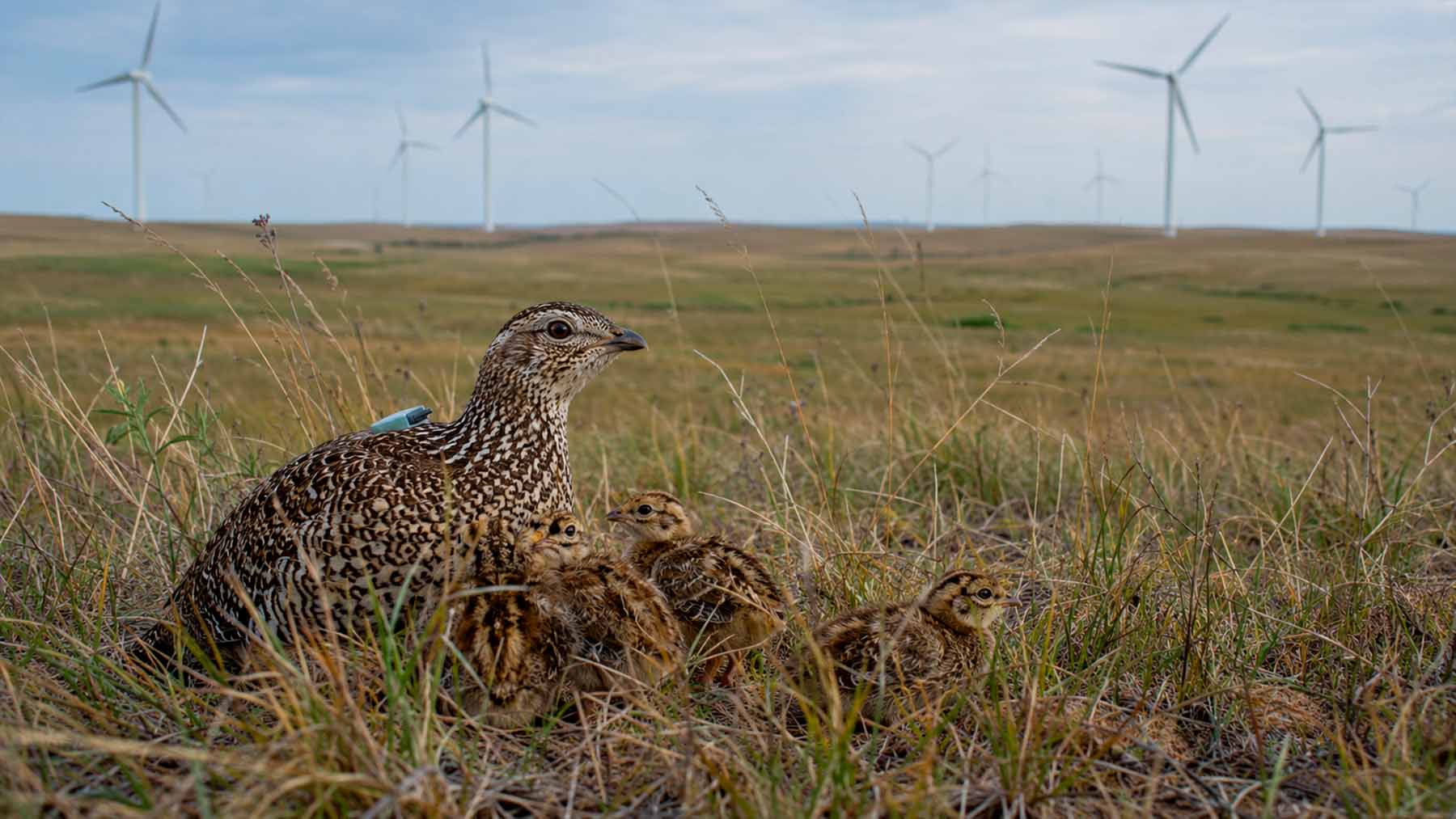
Wildlife biologists studying sharp-tailed grouse near wind farms in South Dakota’s grasslands fitted 119 females with solar-powered transmitters. The birds were monitored across multiple breeding seasons to figure out how the energy infrastructure affects nesting and rearing.
Adult females were content to continue nesting inside the array perimeters, but mothers with young chicks avoided the areas with the most turbines.
What critical habitat challenge was highlighted by the shifts in behavior?
How the expansion of wind energy intersects with prairie wildlife habitats
South Dakota’s mixed-grass prairies are vital breeding grounds for sharp-tailed grouse. This is a native species that needs uninterrupted expanses of grassland to survive. The expansion of the wind energy sector has reached the Great Plains. Researchers, project operators, and regulators need data about how utility-scale turbines affect wildlife behavior.
Six commercial wind farms were chosen to gather field evidence by tagging and tracking female grouse. High-precision telemetry was applied to location coordinates during the spring and summer reproduction seasons.
Of 75 nests analyzed, 19 were within three miles of a turbine and 56 were three to 20 miles away. The defensible result is that nest-site selection was not statistically related to wind infrastructure at the scales tested.
However, the situation changed when the eggs hatched. The tracking data showed changes in habitat selection, where mother birds began moving away from clustered development zones.
The survival of the broods relies on ecological conditions
Raising the young grouse is more ecologically demanding than sitting on eggs. Nesting hens sit in the brush and remain hidden, but when the chicks are hatched and growing, they have to walk constantly as they forage for several weeks before they can fly.
The survival of the chicks during this vulnerable period depends on locating insects, seeds, and grass. The vegetation keeps the young birds out of the high summer sun and also serves as cover from raptors.
Analysis of the spatial field data shows that isolated turbines or arrays with wide spaces between them did not have much effect on grouse movements. However, densely grouped turbine installations created much more notable changes.
The mother grouse purposely steered their broods away from the areas with the most turbine bases and the access roads around them. Conservationists wanted to know why the habitat conditions shifted around the concentrated infrastructure.
Infrastructure disturbance and vegetation may contribute to brood avoidance
Building multiple turbines close together requires extensive gravel access roads, equipment pads, and utility lines. This construction removes native prairie plants and compacts the surrounding soil.
For growing chicks that rely on high-protein diets, these cleared zones yield far fewer insects and seed heads. Reduced plant height along road margins leaves flightless broods exposed to hunting hawks and mammalian predators, while routine maintenance truck traffic creates persistent physical disturbance. As a consequence, female grouse guided their chicks into surrounding intact prairie where taller native grasses offered dependable food, shade, and thermal cover.
Habitat choices, not population decline
However, researchers emphasize that these spatial shifts represent localized habitat choices rather than widespread population decline. Nesting success remained consistent across varying distances from turbines, showing that sharp-tailed grouse can adapt to low-density energy layouts when contiguous grassland remains available nearby.
The study recommends limiting turbine siting within miles of sharp-tailed grouse breeding habitat. It recommends collocating new transmission lines with existing infrastructure and outside breeding habitat.
These fine-scale movement findings give land managers clear benchmarks for planning future renewable projects alongside sensitive Great Plains species.
You can find the full study here: Kelly, C. S., LeBeau, C. W., Beck, J. L., Solem, A., Morey, H., & Smith, K. T. (2025). Resource selection and survival of plains sharp‐tailed grouse at a wind energy facility. Ecosphere, 16(1), e70164.
Read the whole thing?
Get the week's signal, not the noise
Our sharpest reporting on energy, climate and nature — free, once a week.