The channel here is brown and slow and runs between farm levees, nothing anyone would photograph.
Staked in the current is a cylinder of net wide enough to walk into.
Inside it, something heavy is turning.
The fish came in from the Pacific, found the mouth of the river, and swam up it until the water stopped going anywhere.
Then it swam into the only opening left.
The rest of the trip north will happen at 55 miles an hour.
Why a cone of net beats a fish that will not turn around
A fyke trap is not clever. It is a large diameter cylinder of mesh held open on hoops and staked across the flow, with a wide mouth at the downstream end.
A migrating fish pushes upstream into that mouth because upstream is the only direction it has.
Behind the mouth the mesh narrows into a funnel, and the fish passes through the throat into the chamber beyond.
Getting back out means finding a small opening from the wrong side while still swimming forward. Salmon do not reverse.
So the trap works on the animal’s own determination rather than on any bait or current trick.
Crews lift the chamber, scan each adult for a coded wire tag, measure it, and lower it into a tank.
What the river actually looks like between here and the gravel
Friant Dam was finished in 1942 and the water behind it went into canals. Long stretches of the San Joaquin below it simply stopped flowing.
Spring run salmon were gone from the mainstem for more than sixty years.
Water is back now, under a settlement reached in 2006 and an act of Congress three years later, and the river reconnected to the Merced in 2016.
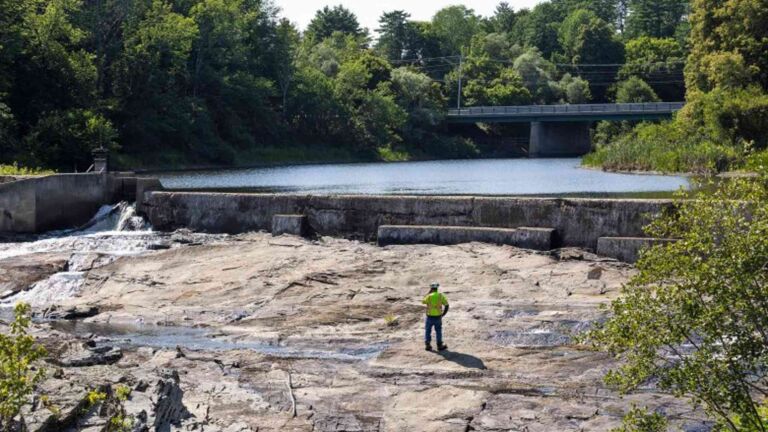
Flow is not the same as passage. Three structures still stand in the way, the Eastside Bypass Control Structure and two irrigation dams at Mendota and Sack.
In a wet year high water lifts fish over them. In an ordinary year it does not.
Which leaves 120 miles of river that these adults cannot swim, and a truck that can drive it in an afternoon.
What one season of trapping produced
The 2025 count came to 448 captured adults, the highest since juvenile reintroduction started in 2014.
Most were taken in the Eastside Bypass below the control structure. The rest came from Sack Dam, roughly 45 miles upstream.
The previous record for captured returns was 93 fish, four years earlier.
One caveat travels with the number. In a flood year biologists put the return near 400, but conditions made counting impossible and no exact figure exists.
Monitoring closed on the fifth of June, and the fish went into cool water in Reach 1 below the dam to wait out the valley summer.
Spawning starts in September, which is the whole reason for hauling them that far.
What 448 is not
It is a count of animals handled, not an estimate of a run. Nobody knows how many arrived and were missed.
These are also not a relict population that hung on. Central Valley spring run Chinook salmon are listed as threatened, and the fish here are a reintroduction managed as a nonessential population under a separate federal rule.
Juveniles come from a hatchery a mile below the dam, which puts out about 250,000 a year.
The program has also trucked in hatchery raised adults to spawn alongside the wild returns, 150 of them in one year against 74 that came back on their own.
None of that makes the return fake. It makes it an early result rather than a recovery.
The honest comparison is not to a healthy river but to the same problem elsewhere, whether that means pulling two hydro dams out of the Eel or carrying steelhead out of a burned canyon in buckets.
The part that is supposed to end
Trap and haul is a stopgap and the program says so.
A 93 million dollar contract was awarded in July 2025 to screen the Arroyo Canal intake and build a bypass channel around Sack Dam, with a new headworks replacing an 80 year old structure.
Construction began that November. Completion is expected in the summer of 2028, and roughly 47,000 acres keep their irrigation water either way.
After that the fish would still face the bypass control structure, so the record is a milestone on a road that is not finished.
The test nobody can run yet is simple. Put a fish in the estuary and see whether it can reach the gravel without a driver.
Until then the measure of success is how many salmon are willing to swim into a managed river and get in the truck, and 448 of them did exactly that.
Read the whole thing?
Get the week's signal, not the noise
Our sharpest reporting on energy, climate and nature — free, once a week.