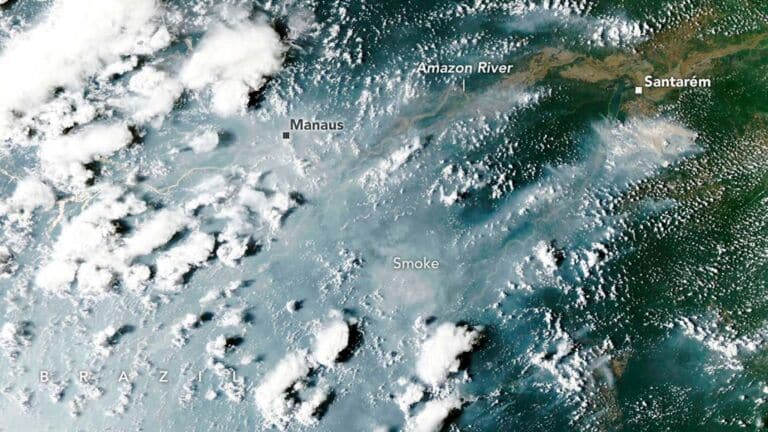
Picture the Atlantic on a summer afternoon, a thick white quilt of cloud stretching from horizon to horizon, bouncing sunlight back out to space before it ever reaches the water.
Now picture that quilt thinning, fraying, opening up dark holes where heat pours straight through.
Scientists spent two years trying to explain why 2023 shattered every temperature record on the books, and when they added up greenhouse gases, El Niño, increased solar activity, aerosol changes, and water vapour from a volcanic eruption, they kept arriving at the same maddening problem.
There were 0.2 degrees Celsius of warming that simply had no explanation.
The answer, researchers now suggest, was written in the clouds, or rather, in the places where clouds used to be.
The year the math stopped adding up
2023 set a string of alarming new records, and the global mean temperature rose to nearly 1.5 degrees Celsius above the preindustrial level.
Climate scientists are good at accounting for warming.
Factoring in greenhouse gases, El Niño, solar activity, aerosol changes, and volcanic eruptions can account for a major portion of the rise, but doing so still left a stubborn gap of roughly 0.2 degrees Celsius that resisted every explanation.
That gap might sound small, but in the language of planetary temperature it is enormous.
It is the difference between a bad year and a year that rewrites the record books, and researchers knew they were missing something big.
Earth wears white for a reason
Our planet has a natural defense against solar heat, and most people walk right under it without a second thought.
Planetary albedo describes the percentage of incoming solar radiation reflected back into space after all interactions with the atmosphere and the surface of the Earth.
Snow, ice, and especially low-altitude clouds act like a giant parasol over the oceans, sending sunlight back the way it came.
Low-level clouds such as cumulus and stratus are thick enough to bounce a substantial share of the sun’s radiation straight back into space.
Lose those clouds and the ocean beneath absorbs energy that was never meant to stay.
The system had been working, imperfectly but reliably, for decades.
Then something started to crack.
A shield dissolving over open water
Earth’s albedo has been in decline since the 1970s, driven partly by shrinking Arctic snow and sea ice leaving fewer white surfaces to reflect sunlight.
Scientists had tracked that slow fade without too much alarm.
But the polar regions turned out to be only part of the story.
Their albedo loss accounts for roughly 15 percent of the most recent planetary decline.
The rest was happening over open ocean in the tropics and northern mid-latitudes, the Atlantic in particular.
That happened to be exactly the region where the most unusual temperature records appeared in 2023.
The parasol was dissolving right where the planet needed it most.
The cloud clue that cracked the case
A team from the Alfred Wegener Institute and the European Centre for Medium-Range Weather Forecasts turned to satellite data from NASA and cross-checked it with the ECMWF’s own weather reanalysis archives.
In both datasets, 2023 stood out as the year with the lowest planetary albedo since at least 1940, the full extent of the available record.
The researchers ran an energy model to calculate how much extra heat that cloud loss had allowed through.
Without the reduced albedo since December 2020, the mean temperature in 2023 would have been approximately 0.23 degrees Celsius lower, almost precisely the missing 0.2 degrees.
That finding was published in the journal Science in December 2024.
Stricter maritime fuel regulations introduced in 2020 sharply reduced sulfur emissions from shipping, cutting the aerosol particles that help seed cloud formation across the busiest ocean corridors, and warming seas may be suppressing the atmospheric dynamics that build low cloud.
What no one yet fully understands is why those low clouds thinned so sharply when they did, and the authors are careful to describe their result as a strong candidate explanation rather than a settled verdict.
What a dimmer planet means next
The finding reframes something most people picture as soft and passing: clouds are a structural part of Earth’s cooling system, one that has taken on a new fragility.
Albedo changes represent an accelerating factor that could push tipping points closer than previously calculated.
The hopeful edge of this discovery is that some albedo changes are, in principle, manageable.
Cool roofs, reflective pavements, and urban modifications could, research suggests, offset significant warming at a local and even regional scale.
The sky has always been doing invisible work on our behalf.
The research, reported independently by multiple outlets, is a reminder that the most powerful forces shaping our climate are sometimes not the ones we can touch at ground level, but the ones drifting and thinning thousands of feet above our heads.
The math finally comes close to adding up, and the answer turns out to be one of the most ordinary and extraordinary things in the sky.
Read the whole thing?
Get the week's signal, not the noise
Our sharpest reporting on energy, climate and nature — free, once a week.