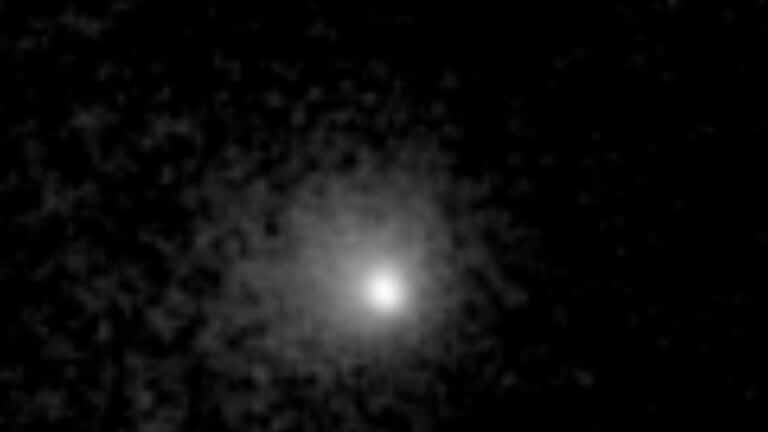
On the night of July 1, 2025, a survey telescope in Chile caught something crossing the sky at a speed that made no sense for our solar system.
It was not an asteroid drifting on a familiar loop around the Sun.
It was not a comet born here, built from our ice and our dust, the leftovers of a system four billion years old.
Whatever it was, it had come from between the stars, and it was already headed straight our way.
The object that did not belong here
Most comets follow long, looping paths that swing around the Sun and come back, sometimes after centuries, sometimes after thousands of years.
This one would never return.
Its orbit had an eccentricity of 6.1, a number that simply means the path is not a closed loop at all, so the object can only pass through once and then leave forever.
It was moving at about 58 kilometers a second, roughly 130,000 miles an hour, the most extreme object of its kind ever recorded in our solar system.
For comparison, our fastest spacecraft, Voyager 1, travels at about 17 kilometers a second.
This thing was more than three times quicker, and it came from somewhere else entirely.
What the telescopes started to see
Within days of the discovery, observatories around the world swung toward it.
Older images from NASA’s TESS satellite showed it had already been active on May 7, 2025, out at about six times the distance between the Earth and the Sun.
In other words, it was shedding gas and dust nearly two months before anyone on Earth knew it was there.
As it fell closer to the Sun, the picture grew stranger.
Telescope after telescope turned to look before it slipped away for good.
The James Webb Space Telescope read the light coming off its coma, the glowing cloud of gas and dust that swells around a comet’s icy core as it warms.
That cloud was dominated by carbon dioxide, alongside water, carbon monoxide, ice, dust and a faint trace of a sulfur compound.
The balance of those gases read like a recipe from a completely different kitchen, unlike anything ever sampled from a comet born in our own system.
The spinning and the shuddering
As the comet neared the Sun, scientists tried to clock its spin, to find its heartbeat.
Every spinning comet flickers a little as it turns.
Its solid icy core was expected to be lumpy and uneven, which should make it brighten and dim as it turned.
But the dusty cloud around it muffled those signals and made a clean measurement hard.
One team clocked a turn of about 16.8 hours, and a second, working separately, found a similar figure near 16 hours.
A third group, using the Hubble telescope, watched a wobbling jet of gas and dust that traced the same slow, steady spin.
Three teams, three slightly different clocks, all pointing at a body tumbling once every 15 to 17 hours through the dark between stars.
A comet born around a different sun
Its name is 3I/ATLAS, only the third object ever caught passing through our solar system from interstellar space, after 1I/’Oumuamua in 2017 and 2I/Borisov in 2019.
It made its closest approach to the Sun on October 29, 2025, passing a little farther out than the Earth sits, just inside the orbit of Mars.
Then it began to leave, and it will never pass this way again.
The heavy load of carbon dioxide points to a core rich in that ice, which may mean the comet formed in the cold outer edge of the disk of gas and dust that once circled its home star.
Locked inside that ice are the birth conditions of a planet building disk around a star we will probably never even name.
The traveler that changed the map
By early 2026, 3I/ATLAS was already fading, racing back out toward the stars it came from.
The Webb readings, taken in August 2025, captured the chemical fingerprint of a comet from another star, and they will shape our understanding for years.
The real surprise was not how alien it was, but how familiar.
Water ice, carbon compounds and organic molecules, the same raw ingredients found in comets born right here, were packed inside a body that formed around a different sun.
It let scientists hold material from another star system up against our own and compare them directly.
That hints the chemistry of building planets may be far more universal than we thought, scattered across the galaxy in travelers like this one.
For a few months in 2025, a comet from another star hung within reach of our telescopes, and the universe felt, for once, close enough to touch.
Read the whole thing?
Get the week's signal, not the noise
Our sharpest reporting on energy, climate and nature — free, once a week.