
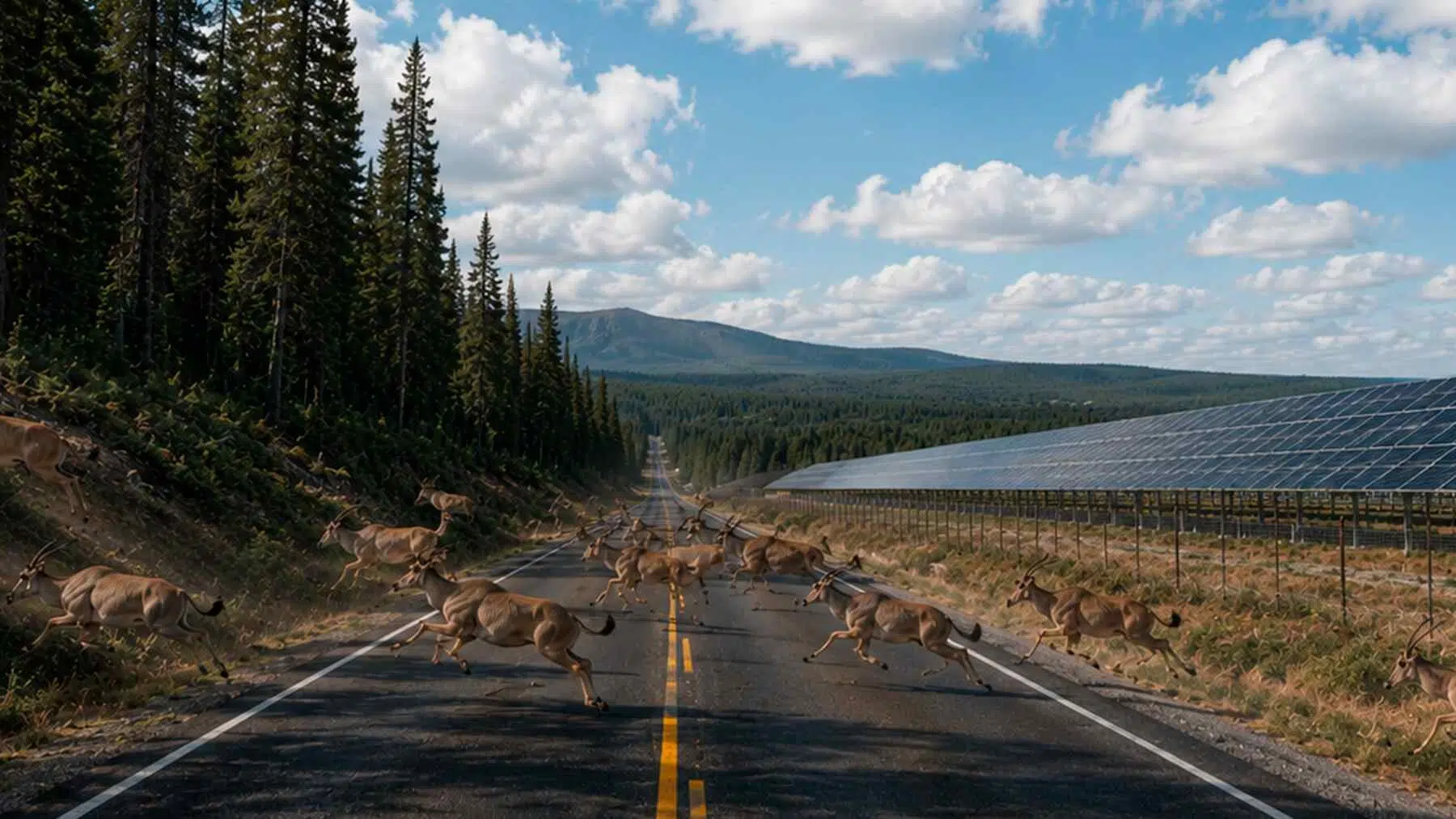
More than 1,000 antelope suddenly abandoned their normal migration route.
And a solar farm was to blame.
Biologists expected a bottleneck. They didn’t expect 1,000 animals to surge toward a high-speed highway.
One that carries roughly 2,000 vehicles daily.
The odd detour shocked biologists and terrified drivers in Wyoming. Now, experts think this new reality may be becoming more common.
The antelopes’ next moves raised even more concerns.
How 1,000 antelope have been fenced out of their future
The issues began right after the Sweetwater Solar facility in Wyoming began operations.
The plant sat across land used for generations by the Pronghorn antelope.
Experts tracked the herd using GPS collars before and after construction kicked off. The change was almost immediate.
70% of the herd lost access to their historical winter range instantly.
86% were forced to abandon paths used for over 6,000 years.
The biggest problem wasn’t the solar panels. It was the fencing surrounding the panels.
One scientist monitoring the antelope described the issue rather bluntly, saying:
“That habitat is just gone.”
The herd funneled into a 600-foot ‘death trap’ corridor between the farm’s fence and Highway 372.
This created a new issue not just for the solar plant, but for drivers as well.
The scene stunned wildlife experts. And that was just the start of the danger.
A highway to the danger zone
Some renewable energy projects have been causing chaos around the world. But this one in Wyoming was different.
Experts soon realized the antelope were not behaving randomly. They were adapting to a new reality.
They were simply following their instincts of migration. But their normal established path was now blocked by a solar project.
Pronghorn are the fastest land animals in North America, reaching 60 mph, but they cannot jump fences.
Some migration routes in Wyoming have been there for thousands of years.
The antelope rely on uninterrupted migration and open visibility to survive.
This is where this story became a story of adaptation.
Renewable energy projects can unintentionally disrupt migration systems.
Solar projects are doing far more than just generating clean energy.
Researchers noted that the fencing resembled the impact of another issue. Habitat devastation.
The herd rerouted to Highway 372. Creating new fears of mass collisions with drivers.
That’s where things become even more dangerous.
Experts noted something odd among the herd of antelope.
They targeted the highway because the road’s wind-swept surface was the only snow-free ground left.
They improvised a new migration corridor in real time.
A scene of carnage followed that biologists had warned about for months.
Green power vs. ancient instincts: A 6,000-year-old struggle
Solar projects have been found to impact more than just wildlife. They are changing the very landscape they operate in.
The antelope had not abandoned their migration route.
They merely adapted and found what they thought was a new one.
That one instinctive decision would prove to be critical.
Trapped against the road by 700 acres of chain-link fence, the herd began darting into 70 mph traffic.
Drivers panicked as antelope were found dangerously close to passing cars.
1,000 animals, one highway: How authorities diverted a wildlife disaster
Migration routes that were established thousands of years ago are now dead ends.
Officials described a chaotic situation where thousands of antelope reached the highway.
Authorities opened the fencing and actively guided animals away from the road.
Dozens of pronghorn died from vehicle strikes and fence entanglement within the first year.
This raised a new concern that impacts the entire solar power industry.
It is a warning for other massive solar projects across the nation.
And understand the potential impact of solar power generation on wildlife.
This disaster forced Wyoming to map ‘low-conflict’ zones to prevent solar projects from becoming extinction traps.
Disclaimer: Our coverage of events affecting companies is purely informative and descriptive. Under no circumstances does it seek to promote an opinion or create a trend, nor can it be taken as investment advice or a recommendation of any kind.
Read the whole thing?
Get the week's signal, not the noise
Our sharpest reporting on energy, climate and nature — free, once a week.


