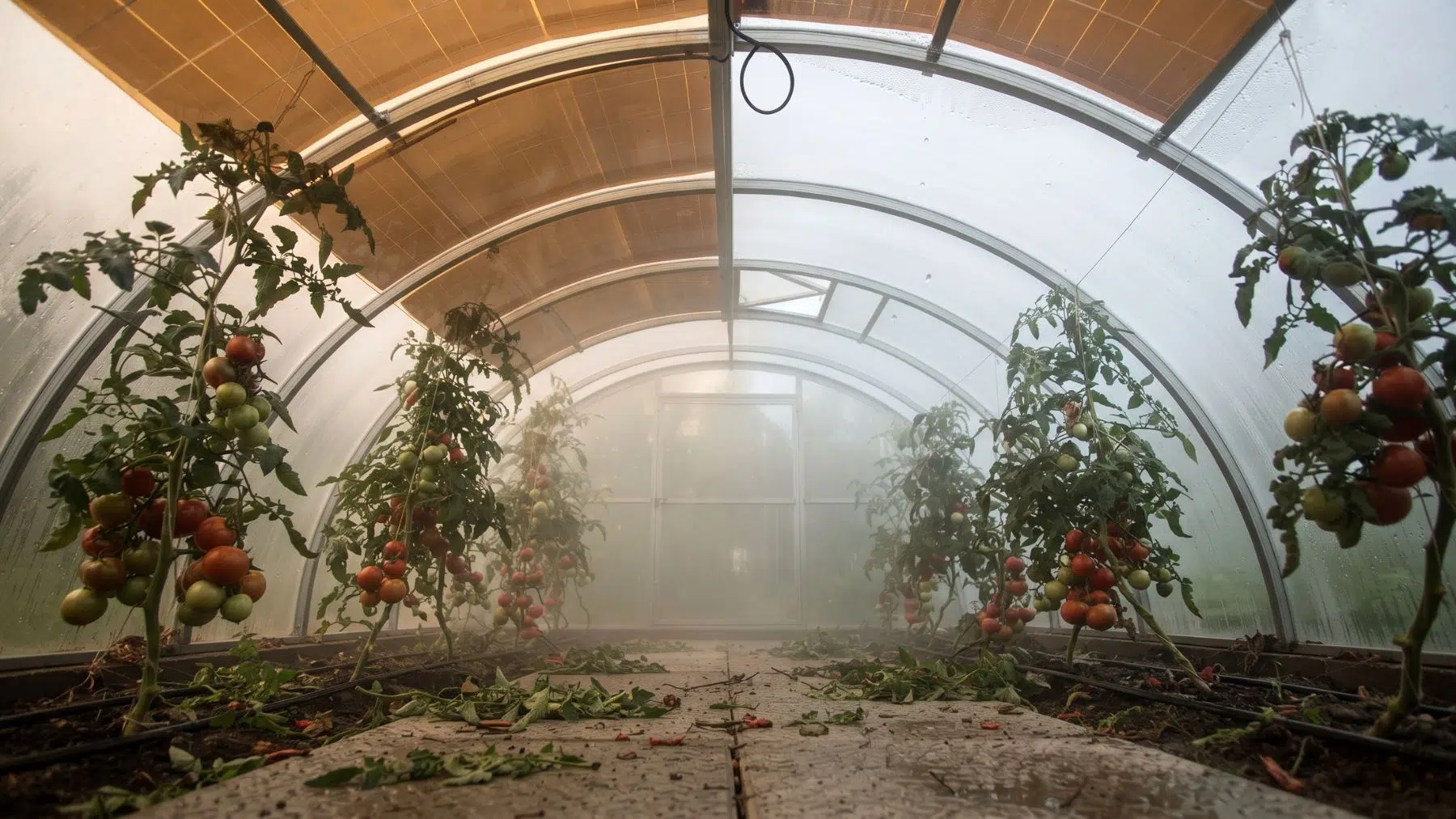
Stand in the middle of the row and look up.
Half the roof is glass and half is something darker, laid across the arch in one continuous run.
The line between them falls across the canopy.
Leaves on one side read a shade cooler than the leaves on the other, and the fruit hanging under both looks about the same.
A third of the light is missing on one side, and the plants have not noticed much.
Why a leaf stops using light long before noon does
Photosynthesis has a ceiling. A leaf runs photons through a fixed number of reaction centers, and once those are busy the extra light has nowhere to go and leaves as heat instead of sugar.
That ceiling arrives earlier than most expect. On a clear summer day the sun delivers far more than a tomato leaf can process, for hours at a stretch, and none of the surplus is banked. It is simply wasted, which is why a canopy in full desert sun is not twice as productive as the same canopy at half the brightness.
So a roof that takes light away is not automatically taking yield. It depends on whether it takes from the part of the day the plant was using or from the part it was throwing overboard.
What is actually on the roof
These solar panels are not the blue crystalline kind. They are flexible organic film, thin enough to lie along a curved arch, and the working part is a set of dye molecules tuned to absorb where the crop is least interested.
Plants run mostly on red and blue.
That is why leaves throw green back at you, and why a film can be tuned to take a bigger share outside those bands than inside them. Nothing sorts and nothing switches, because the absorption happens in the chemistry, which lets the same square foot of roof be generating and transmitting at once.
There is a second payoff in a hot climate. A film that catches infrared before it enters keeps the house cooler, cutting ventilation and lowering the bill the panels already reduce.
Where the numbers come from
The trial ran in a working greenhouse in Tucson, about 30 feet by 48 feet, with 550 square feet of film over the north half and the rest left clear.
That film cut photosynthetic light by about 37 percent. Fruit came in 11 percent below the control side across the season, and after the fourth of ten harvests the weekly yield, fruit count and fruit size were no longer significantly different.
The efficiency figure is the one worth keeping. Measured as fruit per unit of light received, the shaded side ran at more than double the clear side.
Separately, a modeling study put such a roof at energy neutral in Arizona while blocking only 10 percent of photosynthetic light, neutral in North Carolina at 20 percent, and covering up to 46 percent of demand in Wisconsin. Lettuce under similar filters held its weight and gained anthocyanin, and one of the plant biologists was blunt about it. “There was no real reduction” in plant growth or health, she said.
What the trial does not settle
There is no universal number here, and that is what most write ups get wrong. A systematic review found no single threshold of light transmission that keeps everything commercially viable, because every crop answers differently.
Tomatoes sit among the fussier ones.
They tolerate roughly 25 to 37 percent shading before yield moves. Strawberries hold up well above that, and lettuce under scattered shade has come in well ahead of full sun.
Those panels are also weak. The film in Tucson converted less than 2 percent of the light it took, a fraction of what silicon manages, so a lot of roof buys a little power.
And the scale is small. These are single houses and growth chambers, not the acres a commercial operation runs, and the researchers say results move with climate and design.
What a roof is allowed to do
The interesting shift is not the electricity. It is that a greenhouse roof stopped being one decision.
A roof used to be one trade between light and shelter. Now the covering is a variable, tuned by band rather than opacity, so a grower in Tucson and one in Wisconsin are no longer buying the same object.
That desert case is the strongest one. Where sun is the surplus and cooling is the cost, taking light off the roof is the cheap move, and the fruit barely registers it.
Further north it inverts. Light becomes the scarce thing, the ceiling is rarely reached, and every photon the film takes is one the plant wanted, which is why the Arizona result is not a national one.
So the honest summary is small. In the right climate a tomato gives up almost nothing for a roof that pays for itself, a narrower claim than the headlines and a sturdier one.
Read the whole thing?
Get the week's signal, not the noise
Our sharpest reporting on energy, climate and nature — free, once a week.