
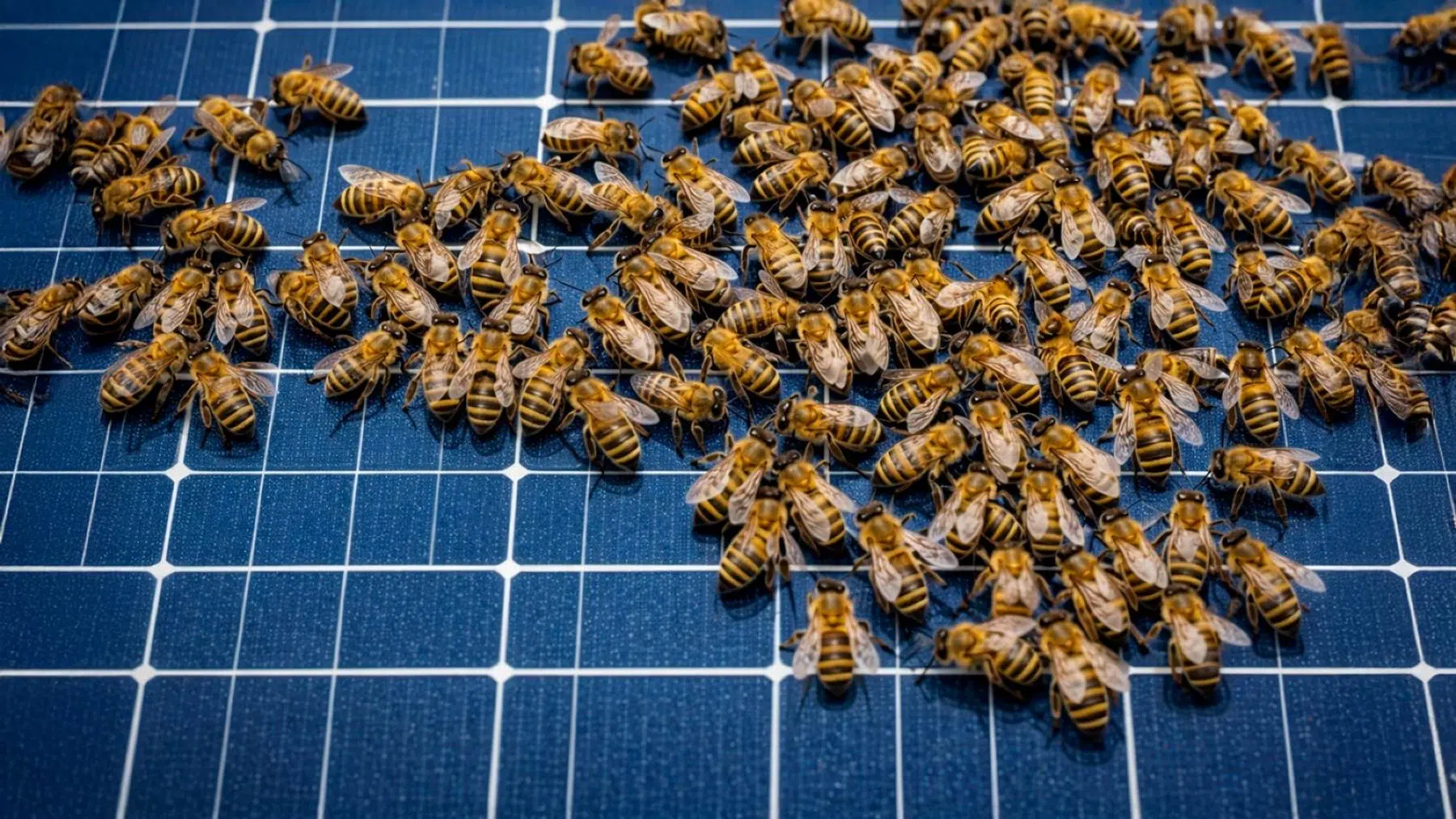
Solar panels have a dark side that nobody is talking about.
It stands to reason that the longer a “new” technology is around, the more we’ll learn about it. This applies to the good and the bad. Now, while we’re excited about renewable energy and its increasing accessibility to the average person, there are some negatives coming to light.
What’s going on with the honeybees and the solar panels?
Bees and solar panels “know each other”
Yes indeed, bees and solar panels do in fact “know each other.” The universal truth is that nature and mankind impact each other’s environment, and now, honeybees and the plethora of solar panels in the United States have developed a “relationship.”
Bees think nothing of the power that we draw from solar panels. They’re just interested in the warmth and shelter they find behind them — a seemingly ideal place to swarm and build hives.
On the surface, this looks like a positive effect. What’s wrong with the bees “beeing happy” if the panels continue to operate as they should?
But if we look deeper — in fact, at something invisible — there’s an unintended process happening involving the solar installations.
Environmental studies show that what’s happening between them is not beneficial to the bees or the greater ecosystem. Experts are monitoring another implication of solar panels that was recently revealed.
The problem: A strange magnetic field
Solar panels emit an electromagnetic field that is neither dangerous nor harmful to our health or that of any fauna or flora.
The field that solar panels produce is an extremely low-level, non-ionizing electromagnetic force, known as an EMF. The radiation is similar to that found in most common household appliances.
Research shows us that these fields pose no threat to our health — or the honeybees’ health, for that matter. In fact, bees make use of a natural electromagnetic field in nature to navigate their surroundings. They are able to sense the Earth’s magnetic field with an organ in their bodies that works like a tiny, built-in biological compass needle.
But now, in a world populated by our appliances, the EMF emitted by solar panels is connecting them to bees and in a way, influencing their behavior even though it doesn’t damage their health.
What’s happening to the bees?
According to a recent study, bees may become disoriented by any electromagnetic disruption.
The research found that artificial EMFs may disrupt the honeybees’ ability to navigate the world, and could even cause forager bees to get lost and never find their way back to the hive.
In the worst cases, honeybee hives may not have enough foragers to survive.
This could have far-reaching implications, seeing as bees are a vital cog in the wheel of the environment and are needed for plant pollination.
At the University of Talca in Chile, one researcher found that bees that were subjected to electromagnetic fields saw a drastic increase in body heat — or, more specifically, a physiological stress response.
This response makes it significantly harder for the bees to pollinate and navigate the world. While other researchers have made alternative findings, it’s still clear that the EMFs emitted by solar panels are affecting these essential insects, and we don’t know to what exact extent yet.
Some estimates predict that if bees were to go extinct, the world’s ecosystems would fall apart in as little as four years.
Every solar panel owner needs to understand their role and keep the bees that pollinate our flowers in mind when purchasing their solar panel array. What part do you play in maintaining your environment in harmony?
Read the whole thing?
Get the week's signal, not the noise
Our sharpest reporting on energy, climate and nature — free, once a week.


