It has been hanging in the night sky for as long as anyone can remember, the seventh planet from the Sun, bigger than you think and bluer than most people imagine.
Most of us learned its name in grade school and moved on.
But the planet everyone thought they understood has been keeping a family of secrets, tucked inside rings so dark they are barely visible from Earth.
What astronomers just found inside those shadows is forcing them to rethink the whole census of one of the most overlooked worlds in the solar system.
A planet on its side, spinning through the dark
Uranus rotates at a roughly 98-degree angle from the plane of its orbit, which makes it appear to spin sideways, like a rolling ball.
Picture a top that fell over and never got back up.
That bizarre tilt is just the beginning of what makes this world strange.
It carries two sets of rings. The inner system consists mostly of narrow, dark grey bands, while the two outer rings are something else entirely: the innermost is reddish, and the outermost is a rare, striking blue.
Dark and invisible to the naked eye, those rings held on to their secrets for a very long time.
They were only discovered in 1977, when they were noticed blocking the light of background stars during stellar occultations.
The only visitor that ever came close
For nearly four decades, just one spacecraft had ever laid eyes on this place up close.
NASA’s Voyager 2 probe traveled past Uranus in January 1986, becoming the first and, to this day, the only spacecraft ever to have visited the distant ice giant.
When Voyager 2 arrived, astronomers knew of five moons.
The spacecraft found 10 more, including moons with names like Juliet, Puck, Cordelia and Ophelia, with the largest of the new finds, Puck, spanning roughly 90 miles across.
Those names are not an accident.
While most satellites orbiting other planets take their names from Greek or Roman mythology, Uranus’ moons are named for characters from the works of William Shakespeare and Alexander Pope.
A literary solar system, spinning in the dark 1.8 billion miles from the Sun.
The crowded neighborhood nobody could see clearly
Even after Voyager 2’s visit, the count kept rising, slowly.
Advances in astronomy and the Hubble Space Telescope enabled scientists to spot a further 13 moons far smaller than the big five.
But the inner region closest to the rings remained a puzzle.
This region is so crowded that astronomers do not yet understand how the little moons have avoided crashing into each other.
Some may act as shepherds for the planet’s narrow rings, and scientists suspect there must be more moons, still interior to any known ones, to confine the ring edges.
The suspected moons were tiny, as little as 5 to 6 miles across, and blacker than asphalt, sitting nearly 1.8 billion miles from the Sun.
No telescope on Earth or in orbit was sensitive enough to see them, until a far more powerful eye turned their way.
A 6-mile world hiding in plain sight among the rings of Uranus
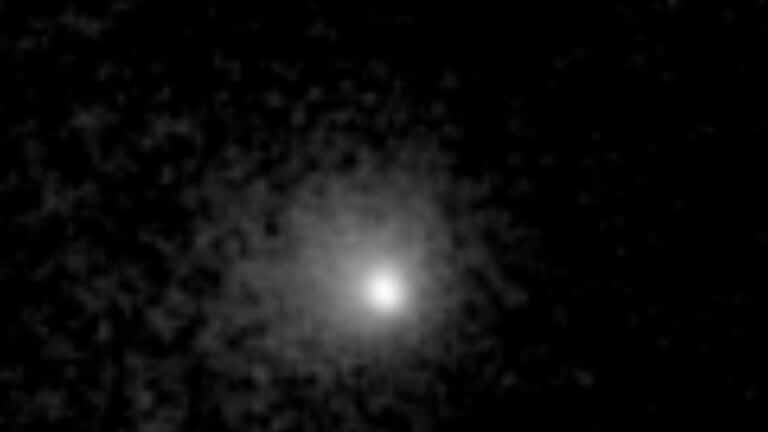
Using NASA’s James Webb Space Telescope, a team led by the Southwest Research Institute identified a previously unknown moon orbiting Uranus, detected during a Webb observation on February 2, 2025.
The newly discovered moon is estimated to be just six miles, or about 10 kilometers, in diameter.
Six miles across: roughly the distance from one end of a mid-sized American city to the other, adrift in space 1.8 billion miles away.
That tiny size made it invisible to Voyager 2 during its 1986 flyby, and undetectable by every telescope that followed.
Its discovery brings the total number of known Uranian moons to 29.
Observations suggest that small mysterious moons are the source of the particles making up the two outermost rings, and that there are probably even more undiscovered moons waiting to be found, according to researchers studying the ring system.
Scientists studying lost planets and hidden ring systems now believe the Uranian rings are a map, written in dust and ice, pointing toward worlds still waiting to be named.
The ice giant that keeps rewriting its own story
Scientists have found evidence that four of the larger moons, Ariel, Umbriel, Titania and Oberon, could have internal oceans sealed under miles of ice.
An ocean in orbit around a planet most people only half remember from school.
Studying Uranus may help scientists understand how planets and rings form and how life’s ingredients end up on icy worlds far from the Sun.
Returning to Uranus was named the top planetary priority in the most recent Decadal Survey from the National Academy of Sciences.
No dedicated spacecraft has been funded yet, and the full picture of this hidden moon family may take years more to assemble.
But a 6-mile speck found inside ancient ring shadows, with Shakespeare’s characters orbiting on all sides, is already one of the most astonishing things the solar system has shown us in a long time.
The planet everyone moved past in grade school has been keeping score ever since.
Read the whole thing?
Get the week's signal, not the noise
Our sharpest reporting on energy, climate and nature — free, once a week.