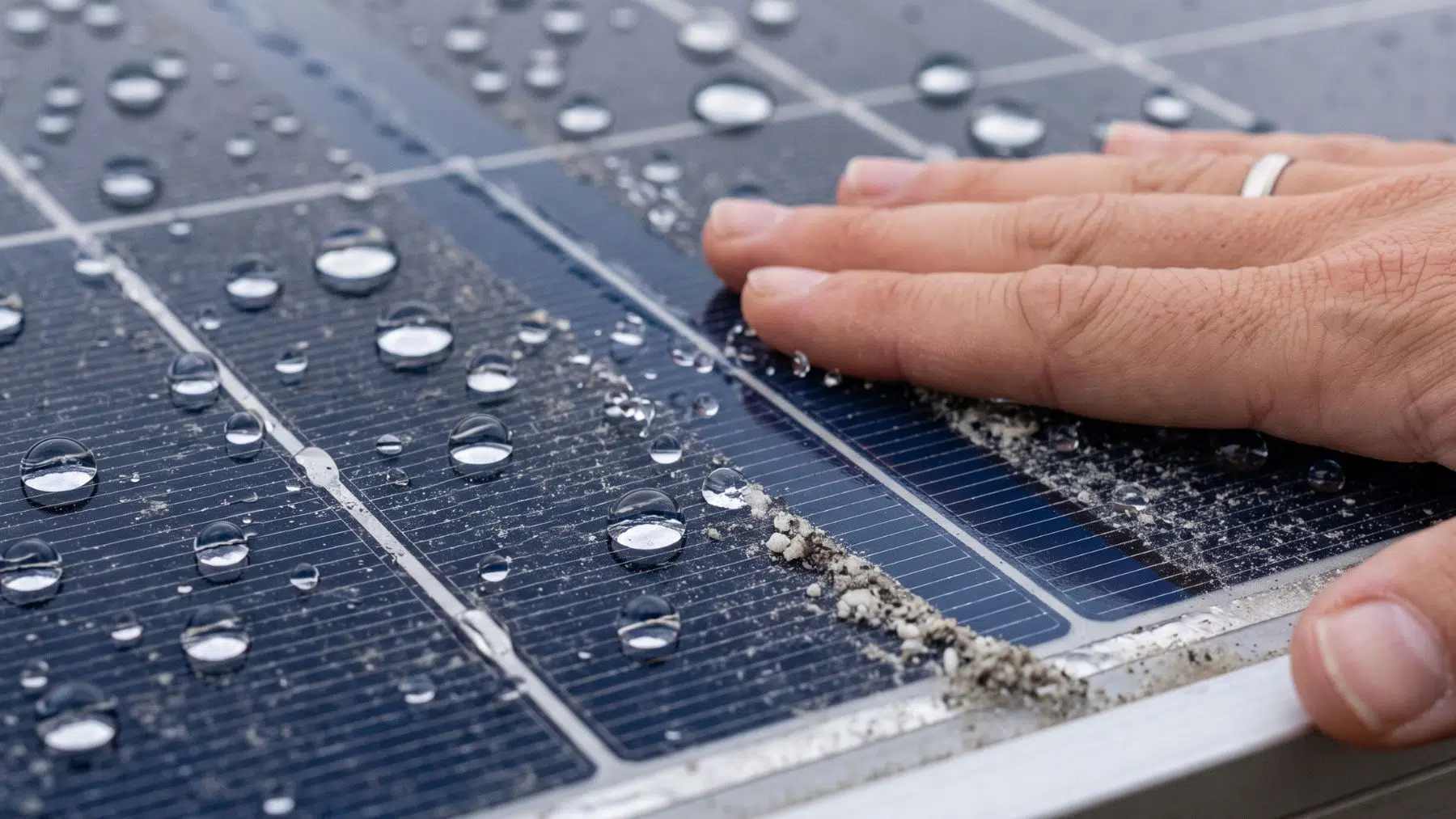
Rain falls on a solar panel and mostly smears the dirt around.
That is the everyday reality of solar panels tilted at the sky.
Water spreads, dries, and leaves the grit exactly where it was.
Coat the same glass with something rough enough at a microscopic scale and the water stops spreading.
It balls up instead, and rolls.
What it takes with it on the way down is the entire point.
What the readout actually said
A team working across Scotland, China and India put a two layer silica coating on a test cell and measured it. Efficiency went from 13.90 percent to 14.56 percent.
That is a relative gain of 4.75 percent, and the distinction matters.
The cell did not jump five points. It produced 4.75 percent more power than before, which is 0.66 of a percentage point in absolute terms, and nobody touched the cell itself. The improvement is entirely a matter of keeping the glass face clean.
The surface numbers explain how. Water sits on the coating at a contact angle of about 154 degrees, meaning it barely wets the surface, and it starts sliding at a tilt of 1.5 degrees. Light transmission stays at 96.2 percent, so the coating gives away almost nothing on the way in.
Two layers, and no forever chemicals
The recipe is unglamorous. A hydrophilic silica sol goes down first as a base that grips the glass, and a layer of hydrophobic silica nanoparticles goes on top, built from tetraethyl orthosilicate, ethanol and ammonia.
The roughness of that top layer is what does the work.
“The microscopic roughness created by these particles traps air at the surface, causing water to bead up and roll off,” said Sudhagar Pitchaimuthu of the Scottish team. A droplet is effectively sitting on a cushion of trapped air rather than on the glass, so it never gets a grip.
Most commercial water repelling treatments reach the same result with per and polyfluoroalkyl substances, the compounds that never break down in the environment or in a body. This one uses none. “Silica is an abundant, low cost and environmentally benign material derived from widely available resources,” said lead author Shanhu Liu, and with regulators on both sides of the Atlantic moving against those compounds, a fluorine free route is worth money.
Why droppings beat dust as a problem
Dust is the enemy everyone pictures, and it is annoying, but it is also thin, even and washable. A bird dropping is none of those things.
It is thick and opaque, and it bonds to glass.
Measured on real modules, a dropping knocks output down hard. One study recorded a 23.8 percent drop in power, and another found four droppings on a single module cut current by 36 to 38 percent while barely touching voltage. The blocked area also runs hot, which is its own problem for the cell underneath.
The reason a small stain does outsized damage is the wiring. Cells are strung in series, so a single shaded cell drags the whole string down with it, and a panel does not lose the fraction of its surface that is covered. It loses more.
The part that could actually matter
New coatings usually arrive with an unspoken catch, which is that they only work if applied during manufacturing. This one is being designed the other way around.
“We have designed the coating so that it can be applied retroactively onto solar cells, as well as new panels,” Pitchaimuthu said.
If that holds up outside the lab, the addressable market is not next year’s panels but the hundreds of gigawatts already bolted to roofs and desert floors. A co author in India said the team should have a product on the market within five years if not sooner, and the announcement sets out the wider aim of cutting maintenance rather than chasing output.
Cleaning is a genuine operating cost anywhere panels sit still, and the same logic drives design at an offshore wind farm, where sending a crew out is far harder than across a field.
What is still unproven
This was a laboratory cell, not a field panel through a winter. Durability under hail, sand, thermal cycling and years of ultraviolet is the question that kills most coatings, and it has not been answered here. The measurements are a starting point, not a product.
There is also a question nobody has tested yet.
Panel glass throws off polarized reflected light that water birds read as open water, a trap ecologists have documented for years, and birds landing on an array is exactly how droppings get there in the first place. Whether a beaded surface changes that signal is unknown, and worth knowing, because arrays already reshape what lives around them and even a resident fox treats one as habitat.
Either way, the appeal here is not the efficiency number. It is that a fix made of sand might take over a job currently done by a truck and a hose.
Read the whole thing?
Get the week's signal, not the noise
Our sharpest reporting on energy, climate and nature — free, once a week.