The first cell came through in the late afternoon and the last one arrived in the dark, and the whole sequence took under twelve hours.
What fell out of it ran from gumball to grapefruit.
Four big arrays sat under that track, all inside a nine mile circle.
One of them woke up to a field of glass.
The other three were essentially untouched.
So what did those three do that the fourth did not?
Why the same hail breaks one array and not the next
The answer is an angle.
Panels on a single axis tracker spend the day rotating to face the sun, which means they can also be told to rotate somewhere else.
Point them nearly vertical and a falling stone stops hitting the glass square.
It arrives at a steep glancing angle instead, and only a fraction of its energy transfers into the sheet.
The rest of it skids off.
That maneuver is called hail stow, it is triggered off a forecast, and the three arrays that survived were sitting at 52 degrees when the stones came down.
One of those three still lost about forty modules.
Not randomly: a motor fault left that one section lying flat while everything around it stood up, and the flat ones broke.
It is as clean a side by side as anyone could ask for.
The county underneath the storm
Fort Bend County sits southwest of Houston and now carries more than 1.2 gigawatts of utility scale solar.
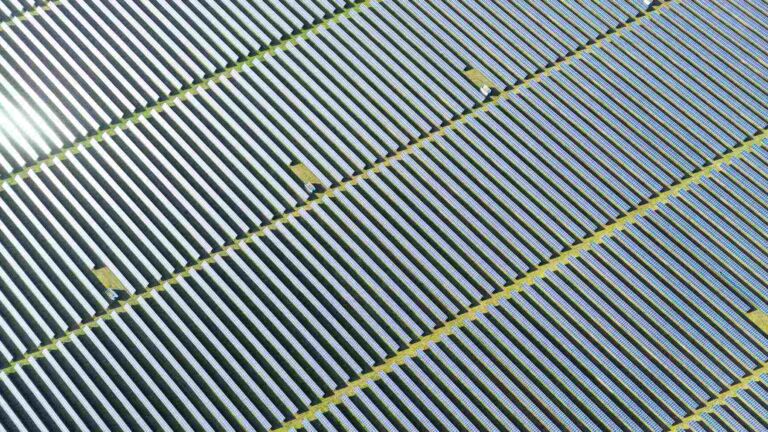
The solar farm at the center of this holds 350 megawatts across 3,300 acres, enough for roughly 62,000 homes on a hot afternoon.
Three others operate within a few miles of it.
Hail country is not a surprise here. It is the reason the trackers have a stow mode in the first place.
What arrived that night was still exceptional.
The first two cells brought stones between about an inch and three inches with gusts near 51 miles an hour.
The third came through in the small hours and dropped stones past four inches, which is the size the weather service calls giant hail.
What the forensic numbers say
The storms hit on March 15 and 16 of 2024, and the analysis landed the following January.
Engineers set a severity threshold at 2.5 inches, the size expected roughly once in 500 years at that location.
All three storms cleared it.
The worst hit array saw stones above four inches; its neighbors saw between 1.6 and 4 inches and came through with no direct hail damage at all beyond that one unstowed section.
Set that against the test every module already passes.
The standard hail check fires a one inch ice ball at 51 miles an hour into eleven spots on the panel, and the module passes if the glass holds, output drops under 5 percent and it survives a wet leakage test.
A four inch stone carries roughly sixty times the mass of that ice ball.
The certification is a floor. It was never a hail rating.
What stow cannot do
Stowing is not a free upgrade bolted onto any project.
It needs trackers, so a fixed tilt array cannot do it at all.
It needs a forecast trigger that fires early enough, motors that answer, and someone watching overnight.
It also costs output every hour the panels are standing on end rather than tracking, which is a live argument during a summer peak.
And it is imperfect by design: the engineer who ran the forensic review pointed out that stowing away from the wind would be better still, except nobody can predict wind direction during a hail fall.
None of that changes the outcome here, where the arrays that stowed kept their glass.
Nor does it change what happens on the ground, where the seeded strips between rows go on growing regardless of what the trackers are doing above them.
The bill, the glass and the rumor
Hail is the largest single contributor to insured solar losses worldwide, and the benchmark is older than this storm.
A West Texas project lost about 400,000 of its 680,000 panels to hail in 2019, roughly a $70 million insurance claim.
Manufacturers have responded with front glass rated to 1.8 inch stones, and broken modules now feed plants that pull the glass, aluminum and silver back out, though recycled panels still leave one plastic layer nobody separates cheaply.
One thing that did not happen was contamination.
The damaged modules were silicon, contained no cadmium telluride, and the operator stated it had identified no risk to the local community or the environment, a correction that traveled far less widely than the claim it answered, as trade coverage noted at the time.
The story that spread was poison in the soil.
The story that mattered was a tracker angle.
Read the whole thing?
Get the week's signal, not the noise
Our sharpest reporting on energy, climate and nature — free, once a week.