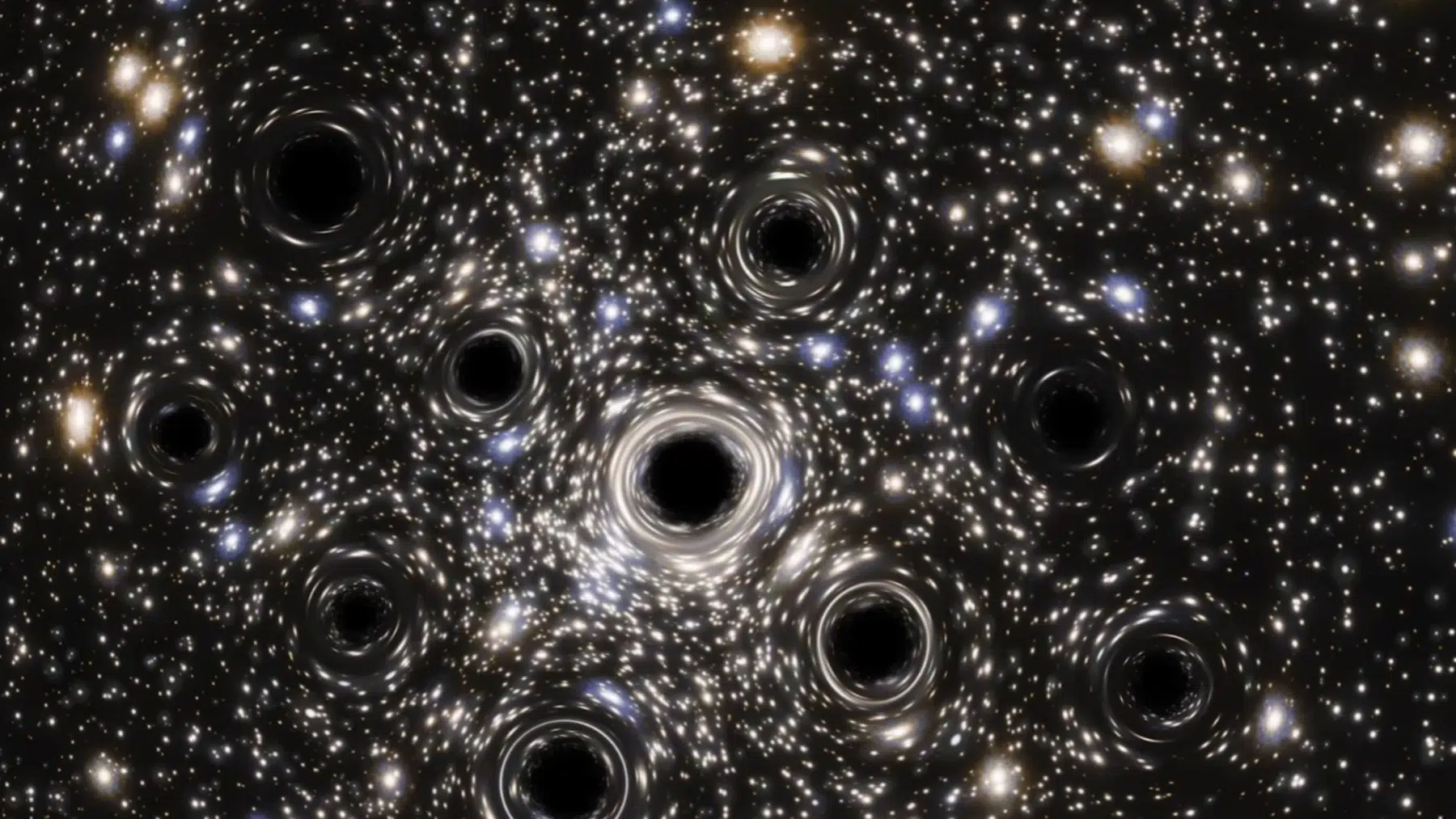
The European Space Agency’s Gaia spacecraft has helped discover more than 100 stellar-mass black holes in the Milky Way’s Palomar 5 star cluster, which is a startling discovery. Nature Astronomy published this discovery. Researchers have made this celestial finding using sophisticated data from the European Space Agency’s Gaia spacecraft.
Once hidden away in old star clusters, these black holes suddenly become mysterious objects that change our perception of the cosmos. About 80,000 light-years from Earth, Palomar 5 is a distinctive star cluster that spans 30,000 light-years. Palomar 5 stands out because of its loose, dispersed formation and extended tidal stream—a large river of stars following it—while globular clusters like this one are usually compact, spherical collections of stars.
Undiscovered giants in old star clusters: Gaia’s revolutionary discovery
Recently, the Gaia telescope—which was built to survey the Milky Way with unprecedented precision—discovered more than 100 hidden black holes in the remains of old star clusters. These black holes, which are the remains of huge stars that have imploded, are dispersed throughout the galaxy and reside in gravitational isolation. The fact that they are invisible to conventional observation techniques emphasises how crucial state-of-the-art technology is to discovering such phenomena.
The fact that these black holes are found in areas that were previously thought to be devoid of substantial activity is what makes this discovery noteworthy. This poses fresh queries regarding the dynamics of old star systems and how black holes shaped them. Researchers are now focusing more on the effects of these elusive things on their environment and the ramifications of their pervasiveness.
Why are these black holes wandering the galaxy?
These smaller, rogue black holes travel through space without a core gravitational tether, in contrast to the supermassive black holes that serve as galaxies’ anchors. Scientists think that strong gravitational interactions within star clusters are the cause of this roaming behaviour. Black holes currently live a solitary, nomadic existence since they frequently launch one another into intergalactic space when they originate.
This finding broadens our knowledge of star evolution while also adding to our collection of black holes. Scientists aim to learn more about the violent dynamics that create star clusters and the galaxy as a whole by pursuing these roving giants. Astronomers are excited about the finding that black holes are prevalent in globular clusters. It is believed that many black hole mergers, which happen when black holes collide, originate in these areas.
What this signifies for our knowledge of the universe
Long-held beliefs about the composition and behaviour of the Milky Way are called into question by the discovery of more than 100 renegade black holes. It draws attention to the galaxy’s complexity by demonstrating how many of its activities take place outside the purview of conventional observers. The overall number of black holes in the cosmos and their impact on cosmic development are other urgent issues raised by these results.
Furthermore, since black hole interactions frequently result in spacetime ripples, this discovery has ramifications for our understanding of gravitational waves. By examining these rogue black holes, researchers could improve models that forecast such occurrences, deepening our understanding of the most enigmatic phenomena in the cosmos.
According to the team’s simulations, the cluster will totally vanish in about a billion years. The remnants of the cluster will be made up entirely of black holes that circle the galactic centre just before this. This implies that Palomar 5 is not special after all; like other objects we have found, it will entirely melt into a star stream. It also implies that other globular clusters will probably eventually suffer the same fate.
Read the whole thing?
Get the week's signal, not the noise
Our sharpest reporting on energy, climate and nature — free, once a week.