How many of us have ever attempted to imagine how vast the universe is? From our point of view, the universe is a large and endless spread with tiny blinking objects. However, like everything around us, objects in the universe exist within a concept of scale. In today’s article, we discuss what scientists believe is the largest class of objects within the universe.
A brief overview of galaxy clusters within the universe
Astronomy is a practice that has existed for centuries. In those many years, one concept that has never been taken lightly is the concept of scale. Given how large the space is, every object within its expanse is always qualified under scale. However, this scale is influenced by all things, including mass, volume, gravitational pull, and temperature.
This means that, whenever astronomers come to describe something as large, it means the object has defied assessments on these various categories. In a recent observation, a team of scientists has studied a cosmic phenomenon that fits the narrative. These are called galaxy clusters.
According to scientists at NASA, galaxy clusters are the largest entities in our universe. They are held together by gravity in a group of several thousand galaxies. However, because of their massive sizes, clusters often act as cosmic monsters, containing enormous amounts of dark matter and gases at extreme temperatures.
What scientists’ observations reveal about galaxy clusters
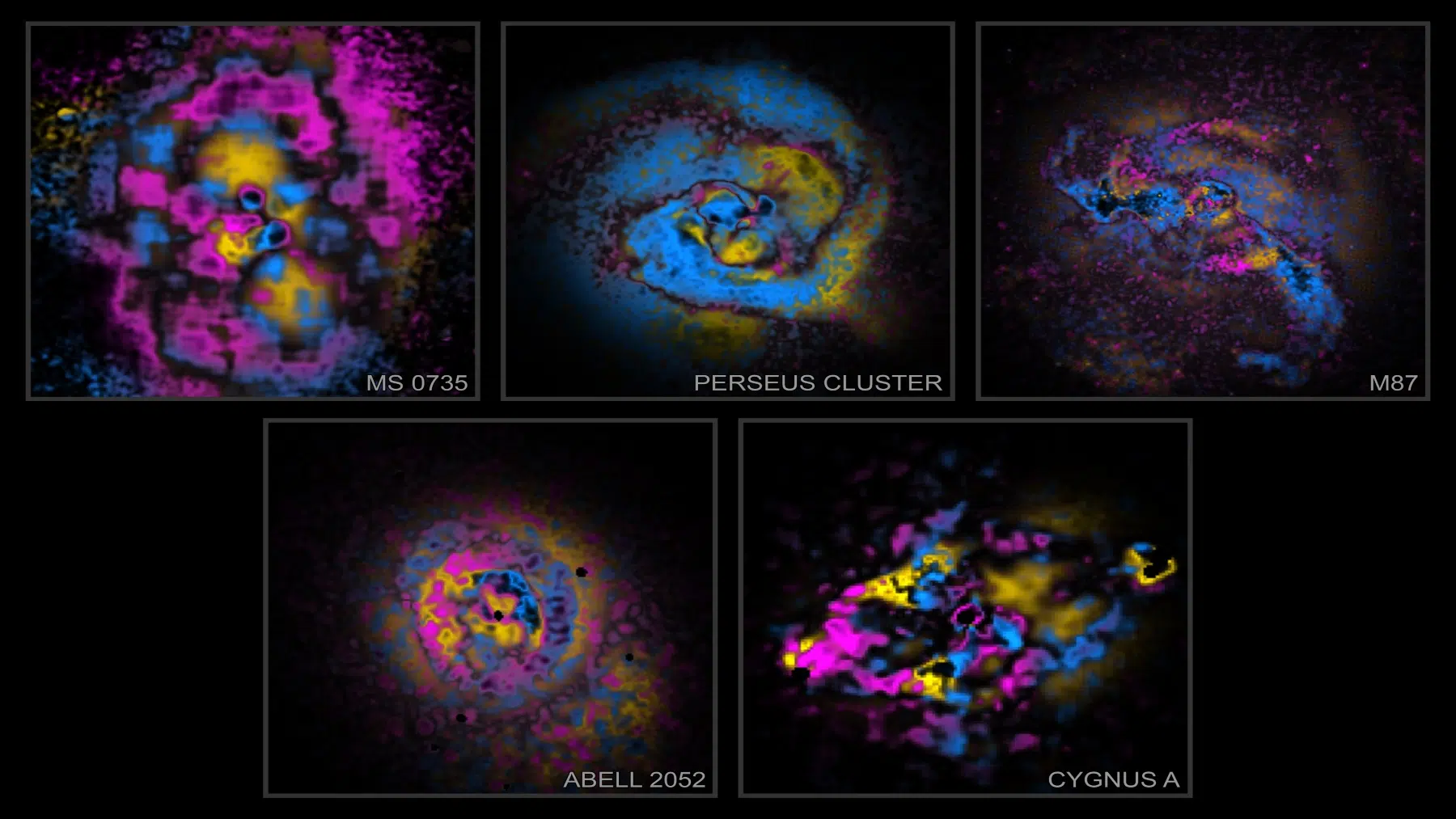
Over the past decade, NASA’s Chandra X-ray Observatory has reported on several galaxy clusters in its mission. Through the observatory, NASA has observed these clusters to be an arrangement of individual galaxies in a huge reservoir of superheated gases. Most of these gases emitted X-rays, and their temperatures were as high as 100 million degrees.
In addition, the mass of these hot gases was observed to be significant — making up a substantial portion of the total mass of their respective galaxy clusters. Moreover, these galaxy clusters host supermassive black holes at their centers that periodically erupt into space jets. Like most jets, however, they are visible in radio wavelengths and deposit energy into their surroundings.
During their observation, scientists struggled to take apart the complex structures surrounding galaxy clusters, like the galactic fossil wandering the universe. This led them to develop a processing technique called X-arithmetic. What this technique does is classify the images captured by their nature rather than how they appear. So far, X-arithmetic has been applied to 15 galaxy clusters.
The difference between galaxy clusters and groups
In this study, galaxy clusters were observed to have large regions of cooling but slow-moving gas near their centers; also, only a few clusters had shock fronts. In contrast, galaxy groups showed multiple shock fronts at their center and a small amount of cooling, slow-moving gas within that region.
What galaxy clusters say about the universe
The recent study on galaxy clusters has opened scientists’ eyes to a part of the universe often left unnoticed. It allows them to understand more about galaxies and how they are distributed across the universe. More than that, it also helps us understand the influence of gravity within the underlying structures of the universe.
Through this observation, we are able to understand how galaxies in their numbers make up the biggest entities in the universe. Most of the dark matter within the clusters was measured indirectly using techniques such as lensing. This means that scientists need to understand galaxy clusters before they can comprehend dark matter.
There is a wealth of information yet to be uncovered about galaxy clusters. However, scientists and astronomers are limited by available technologies and tools. Going forward, NASA has begun developing advanced tools that would aid further observations into galaxy clusters and the universe at large, like this mysterious discovery, defying the laws of the universe.
Read the whole thing?
Get the week's signal, not the noise
Our sharpest reporting on energy, climate and nature — free, once a week.