We measure time constantly — yet physicists still don’t fully understand what it actually is. Einstein showed that time doesn’t tick at a uniform rate for everyone. Quantum mechanics pushes further, suggesting a clock could theoretically exist in a superposition of multiple flows of time at once. No experiment has ever captured that effect directly.
A new theoretical approach developed by an international research team may have just opened the door.
The strange frontier where quantum physics meets relativity
Einstein’s theory of relativity established something deeply counterintuitive: time doesn’t tick at the same rate everywhere. Clocks run slower in stronger gravitational fields and at higher speeds. That isn’t a quirk of measurement — it’s how time actually behaves.
Quantum mechanics adds another layer of strangeness. It allows objects to exist in “superposition,” occupying multiple states at once. Apply that to a moving clock and things get genuinely unsettling: if motion affects time, and a clock can be in a superposition of multiple motions, it could theoretically experience multiple rates of time simultaneously.
That predicted effect — the quantum superposition of time — sits at the intersection of the two most successful theories in physics. It has never been directly observed. Until now, no experiment has been sensitive enough to catch it.
Why atomic clocks are the right tool for the job
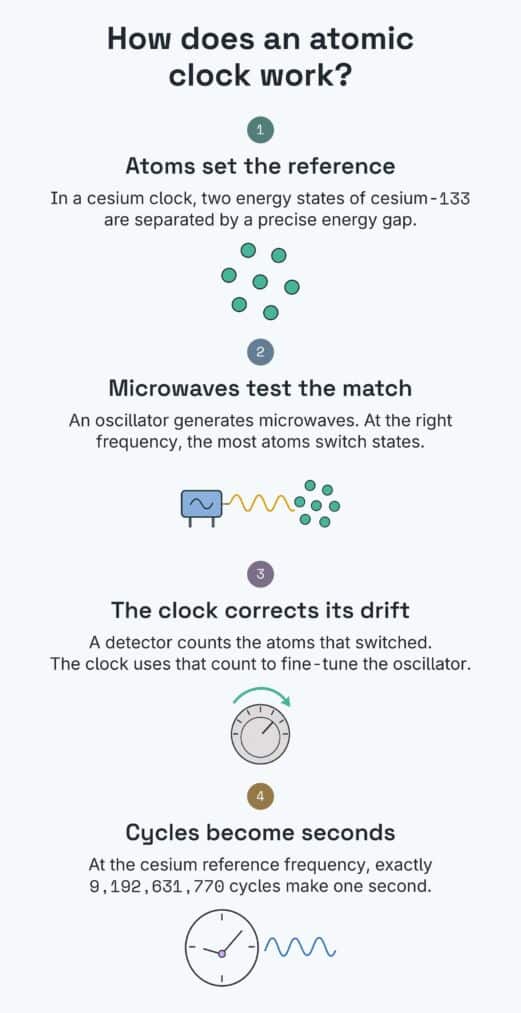
Atomic clocks don’t rely on gears or pendulums. They measure time using the extraordinarily consistent frequencies of atoms — a method so stable it makes them the most precise timekeeping instruments ever built.
That precision already has real-world consequences. GPS systems depend on atomic clocks to calculate locations accurately; without them, navigation errors would compound within minutes. Modern atomic clocks can now detect tiny time-dilation differences across just a few millimeters — remarkable sensitivity that makes them natural candidates for probing quantum effects previously just beyond experimental reach.
Entanglement as the key: how the new method works
The research team identified a specific mechanism that could make the quantum superposition of time detectable. A clock’s quantum motion, they found, can become entangled with its internal energy. In quantum physics, entanglement links two properties so tightly they can no longer be described independently — and that linkage produces measurable changes in the clock’s quantum behavior.
A detectable signature, in other words.
“The signature of this entanglement is that the clock itself loses some of its quantum properties, which can be detected using modern techniques,” explains Associate Professor Joshua Foo of Kyushu University.
The team also developed a new technique for controlling the clock’s motion, boosting sensitivity to this effect by 100 to 1,000 times. That’s a leap large enough to bring a vanishingly subtle phenomenon within reach of existing atomic clock technology.
An international collaboration and a published framework
The study was published in Physical Review Letters and led by Kyushu University. Collaborating institutions include Stevens Institute of Technology, the University of Waterloo, the National Institute of Standards and Technology (NIST), Colorado State University, and Stockholm University.
The work is currently theoretical. Foo is direct about what comes next: “Bringing our theoretical model to reality is the big next step, and developing a detailed experiment that accounts for real-world unpredictability will give us further insight into our model.” Translating that framework into a functioning laboratory experiment means accounting for noise, disturbances, and the uncertainties that real-world conditions introduce — a significant engineering challenge, though not, the team suggests, an insurmountable one.
What success could mean for physics — and beyond
A successful experiment would mark the first direct observation of the quantum superposition of time. That alone would be a landmark in fundamental physics — confirmation of a predicted effect that has existed only in theory.
The implications reach further still. Foo notes that the team is exploring whether atomic clocks could eventually probe quantum gravity — the long-sought framework that would explain how gravity behaves at the smallest scales of nature. Unifying quantum mechanics and general relativity has resisted roughly a century of effort, and new experimental tools could shift that. The method might also drive development of even more precise atomic clocks, with practical benefits well beyond fundamental research.
What the team has built is a theoretical bridge pointing toward experiments that were, until recently, untestable. Whether the results confirm the prediction or surface something unexpected, they’ll push the boundary of what physics can actually measure. That’s worth watching closely.
Read the whole thing?
Get the week's signal, not the noise
Our sharpest reporting on energy, climate and nature — free, once a week.