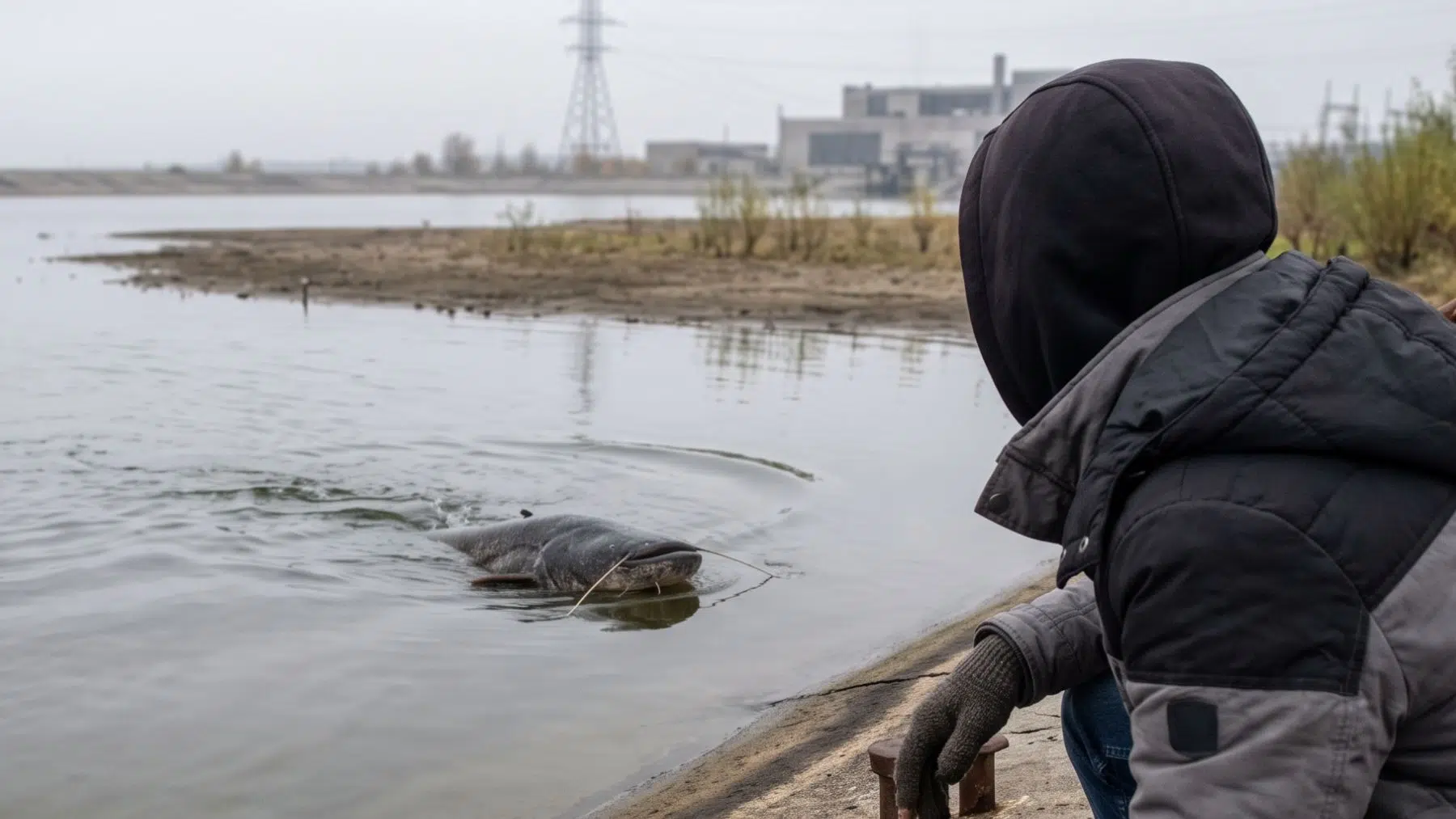
A shape the size of a bench turns just under the surface of the reservoir beside the Chernobyl plant.
Visitors film it, and the footage travels under a caption about radiation and a mutant fish.
The Chernobyl catfish is one of the most reliably wrong animal stories on the internet, and the correction is more interesting than the myth.
The largest specimen ever taken from that water for measurement was 5 feet 5 inches long.
That is a big animal and a completely normal one for the species, which is a wels catfish.
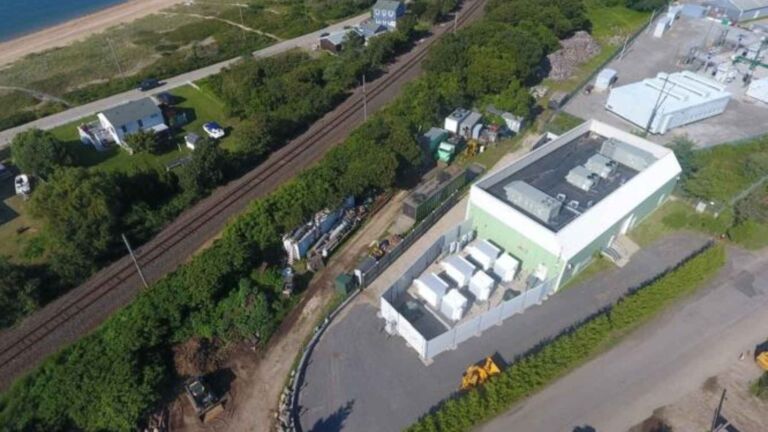
The reservoir around it is the stranger subject, because it was never a lake and was never meant to outlive the plant.
It has outlived the plant anyway, and it is currently in the process of disappearing.
What the pond was actually built to do
The dates in most retellings are off by a few years, and the order matters.
Filling began in 1976, before a single reactor at the site had produced any power.
Units 1 and 2 came online in 1977 and 1978, and the pond was enlarged in 1981 to carry Units 3 and 4, which followed in 1983 and 1984.
So it did end up serving four reactors, but not from the start and not by original design.
At full size it covered roughly 9 square miles, held about 40 billion gallons, and averaged 22 feet deep with a maximum near 61 feet.
The odd part is the elevation. The whole thing sat about 23 feet higher than the Pripyat River running alongside it.
The pumps ran 13 years past the last reactor
A pond perched above a river only stays there while something keeps pushing water uphill.
The last operating reactor was shut down in December 2000, and the usual version of the story ends the pumping there.
It did not end there. The pumping station kept topping the reservoir up from the Pripyat until May of 2014.
Only then was it switched off and the level allowed to fall, on purpose, as part of decommissioning.
Planners expected roughly 70 percent of the bottom to come up out of the water, which is about 6 square miles of exposed sediment.
Willow and birch have moved onto the drained margins, and the pond is now a set of pools rather than one body of water.
How big the fish really are
Wels catfish did not arrive because of anything that happened in 1986.
They were already in the Pripyat River, and the pond is simply warm slow water connected to their home range.
What changed is that nobody has been allowed to fish there for decades, and no larger predator uses the reservoir.
The species record stands at about 9 feet and 287 pounds, with a maximum reported age of 80 years.
Those are the outer limits for wels catfish anywhere in Europe, not a Chernobyl figure, and the pond’s fish sit well below them.
The reserve’s own ecologist puts it in one line, which is that the longer they live, the bigger they get.
What the radiation work actually found
Two studies get quoted about these fish, and they are usually merged into one claim that neither of them makes.
The first, from 1996, looked at channel catfish, an American species stocked into Soviet cooling ponds because the warm outflow suited it.
Those fish showed measurable DNA strand breaks, and the amount of damage tracked the radiocesium load in each individual animal.
The second, published in 2018, sampled perch and roach across eight lakes and found both species in surprisingly good general health, as the assessment of the site records.
But it was not a clean bill. Perch in the most contaminated water showed delayed gonad maturation and undeveloped phenotypes, while roach did not, as that work set out.
Neither paper measured a catfish that had grown large because of radiation, because no paper has.
Why the size story keeps coming back
Part of it is the camera. A catfish filmed from a bridge, close to the lens, with nothing beside it for scale, reads as enormous on a phone screen.
Part of it is that the fish come to people, since visitors feed them from the same spots and the animals have learned to wait there.
The rest is that the real explanation is less satisfying than the mutation one.
An old fish in unfished water grows to the size its species always could, which is the same pattern seen around an offshore array or inside a fenced solar site.
What makes this pond unusual is not the wildlife in it but that the water itself is on its way out.
The catfish are living in a reservoir that is being switched off around them, one drained margin at a time, and nobody wrote a plan for that.
Read the whole thing?
Get the week's signal, not the noise
Our sharpest reporting on energy, climate and nature — free, once a week.