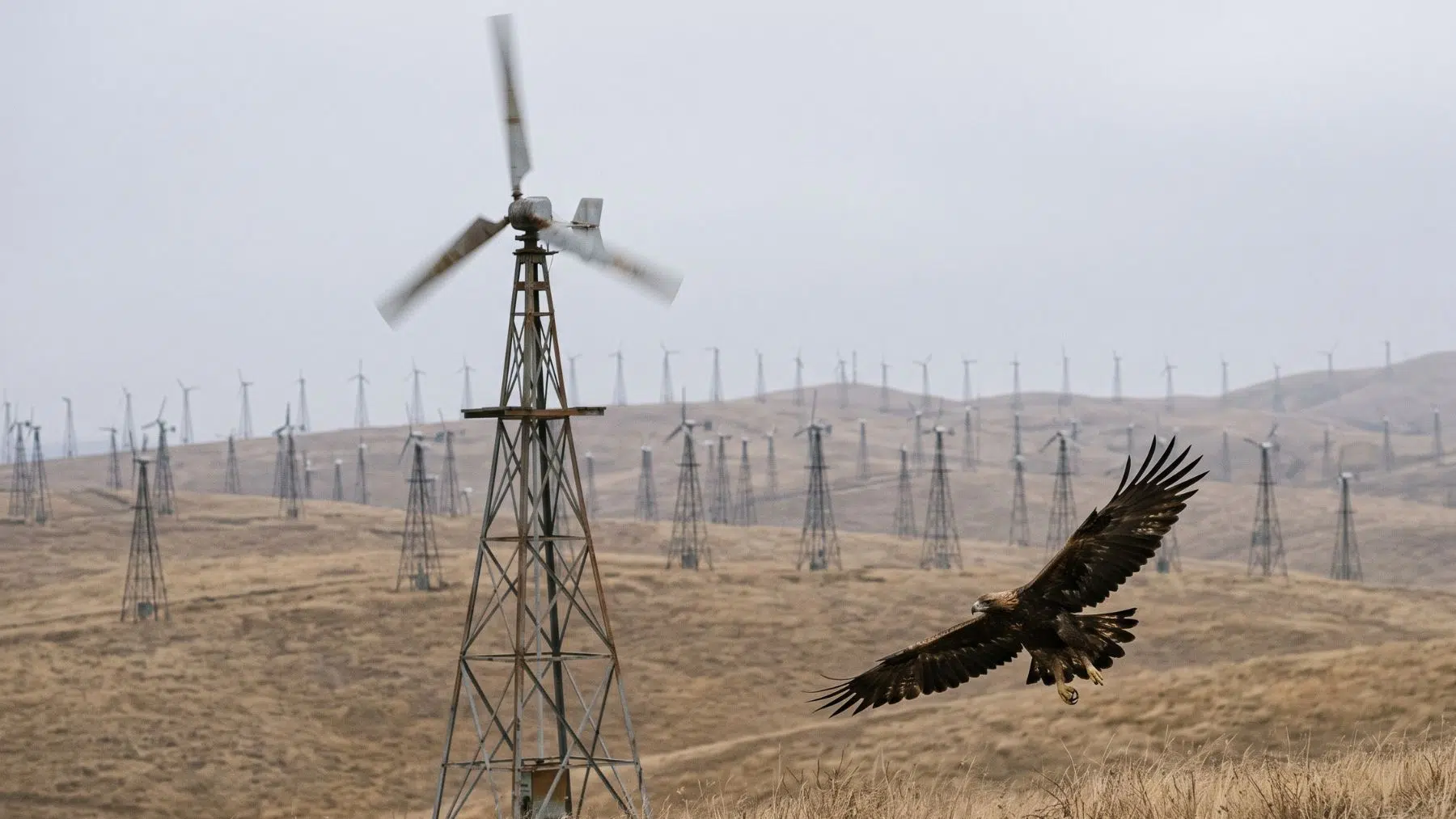
In the golden hills east of San Francisco, a golden eagle tips its wings into the afternoon wind.
This ridge has belonged to eagles and hawks longer than anyone can remember.
Then thousands of small wind turbines sprouted across the same slopes.
Their blades spun fast and low, right where the raptors hunt.
For years, it was one of the deadliest places on earth for a bird of prey.
So what do you do when a clean energy site kills the wildlife around it?
The most dangerous wind farm in the world
Altamont Pass earned a grim title. Its old turbines killed more birds of prey than any wind site on earth, close to a thousand raptors a year at their worst, and they did it in a place packed with rare birds. The toll ran on for decades.
The list of the lost was staggering.
Every year the blades took dozens of golden eagles, along with red tailed hawks, kestrels, and several hundred burrowing owls. This was not a scatter of bad luck but a steady drain of raptors in one of the richest raptor regions in North America.
The trouble was not just how many died but where. Altamont sits on a narrow wind gap that funnels hunting and migrating raptors through a tight corridor, so the birds and the blades were forced into the same thin band of sky.
A ridge built for eagles long before the turbines
The eagles were here first, and for good reason. The Diablo Range that runs through the pass is prime raptor country, with strong updrafts to soar on and hillsides thick with ground squirrels to hunt. Few places in the country feed so many big birds.
A nesting golden eagle needs a lot of room, and this range offers some of the best hunting ground anywhere.
The area holds one of the densest concentrations of nesting golden eagles on the continent, birds that soar for miles scanning the grass below. When the turbines went up across that same wind swept ridge, they landed in the worst possible spot, right in the flight path of thousands of raptors.
None of that was a secret when the towers went up. The pass was known as a raptor stronghold long before the first turbine, which is part of why the mounting death toll became such a public scandal.
Why the old machines were especially deadly
The first turbines were small, and that was the problem. Roughly 5,000 of them stood packed across the hills, each with short, fast spinning blades turning low to the ground, exactly at the height a hunting hawk flies. A raptor fixed on the grass never saw them.
The towers made it worse.
Many sat on open lattice frames that looked like ideal perches, tempting hawks and eagles to land right beside the turning rotors. Thousands of small, fast machines in a tight grid turned a raptor paradise into a deadly obstacle course.
Sheer numbers turned a small risk into a large one. A single little turbine might rarely strike a bird, but thousands of them spinning day and night added up to a relentless yearly count.
Swapping 569 turbines for 23
The fix was to think bigger, not smaller. In one flagship project, crews tore out 569 of the old 1980s turbines and raised just 23 modern ones in their place, machines many times taller with long blades that turn slowly high above the ground, the same rethink behind an offshore wind farm.
Fewer, taller and slower is the whole idea.
A big modern blade sweeps well above the height where most raptors hunt, and it turns slowly enough that a bird can see it and veer off, so the repowering aimed to cut the raptor toll sharply. One county leader said the win was simply so many fewer turbines, all spinning at a lower speed.
The math is almost counterintuitive. Trading hundreds of machines for a couple dozen keeps most of the power while stripping out the dense tangle of blades that made the old field so lethal.
What the swap tells us
Altamont has become the proof that where and how matter as much as how much power a wind farm makes. Since the biggest old turbines came down, monitoring has found raptor deaths falling sharply per machine, and the worst killing fields are gone.
It is not a perfect fix.
The change did not happen on its own. It took lawsuits, a state brokered settlement, winter shutdowns and years of bird counts to force the old turbines down and the safer ones up.
Modern turbines still take some birds, and no wind farm is truly harmless, but the change turned a notorious bird trap into a far safer one, the way a fox settles in around some solar panels once a place is planned with it in mind. The real lesson is about choosing sites with care.
A wind farm can power a region and spare its eagles, but only if someone looks up before the first blade ever goes in.
Read the whole thing?
Get the week's signal, not the noise
Our sharpest reporting on energy, climate and nature — free, once a week.