
The river ran brown and opaque, and the canoes slid deep into one of the last wild corners of Ecuador.
A team of scientists had paddled into a stretch of rainforest that almost no outsider ever sees.
They were not expecting to describe a creature new to science.
But something enormous was waiting in the shallows.
Nothing in the textbooks had prepared them for what they hauled into the light.
It had been hiding behind a familiar name.
A territory almost no outsider had entered
The Baihuaeri Waorani Territory sits inside the Ecuadorian Amazon.
It has stayed intact because the Waorani people have guarded it for generations.
The Waorani first made peaceful contact with outsiders only in the late 1950s.
Their deep knowledge of the forest has passed down for countless generations.
The invitation to enter came from a Waorani chief, one of only a handful ever granted.
Reaching the site took canoes, patience, and days on tangled waterways.
Local Waorani hunters guided the scientists through the flooded forest.
They knew exactly where the largest snakes liked to lie.
For their community, these animals were never a curiosity.
They were sacred presences in a living world the Waorani had mapped long ago.
What the shallows were hiding
The team moved along the riverbanks, scanning where the water thinned to a muddy film.
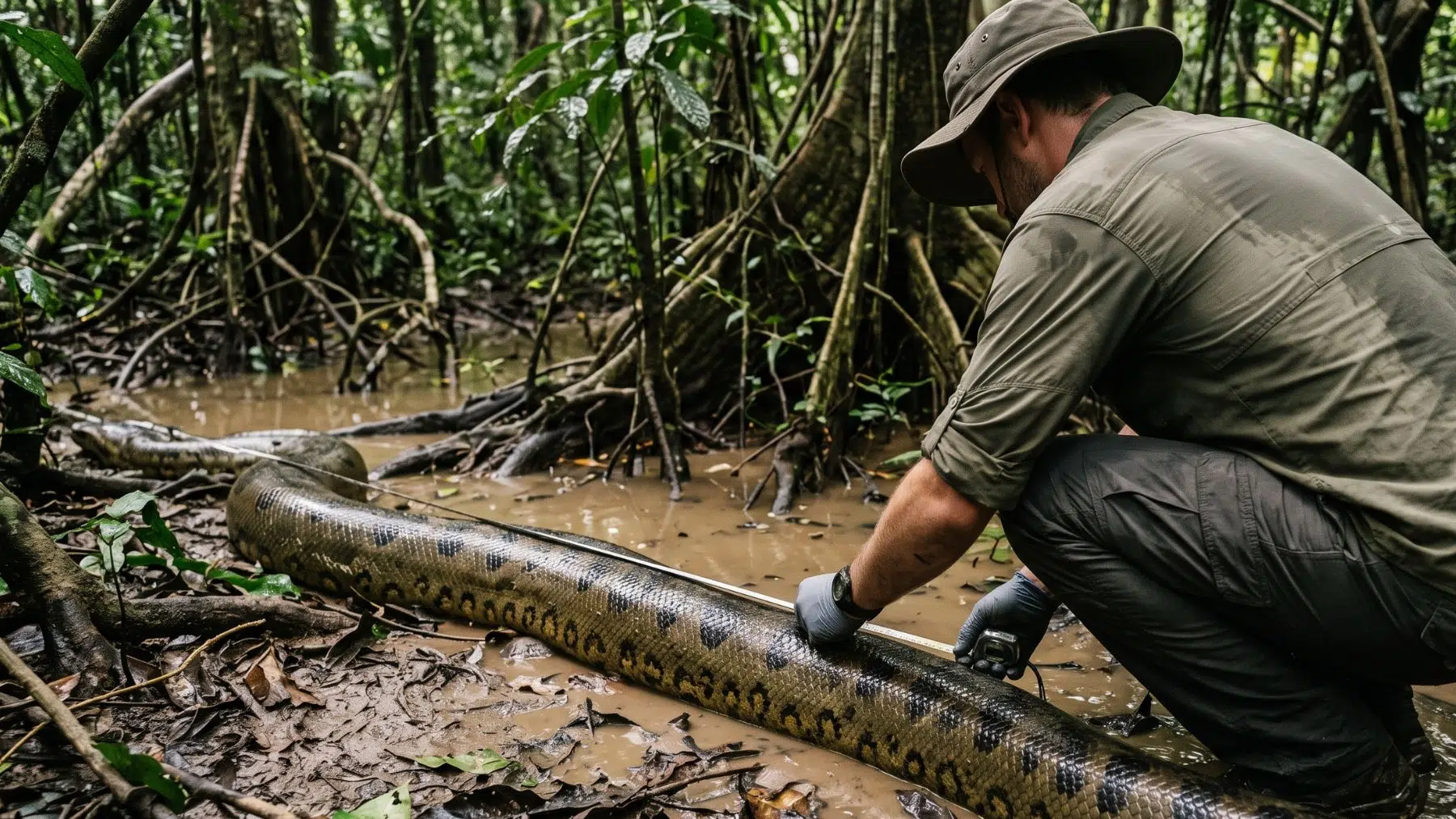
Several huge anacondas lay in the shallows, waiting in ambush for prey.
The snakes were not hiding at all.
Anacondas are ambush hunters that can lie still for hours.
They wait for a capybara or a caiman to wander within reach.
Then they strike and coil, using sheer muscle to hold their prey.
They simply waited, as they had always waited, unbothered by any world beyond the forest.
The specimens the scientists measured were unlike anything they had handled before.
One female in particular stopped everyone cold.
She stretched 20.7 feet long and weighed around 440 pounds.
That makes her one of the largest anacondas ever measured in the wild.
Local reports of even longer snakes suddenly seemed worth trusting.
A difference written in the DNA
Back in the lab, the snake’s DNA told a story far older than the expedition.
The northern anacondas appeared to have split from their southern cousins very long ago.
The team estimated that divergence at roughly 10 million years.
DNA can reveal splits that the eye alone would never catch.
Two animals can look identical yet carry very different histories.
It was a subtle clue with a very large story behind it.
They reported that the two groups differ by about 5.5 percent in the genes they studied.
The researchers compared that gap to the difference between humans and chimpanzees.
That comparison is eye catching, but many scientists warn it is not a fair one.
The snake figure comes from just a few genes, measured a very different way.
Even so, the northern and southern animals looked strikingly alike.
For centuries, people had been calling them the same snake.
Named the northern green anaconda
Here is the name at the center of it all.
According to one report, the team described the animal as a new green anaconda species in early 2024.
They called it Eunectes akayima, the northern green anaconda.
The name akayima is drawn from Indigenous languages and means the Great Snake.
The Waorani hunters who guided the expedition were listed as authors on the paper.
That detail matters, because their world rarely gets credit in a scientific journal.
The people who had always known this snake helped give it its formal name.
The paper drew on years of fieldwork across several countries.
It was a rare meeting of ancient knowledge and modern science.
A giant snake, and a science still arguing
The story did not end with the name, though.
Other scientists quickly pushed back on the new species claim.
According to one account, several researchers argued the evidence was too thin to split the species.
They said the genetic analysis leaned on too few genes to be certain.
The original name was even ruled invalid at first and had to be published again properly.
So whether this is truly a separate species is still an open question.
What is not in doubt is why a snake this size still exists here at all.
It survives because the Waorani kept their forest whole.
Vast stretches of the Amazon are being cleared every year.
A predator this large is a sign the forest around it is still healthy.
The same fragile balance between people and wildlife appears elsewhere, from clever octopuses to the seals near an offshore wind farm.
A creature that big needs a forest that is still standing, and people willing to defend it.
Read the whole thing?
Get the week's signal, not the noise
Our sharpest reporting on energy, climate and nature — free, once a week.




