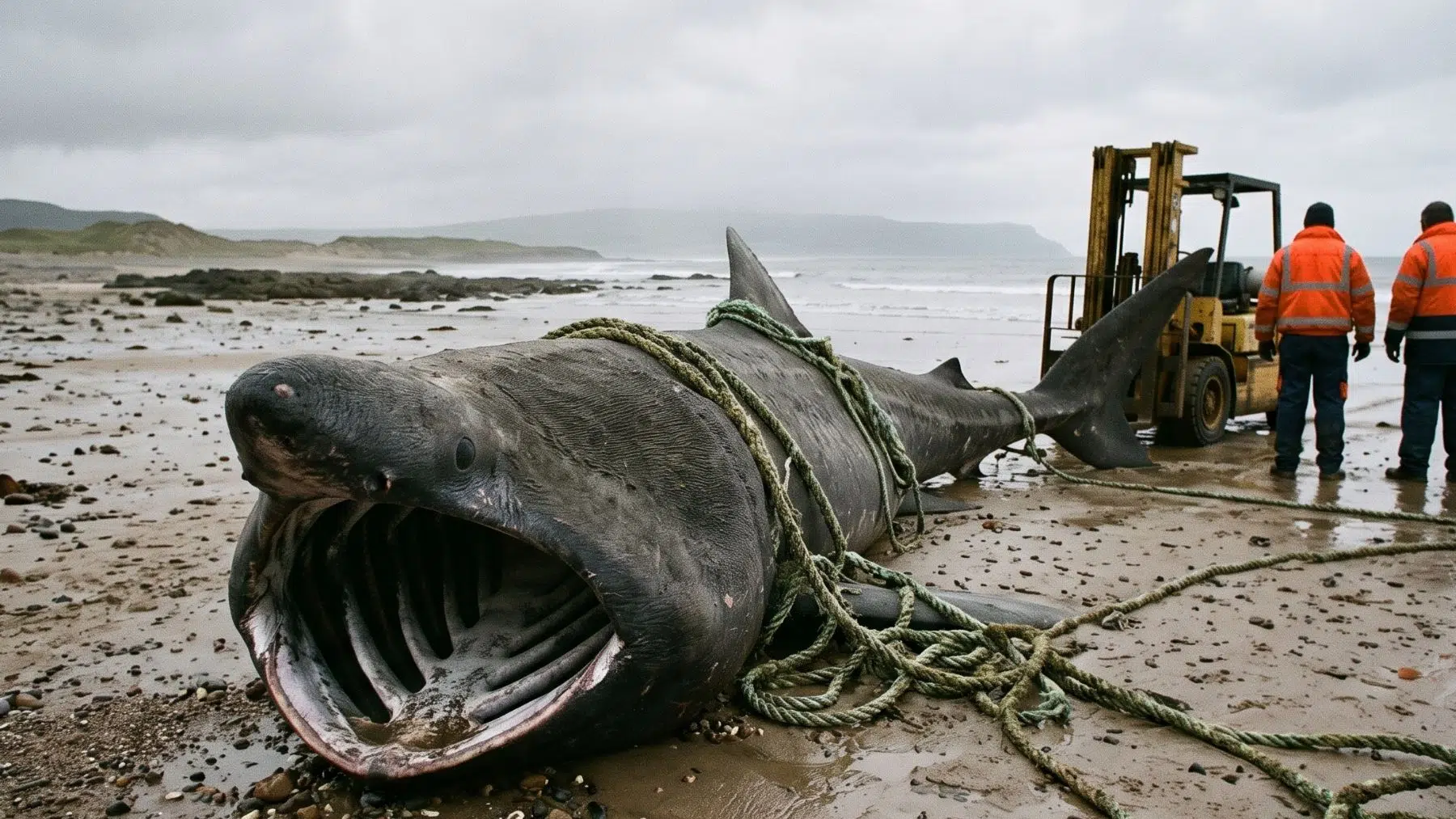
On a Scottish beach early one summer morning, a few walkers stopped dead in their tracks.
A vast dark shape lay half in the surf, going nowhere.
Even from a distance, its sheer size was hard to grasp.
It was a basking shark, dead in the cold shallows.
The animal stretched a full 24 feet from its nose to its tail.
A long length of rope was wound around its body.
It was far too heavy to shift by hand.
In the end it would take a forklift to move.
The scene was a rare and sombre sight on the Ayrshire coast.
The second largest fish on Earth
The basking shark is a true ocean giant.
It can weigh several tons, as much as a small truck.
Only the whale shark grows larger among all fish.
A big adult can stretch past 26 feet long, and old records tell of even larger ones.
Yet this monster is completely harmless to people.
It has no interest in hunting anything at all.
It has no sharp teeth for tearing flesh, only fine rakers.
Instead it cruises slowly with its huge mouth gaping open.
It strains tiny plankton from thousands of gallons of seawater.
In a single hour it filters more water than a swimming pool holds.
A creature this size lives on the ocean’s smallest food.
For all its bulk, it drifts through the sea like a slow shadow.
What the rope was doing there
The saddest detail of all was the rope itself.
It was thick, weathered, and clearly not part of the animal.
It ran from the shark’s tail up into its mouth.
Somehow the animal had become bound up in the loop.
That kind of line usually comes from fishing or shellfish gear.
Ropes hang in the water to mark pots and creels.
They stretch from the seabed all the way to floating buoys.
A slow surface feeder can swim right into them.
Rescuers believe the shark may have died fighting to escape.
The exact story, though, stays impossible to know.
What is clear is that rope and shark should never meet.
For a shark that cannot bite or fight, rope is a quiet enemy.
A filter feeder in the wrong place
To really understand the danger, you have to follow the food.
Basking sharks chase blooms of plankton near the surface.
In summer they gather off the Scottish coast to feed.
Those thick blooms gather in warm sheltered coastal water.
But that is exactly where boats and gear crowd in.
The shark and the fishing lines share the same narrow lane.
Neither one is where it is by mistake.
Cruising with its mouth wide, it cannot dodge a hanging rope.
One wrong pass and the line wraps it up tight.
A gentle habit turns into a deadly trap.
The very water that feeds them is the water that snares them.
Who came, and what it means
When the shark was first found, marine teams moved in fast.
Rescue volunteers and a stranding scheme logged every detail.
Only after the tide dropped could crews reach the body.
Even then, no one could simply drag it up the sand.
It was so massive that a forklift finally lifted it clear.
The loss stings because the basking shark is now endangered.
Global numbers crashed after decades of hunting for its liver oil.
The fish also breeds painfully slowly, with few young and late maturity.
Every animal lost is genuinely hard for the species to replace.
A population that grows this slowly cannot absorb steady losses.
Nobody sees the slow struggle that ends a life like this.
Like the base of an offshore wind farm, the pressure works out of sight.
What one dead shark tells us
At first glance, a single stranding can look like plain bad luck.
But this one fits into a much wider and grimmer pattern.
Slow giants keep meeting the fast moving world of fishing gear.
The same story plays out with whales, turtles, and seals.
Entanglement, strikes, and lost nets all take a toll.
Because basking sharks recover so slowly, each loss lingers.
A female may not breed until she is well into her teens.
Stronger rules on ropes and gear could ease the pressure.
So could simply marking and clearing old fishing lines.
It is the same hidden cost as a fox pushed from its den by solar panels, unseen until you look.
That lonely body on the sand is a warning we can still heed.
In the end, the second largest gentle fish in our seas deserves a far clearer path.
Read the whole thing?
Get the week's signal, not the noise
Our sharpest reporting on energy, climate and nature — free, once a week.