
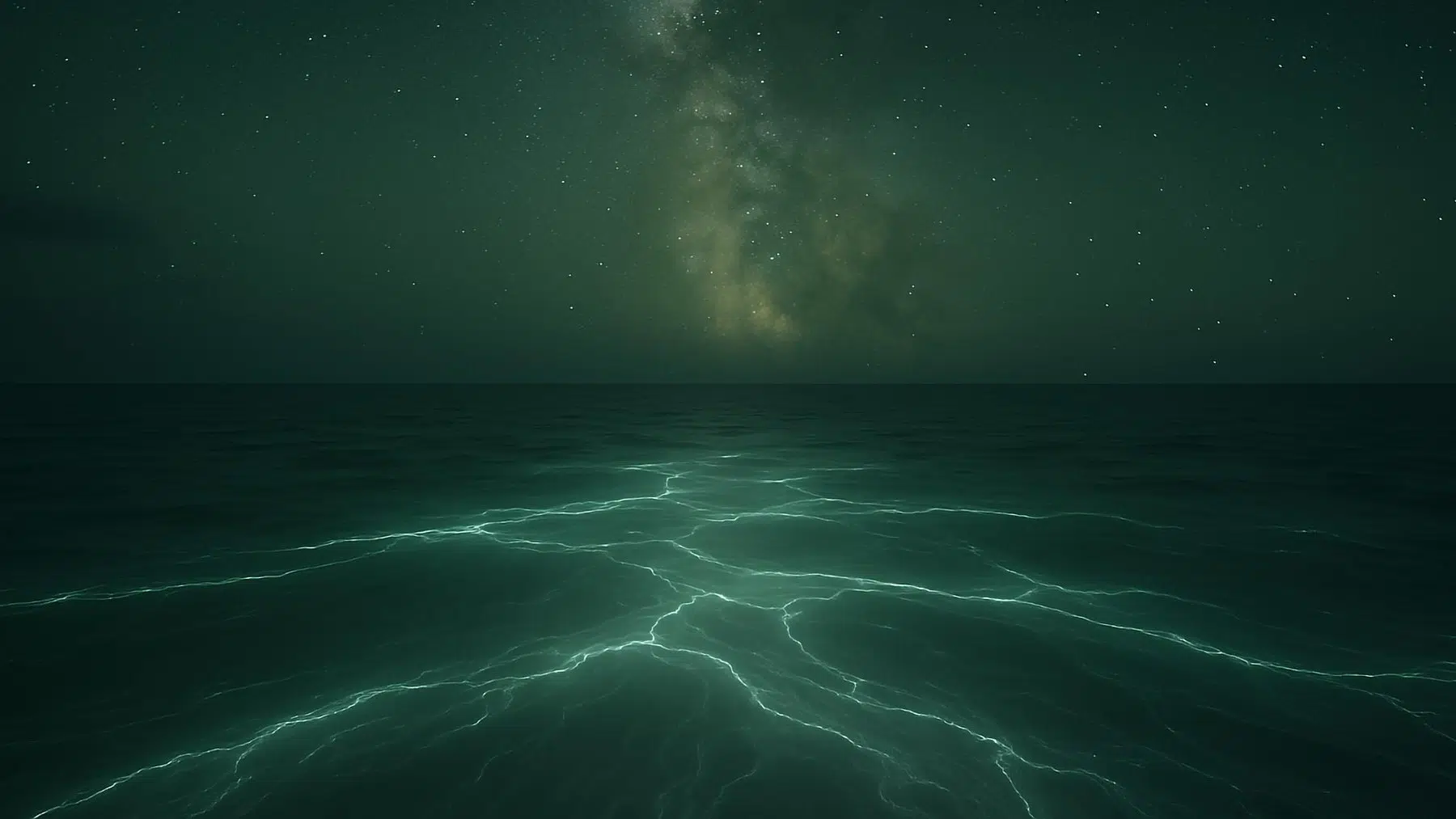
We have seen, heard and read many oceanic mysteries, but one that involves a sudden glow is new. Take a scenario where you are travelling and cruising through the ocean, and suddenly you realise that the sea is shining around you. By shining, it is not just basic light but a spooky, continuous milky light that stretches for hundreds of kilometers. It is a scientific fact that I will expand on in this article. Milky Seas are a real thing despite researchers being baffled by them. Although they have acknowledged their existence, it is still a mystery.
History and context: Where it all began
Sailors and ship commanders prior to the 21st century had more information about milky seas compared to today’s researchers and scientists. However, that does not mean sailors or experts from the 21st century cannot get insight about the mysterious oceans and milky seas; we could be on a path to comprehending more about them. Thanks to researchers at Colorado State University and the Cooperative Institute for Research in the Atmosphere.
This ocean glow was first observed and identified in the 1600s, but was written off as one of those theories and mythologies in science and ocean studies. Thanks to technology and how it has developed over the years, satellite technology has recently shown that large oceanic regions can radiate light for days or even weeks at a time, making them visible from space.
According to CNN Science, J. Brunskill, an officer aboard a ship called the SS Ixion that had sailed through the Arabian Sea in 1967, wrote:
“The sea from horizon to horizon in all directions took on a phosphorescence glow … the moon had just set and the whole sea was several shades lighter than the sky.”
Is the glow the product of an unusual, seldom-found life form that acts unlike anything we have seen?
Experts expressed that the ocean is glowing, and there could be a strange form of life. The whole mystery is centred on what is called bioluminescent bacteria, but not just any type or form of bacteria. This is what scientists believe: There could be a marine bacterium that emits light from beneath the ocean, causing these luminous lights. For the light to be as sharp and bright, there could be millions or trillions of them coming together.
The 400-year ocean mystery remains unsolved. However, although the specific cause of this uncommon glow is unknown, the study suggests that it is most likely a result of large concentrations of small bioluminescent bacteria known as Vibrio harveyi. This theory is predicated on an accidental run-in with a research vessel that had taken and examined a water sample during a “milky sea” incident in 1985, reported by CNN Science.
Dr. Steven Miller, study coauthor and a professor in Colorado State University’s department of atmospheric science, expressed:
“But besides that, the circumstances for how they form and how they set about causing the entire ocean to glow like that is still highly unknown.”
Milky seas and their role in the ecosystem
Milky seas can be referred to as a vast, steady glow. Furthermore, Justin Hudson, the paper’s first author and a Ph.D. student in the Department of Atmospheric Science, states that milky seas aren’t merely arbitrary; rather, they arise as a result of the convergence of particular environmental conditions, acting as a natural bioreactor at sea.
These circumstances would enable the bioluminescent bacteria to congregate at the surface, proliferate quickly, and interact via quorum sensing, a technique some microorganisms employ to coordinate their actions after reaching a particular population density. Hudson and the team’s focus is to try and predict the next milky sea glow.
Read the whole thing?
Get the week's signal, not the noise
Our sharpest reporting on energy, climate and nature — free, once a week.


