The guide to the stars, powered by the stars. No, we are not referring to Hollywood, but rather the promise of a tantalizing trip to outer space. A company has engineered a rocket powered by fuel from the stars. With its significant 500,000 mph potential, this rocket could take us to Mars much sooner than we think! This takes ‘go big or go home’ to a whole other level.
The company behind the superfast rocket
Pulsar Fusion, founded in 2013, is a UK-based company recognized for its innovative clean space propulsion systems and services. Recently, the company has been focusing on delivering “the future through fusion propulsion.”
“Pulsar has built a reputation in this industry for delivering real technology – not just talking about it. We’ve recently commissioned not one, but two of the largest space propulsion testing chambers in the UK, if not all of Europe. Pulsar is now an international space propulsion testing powerhouse, and we have ambitious plans to grow rapidly from here.” – Richard Dinan, Pulsar Fusion CEO
According to the company, its team has been developing a project for the past decade, which could soon be ready for in-orbit testing, as some of the project’s power supply components will be ready for demonstration later in 2025. Pulsar hopes of an in-orbit demonstration by 2027 and a production-ready product by the early 2030s.
A rocket that is powered by the fuel of the stars
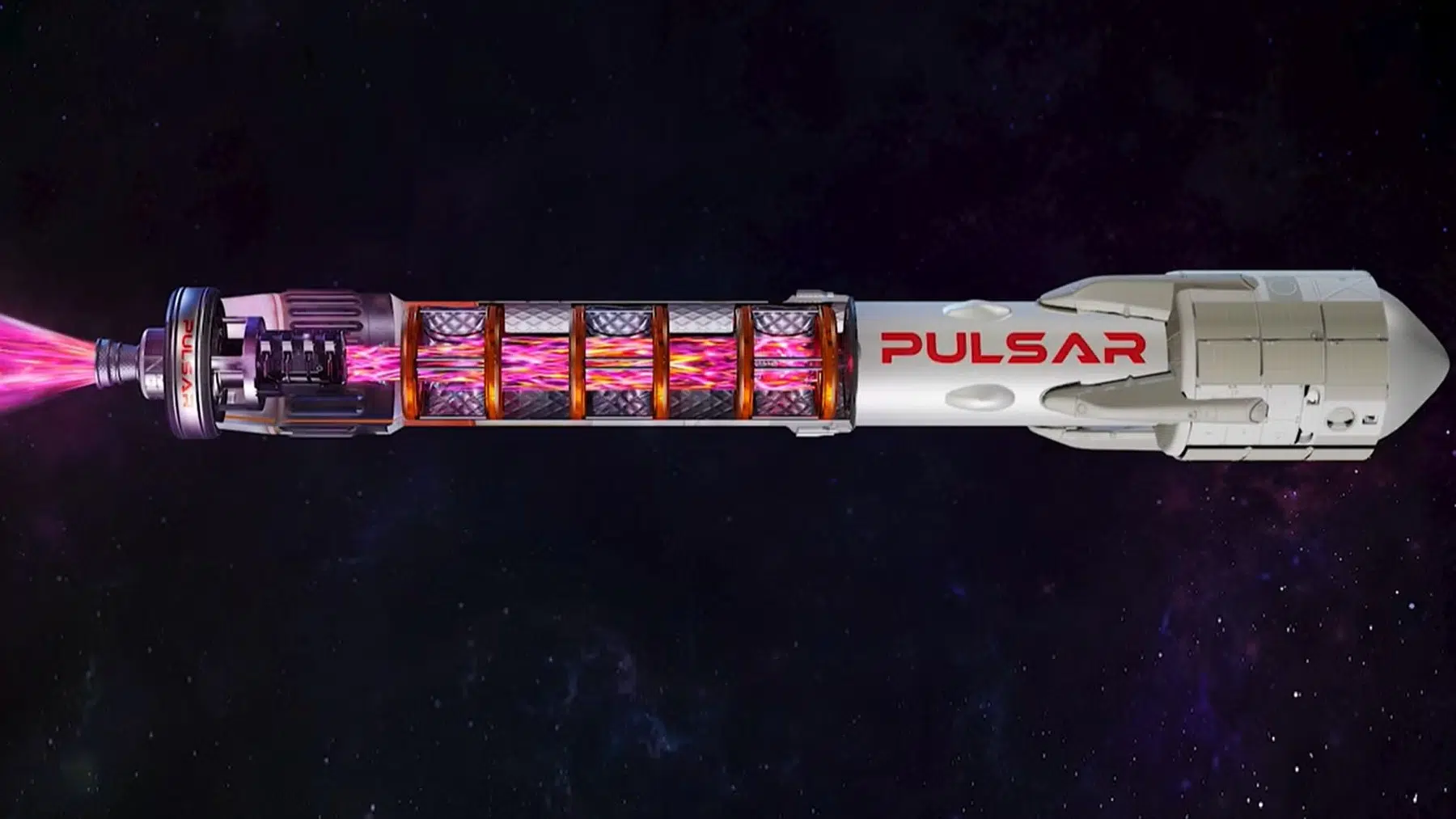
In 2023, the company partnered with US-based Princeton Satellite Systems and together designed a superfast rocket with artificial intelligence for its project. The aim would be to engineer an engine with a 329,000 mph (500,000 kph) potential. This project is known as the Sunbird Migratory Transfer Vehicle, or simply Sunbird.
The Sunbird is a unique rocket, as it will be fueled by a reaction that is similar to a reaction usually seen within stars. While stars undergo the typical nuclear fusion reaction, the Sunbird will be using a type of nuclear fusion reaction called aneutronic fusion. Simply put, the Sunbird will utilize a mixture of small amounts of deuterium and helium-3 to generate stable isotope helium-4, high amounts of energy, and one positively charged proton.
“The reason we, as Pulsar, are remaining so focused on fusion is because, at some point as our satellites and payloads get bigger and we start going into deep space missions, we have a problem, and that is the fact that solar intensity starts to fade away so new power sources will be required.” – Dinan
We could be taken to Mars sooner than we think
According to Pulsar, the Sunbird’s small nuclear fusion engine generates both electricity and thrust for spacecraft, which entails up to 2 MW of electricity at its destination arrival. The Sunbird will have the capability to be space-based indefinitely, dock onto other spacecraft, and propel spacecraft at high velocities over long distances.
Beyond that, this rocket could be taking us to Mars sooner than we think. Usually, the journey to Mars takes around seven to eight months. However, the Sunbird can theoretically cut travel time to Mars in half, as well as the travel time to Pluto, which would be about four years, as per Pulsar. Even better, it can be done without the need to refuel.
While Pulsar has been focusing on nuclear fusion to power its superfast rocket with hopes of traveling to Mars, the rest of the world has also been playing around with nuclear energy. There has been significant development of nuclear energy as a green fuel, which could revolutionize the renewable energy industry.
Read the whole thing?
Get the week's signal, not the noise
Our sharpest reporting on energy, climate and nature — free, once a week.