Many space telescopes are made up of one individual spacecraft.
NASA’s future SunRISE mission has chosen a different approach.
Instead of sending a single observatory into orbit, NASA plans to launch six small satellites. Each satellite is roughly the size of a toaster oven.
Together, they will act as a single radio telescope approximately 22,000 miles above the Earth.
Their purpose is not to photograph the Sun. They will primarily listen for radio waves which are connected to Solar storms prior to those Solar storms reaching near-Earth space.
Six satellites, and one radio telescope
The name of this mission is Sun Radio Interferometer Space Experiment (SunRISE). This mission utilizes a technique known as interferometry.
Several smaller instruments can work collectively as if they were one significantly larger instrument.
Working together, these smaller instruments will form a large radio observatory in space.
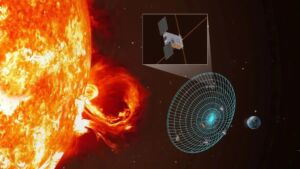
That radio observatory will focus on radio bursts originating from the corona of the Sun.
A significant portion of the radio bursts the observatory will study are related to high-energy particles that leave the Sun.
Tracking these signals may help scientists understand where such particles begin and how they move through space.
Most of the hardware is already finished
NASA’s Jet Propulsion Laboratory (JPL) is managing the mission.
The University of Michigan leads the scientific research for the mission and houses its science operations center.
All of the spacecraft have been constructed. The assembly and testing occurred at Utah State University’s Space Dynamics Laboratory.
The project was initially scheduled to utilize a Vulcan Centaur rocket.
However, NASA later transferred the launch to a SpaceX Falcon Heavy vehicle.
The launch is being funded by the U.S. Space Force’s Space Systems Command. The next major hurdle is putting the spacecraft into orbit.
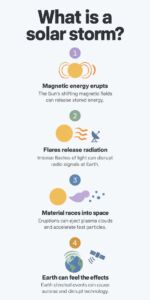
The radio signal arrives before the particles
The Sun emits energy across virtually every wavelength band, including visible light.
But it also generates radio frequency emissions. Some of those emissions come in the form of radio bursts.
Those bursts are associated with accelerating particles traveling throughout the Sun’s atmospheric layer.
These energetic particles arrive later. This creates an opportunity for researchers.
By identifying and analyzing the radio burst before the arrival of the accompanying particles, scientists may be able to detect signs of solar storm activity before it reaches near-Earth space. That is why SunRISE was developed.
Predicting solar storms is still the hard part
Solar activity is complex and does not uniformly release energetic particles. Events differ in terms of intensity, timing, and behavior.
Researchers continue to investigate specifically how radio bursts are related to subsequent particle events.
The mission also faces operational challenges. Six spacecraft must coordinate as a collective system.
There have also been scheduling changes. NASA currently states that the mission launch target date is set for no earlier than mid-2027.
Researchers aim to increase their awareness of space weather prior to dangerous events occurring.
Minutes of warning could be the real prize
The ultimate value of SunRISE boils down to time. Not years. Not months. Potentially minutes or hours.
Modern infrastructure depends on functioning equipment in space.
Communications systems, navigation systems, and scientific space exploration vehicles all depend on that environment.
Solar energetic particles (SEP) events pose risks to satellites and astronauts alike.
The radio bursts associated with SEP events arrive first. That is the window SunRISE seeks to capitalize on.
Additional warning time may allow operators and crew members more time to prepare for elevated radiation environments.
This mission is not designed to prevent solar storms. Rather, it attempts to detect warning signs from the Sun earlier.
If successful, the greatest benefit from SunRISE may not solely be derived from the data collected.
It may come from the additional time created between observing a solar event and experiencing its consequences.
Read the whole thing?
Get the week's signal, not the noise
Our sharpest reporting on energy, climate and nature — free, once a week.