In a laboratory tank at Stanford, a fragment of coral sat bleached white — drained of color, stripped of the algae that keep it alive, and by most measures already a casualty of the ocean’s rising temperatures. Scenes like this are playing out across the world’s reefs as marine heat waves grow more frequent and more severe, and bleached corals have long been treated as beyond saving.
Then a researcher noticed something odd. Two fragments had accidentally fallen against each other in an aquarium. Where they touched, something was changing.
A chance observation that changed the question
Steve Palumbi, a marine scientist at Stanford, wasn’t running a recovery experiment when he spotted it. Two coral fragments — one healthy, one bleached white — had tumbled against each other by accident in a laboratory aquarium. Where they touched, color was slowly returning to the bleached one. The algae, somehow, were coming back.
Around the same time, PhD student Danny Collins was studying something darker: how harmful bacteria hitch a ride on plastic debris and enter coral tissues through direct physical contact. The accidental observation flipped his question entirely. If contact could introduce something harmful, could it also introduce something beneficial?
It was a simple inversion. Bleached corals often take months or years to recover naturally, and many never do — so finding a way to shorten that window could mean the difference between a reef that survives a heat wave and one that collapses entirely.
What bleaching actually does to a coral
Corals look like rocks or plants, but they’re animals. Most species reproduce by creating genetically identical copies of themselves — clones that grow together into the vast colonies forming reef structures. Inside their tissues, they host symbiotic algae that supply most of their energy through photosynthesis.
When ocean temperatures climb too high, corals expel those algae, according to the Stanford Doerr School of Sustainability. The coral turns white, loses most of its energy source, and becomes far more vulnerable to harmful microorganisms. It’s not immediately dead, but it’s in serious trouble. Some estimates suggest coral reefs could disappear within decades if marine heat waves keep intensifying.
How the experiment was designed and what it showed
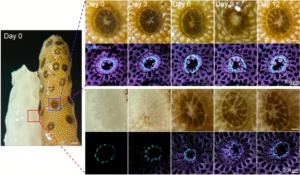
Collins designed a controlled experiment using 10 pairs of coral fragments. Each pair came from the same original animal — one fragment healthy, one severely bleached. Five pairs were placed so the fragments physically touched. The other five were kept apart by gaps of just a few millimeters.
The results were stark. Every bleached fragment in contact with its healthy counterpart recovered fully within seven weeks. Every separated fragment died — no exceptions in either group.
The team then separated pairs after different durations of contact to find the minimum needed. Just five to seven days of touching was enough to trigger complete recovery. Even after the fragments were pulled apart, they still returned to full health within the same seven-week window.
The biological mechanism: tissue fusion and algae transfer
The recovery depends on something unusual: genetically identical corals can recognize each other on contact and fuse their tissues. Palumbi compared it to organ transplants between identical twins — the genetic match eliminates the rejection response.
Under a powerful microscope, Collins and colleagues watched tiny channels within the coral tissues align and connect, forming pathways for materials to flow between fragments. Within three days of contact, beneficial algae were already moving from the healthy fragment into the bleached one. They didn’t settle in slowly. Those algae multiplied at extraordinary speed — doubling roughly every four days during the second week, about ten times faster than growth rates observed in wild corals. The bleached coral wasn’t just borrowing from its neighbor; it was receiving a starter population that then exploded on its own.

Promise and limitations for reef restoration
The finding is genuinely exciting, but the researchers are clear about its current limits. For the technique to work as demonstrated, every bleached coral would need access to a healthy, genetically identical counterpart. Matching and deploying those pairs across entire reefs isn’t feasible at scale — at least not yet.
The team’s next step is to explore whether the algae transfer can be decoupled from physical contact altogether. One approach: collect beneficial algae from healthy corals before heat waves hit, then deliver them in bulk to bleached corals afterward, no touching required. That’s still hypothetical, but the conceptual door is now open.
“These new insights into how corals can naturally recover give us hope for the future,” said Fiorenza Micheli, a faculty advisor on the study. The dangerous window right after a bleaching event may not be as fixed as scientists once assumed. Whether that window can be reliably shortened, and at reef scale, is the question researchers will be chasing next.
Read the whole thing?
Get the week's signal, not the noise
Our sharpest reporting on energy, climate and nature — free, once a week.