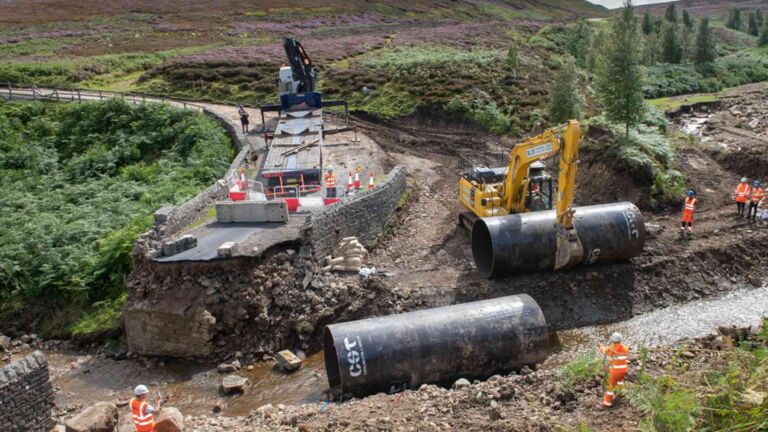
An excavator is working through dry scrub in southern Sri Lanka.
The scrub does not look like much from a road.
It is thorny and gray and it grows on poor soil.
It is also what elephants eat, and the state drew a line around a large block of it and called it elephant habitat.
Solar panels are going up inside the line.
The interesting part is not that it happened, but how it was allowed to.
Seventeen small projects that add up to one big one
The development in the Hambantota district is not a single solar park on paper. It is 17 separate project units, filed by different companies, each one small enough to be assessed on its own.
On the ground they sit in the same place.
Added together they come to as much as 150 megawatts, which is a serious power station by Sri Lankan standards, and campaigners put the scrub forest to be cleared at roughly 500 acres. Assessed as one project, that scale would normally trigger a full environmental impact study.
Assessed as seventeen, each piece qualified for an initial environmental examination instead, which is the lighter and faster review. Nobody had to look at the whole thing at once, and the whole thing is what the elephants meet.
What the line on the map was for
The block is called a managed elephant range, gazetted in 2021 after years of argument. It covers roughly 56,500 acres, with a carve out for the airport that sits inside it.
It was already a compromise before any of this started.
“Some areas used by elephants were not included in the range as these were decided as more important for development,” said Prithiviraj Fernando, who chairs the Centre for Conservation and Research, “and eventually it was a compromise between development and conservation.” The line was drawn smaller than the biology asked for, deliberately, to leave room for everything else.
More than four hundred elephants live in the wider district. They do not move as one herd, which is a detail that gets lost in the retelling, but in family groups that overlap and share the same scrub.
Why scrub forest is the whole argument
Thorn scrub is not scenery. For an Asian elephant it is a working pantry, and an adult animal needs to move through a lot of it every day to find enough of the right plants.
Take out five hundred acres and the animals do not disappear. They walk further.
Walking further means crossing places where people grow food, and the district has been living with the consequences of that for a decade. Between 2015 and 2025 encounters in Hambantota cost lives on both sides, seventy two people and more than twice as many elephants, and nationally the annual toll runs to about a hundred people and four hundred elephants.
“We are already struggling with elephants, and we simply cannot bear any further intensification of this conflict,” said Manoj Gayan, who heads a regional farmers’ association there. That sentence is the part of the story that usually gets left out, because the people closest to the animals are the ones carrying the risk.
Where it actually stands
Clearing has started, and the panels have not. The reporting lays out the sequence of approvals in detail, and a land rights group described heavy machinery cutting and burning the scrub in the field report that put this on the national agenda.
The regulator has not closed the question. Its director general said that if irregularities are found, a decision to intervene would follow within weeks, which is as far as anyone official has gone.
Worth holding onto: solar supplies only around eight percent of Sri Lankan electricity, against forty percent from hydropower, so this is a country at the beginning of a build out rather than the end of one. What gets decided here sets the pattern for everything after it.
Elephants and farmland have a long history in this part of the world, and researchers have found the animals will avoid some crops given the choice.
Solar is not the villain here
Plenty of wildlife does well on solar sites. Ground nesting birds, insects, small mammals, even a resident fox can treat a fenced array as a quiet meadow nobody walks through.
An elephant cannot, and the reason is arithmetic rather than attitude.
A fox needs a few acres. A herd needs tens of square miles of connected ground, and a fence that a small animal walks under is a wall to an animal that weighs four tons. Solar and wildlife are compatible at some body sizes and not at others, and the difference is not a matter of goodwill.
So the fix is not to stop building. It is to assess what gets built, whole, once, on the map where it will actually stand, rather than seventeen times in pieces small enough that nobody ever has to look at the total.
Read the whole thing?
Get the week's signal, not the noise
Our sharpest reporting on energy, climate and nature — free, once a week.