Working from a houseboat moored along the shores of Lake Kariba, deep inside a Zimbabwean national park, a team of paleontologists spent two expeditions pulling fossils from brick-red mudstones — layers of ancient riverbed laid down 210 million years ago across a dry landscape of scattered conifer groves.
They expected to find familiar species. The rocks were the right age, the geography close enough to South Africa that the creatures preserved inside should have looked like neighbors. Instead, the bones told a different story. What emerged had no known relatives next door — a creature that, as far as the fossil record shows, belonged to Zimbabwe alone.
A dinosaur with no neighbors
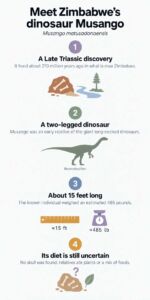
Meet Musango matusadonaensis — a sauropodomorph dinosaur that lived roughly 210 million years ago during the Late Triassic. Its incomplete skeleton came from the bank of the Nyamasango River, near Musango Island on Lake Kariba, and both parts of its scientific name trace back to those same places.
The animal walked on its hind legs alone, reached about 4.5 meters in length, and weighed around 220 kilograms. Growth marks in its bones suggest it was still a subadult when it died. The skull wasn’t preserved, so its diet remains unknown — though its closest relatives were largely plant-eaters.
What makes Musango stand out isn’t its size or its age. Despite sitting geographically and chronologically close to well-studied South African fossil sites, it shares no close relatives with any dinosaur found there. It appears to belong to Zimbabwe, and nowhere else.
How a safari camp manager changed paleontology
Paleontological work in Zimbabwe has a long but uneven history. Bones were first reported there in 1916, and more systematic work followed in the 1970s through Geoffrey Bond and Michael Raath. Most of what they found was attributed to species already known from neighboring South Africa — and after that, momentum stalled for decades.
The story picked up again thanks to an unlikely figure: Steve Edwards, a local safari camp manager who began finding productive new fossil sites along Lake Kariba’s shoreline. His discoveries eventually reached Jonah Choiniere at the University of the Witwatersrand in Johannesburg, an expert on early dinosaurs who recognized their significance immediately.
Choiniere assembled an international team of South African, Zimbabwean, and UK-based researchers. The sites sit deep inside Matusadona National Park with no easy road access, so the solution was to use a Kariba houseboat as a floating base and mobile lab, prospecting the shoreline from the water. Two expeditions followed, in 2017 and 2018.
A prehistoric world unlike any other in Africa
Every fossil animal collected from the Kariba sites so far has turned out to be unique to Zimbabwe. That includes Musango and its relative Musankwa, described from the same rock beds in 2024 — neither closely related to the dinosaurs found in South Africa, despite the similar age and geographic proximity of those sites.
The distinctiveness doesn’t stop at dinosaurs. Alongside the bones, researchers found lungfish and phytosaurs — aquatic reptiles that are rare or entirely absent from South African fossil sites of the same age. The surrounding fauna points to a genuinely different prehistoric world. The fossil-bearing mudstones preserve a dry landscape dotted with large conifer trees, cut through by green corridors of vegetation following permanent rivers — a distinct ancient environment unlike anything currently described from the same period further south.
That impression deepened when the team began reassessing older collections held at a museum in Bulawayo. Many historical specimens, previously assumed to belong to South African species, appear on closer inspection to represent something else entirely. Earlier assumptions may have moved too fast.
Climate as the dividing line
Geography offers a clue to why Zimbabwe’s prehistoric fauna looks so different. During the Triassic, Zimbabwe sat further north than South Africa and closer to the equator, which likely produced warmer, distinct climatic conditions. Climate is known to strongly shape where animals live and how populations diverge over time.
The researchers suspect those ancient climate differences may have acted as an invisible barrier, producing ecosystems distinct enough to support entirely separate groups of species. It’s a hypothesis, not yet a conclusion. The fossil evidence so far, though, supports it.
To test the idea more rigorously, the team plans to return to Lake Kariba. More fossils would help, but so would precise data on the exact ages and depositional environments of the dinosaur-bearing rock layers. Comparing that with sites elsewhere across Africa could reveal whether climate-driven separation was a broader pattern in early dinosaur evolution.
Zimbabwe has long been a footnote in the story of African paleontology. These finds suggest it deserves a much larger role — and that the riverbanks of Kariba may still have more to offer.
Learn more about this discovery: The Conversation. “210-million-year-old dinosaur discovery reveals a lost world in Africa.” ScienceDaily. ScienceDaily, 13 October 2026. <www.sciencedaily.com
Read the whole thing?
Get the week's signal, not the noise
Our sharpest reporting on energy, climate and nature — free, once a week.