A stone bridge in the Yorkshire Dales vanished in a single night.
Floodwater came down Swaledale carrying boulders and debris.
By morning, the crossing over Cogden Beck near Grinton was gone.
A road to the nearest market town went with it.
Engineers needed something enormous and already built, something nobody was using.
They found it in a steel stockyard, fabricated for a wind farm that never happened.
What a wind farm substructure was doing in a moorland stream
The tubes began life as part of a turbine substructure, built for a floating wind demonstration off the north coast of Scotland. The steel belonged to the failed Dounreay Trì project, a roughly 10 megawatt floating wind farm planned a few miles offshore, which was shelved for lack of funding. Instead of being cut up, the finished sections sat waiting for a buyer.
A steel stockholder saved the substructure from being scrapped and stored the sections on its 100 acre stockyard near Thirsk, North Yorkshire. The firm specializes in supplying surplus steel for reuse in construction and infrastructure projects.
That decision, made with no bridge in mind, turned out to matter. A tube built to hold a turbine in the open sea has to resist forces nothing in a modest Dales beck ever delivers.
A structure built for the open sea, dropped into a beck
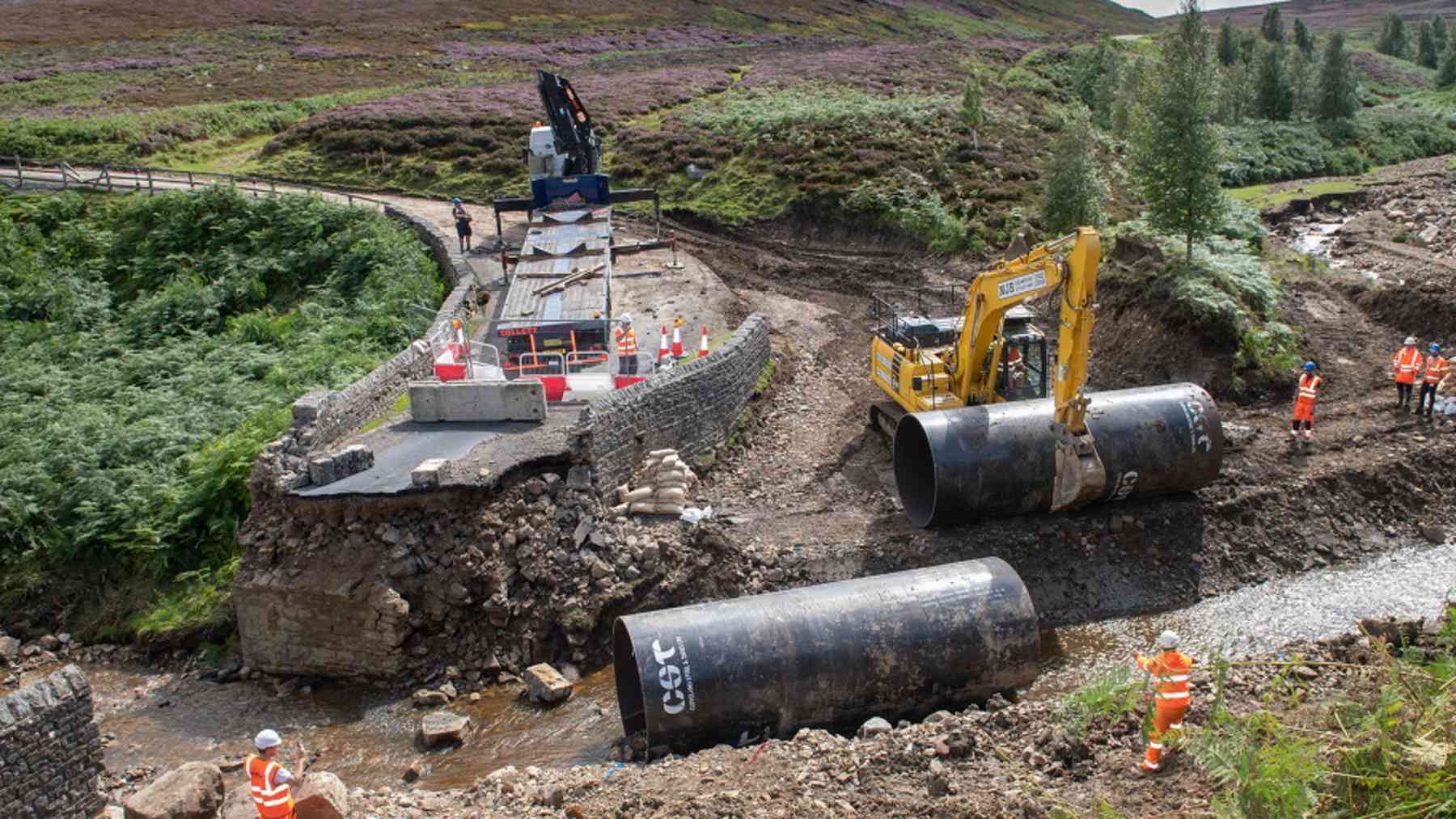
Picture the beck first. Cogden Beck is a small moorland stream on Grinton Moor, unremarkable on an ordinary day. The stone bridge over it was destroyed by torrential water carrying boulders and other debris during the floods of late July.
Into that gap went steel designed for a far harsher environment. Each section runs about twenty feet long and weighs roughly 23,000 pounds. The giant hollow drums measure just over seven feet across and about an inch and a quarter thick.
The two repurposed tubes arrived at the remote spot on the back of a low loader and were rolled into Cogden Beck. A tracked excavator working from the bank then positioned them in the stream. They formed a base with the load bearing capacity needed for a temporary road surface, with water running through them rather than over the deck. You can read the trade account of the emergency repair for the engineering detail.
How the math on reused steel actually worked out
None of this happened by luck alone. The supplier promotes repurposed tube on a carbon argument. A life cycle analysis it commissioned found emissions savings as high as 96 percent compared with buying new.
That figure is a company commissioned estimate rather than an independent audit, and the saving comes from skipping the mining, smelting and rolling that a fresh tube would require. Timing mattered just as much as the carbon math.
The crossing between Grinton and Leyburn had to be repaired quickly because it formed part of the route for the UCI Road World Championship. Crews had been working around the clock since the floods on July 30 and 31, and the two tubes were delivered and rolled into the beck on August 13. A custom fabricated tube could have taken months to order and roll.
You can read more about how other turbine parts find reuse once a project ends, because steel, unlike a cured composite blade, almost never has to be thrown away. That reuse market is what let a scrapped turbine base show up in a Yorkshire beck within a fortnight.
Why the ocean built the tube strong enough for a road
Offshore wind hardware is heavily built by the standards of most civil engineering. A substructure meant to hold a turbine in open water is designed around waves, corrosion and storm loading. That is why the wall here runs more than an inch thick, far beyond what a temporary moorland crossing would normally call for.
That spare capacity became the point. Instead of commissioning something new for a one off emergency, engineers borrowed capacity built for the sea. The firm’s managing director, Roy Fishwick, said: “We were delighted when the council accepted our proposal to deploy steel tubes to repair the bridges.”
It is the same logic behind other retired energy structures finding new purpose, whether that is a pumped storage cavern or a turbine column becoming something nobody designed it to be. The original job sets a bar the second job rarely has to clear.
What happened when the race finally came
The race the deadline was built around never crossed the steel. On the morning of the elite men’s road race, organizers shortened the course by 14.6 miles because of forecast severe weather, bypassing the northern loop and cutting out the Buttertubs and Grinton Moor climbs. You can see the late route change as organizers announced it.
So the crossing’s real work was the ordinary kind. It reconnected a dales village with Leyburn for residents, farms and summer visitors, with the traditional Dales masonry bridge due to be rebuilt afterward.
Even so, the episode is a reminder that a cancelled wind project’s steel does not disappear just because the turbines never got built. Here, more than 46,000 pounds of structural steel found a use nobody had drawn up on any blueprint.
Read the whole thing?
Get the week's signal, not the noise
Our sharpest reporting on energy, climate and nature — free, once a week.