It shows up after dark, moves like it owns the yard, and has almost certainly visited yours.
The raccoon raids bins, tips bird feeders, and washes its paws in whatever water it can find.
What looks like mischief is often careful, deliberate work.
Most people write it off as a clever little nuisance.
But a growing pile of science is rewriting that assumption.
What researchers found when they set a locked box in a real backyard should make you look twice.
The animal that learned to read your garbage can
Raccoons first spread into American cities in large numbers during the last century.
They are now found in every US state except Hawaii, missing only from the harshest deserts and peaks.
Most wildlife shrinks away from human noise and light.
The raccoon moved toward it, drawn by the food and water that cities hand out by accident.
That drift into human space was not random or desperate.
It was a slow, deliberate move toward an easier living.
City raccoons map their routes and time visits to match the trash pickup schedule.
They beat bin lids and bungee cords almost as fast as people can add them.
Few wild mammals have spread so successfully alongside us.
Where people build, the raccoon tends to follow and thrive.
The animal was reading the neighborhood long before anyone thought to study it closely.
The clue those front paws give away
Watch a raccoon at the edge of a pond and something stands out.
It works the water with its front paws like hands, feeling along the bottom.
Those paws turn stones and objects over with an almost searching kind of focus.
The behavior is not simple foraging by touch.
It hints at a mind that science spent decades underrating.
Raccoon paws hold dense nerve endings that give them a fine sense of touch.
Wetting the paws seems to sharpen that sense even further.
Each object gets checked, rolled, and probed before the animal moves on.
That sensitivity turns plain exploring into a hands on experiment.
The real question was how far that curiosity would go.
The night someone set a box for a trash bandit
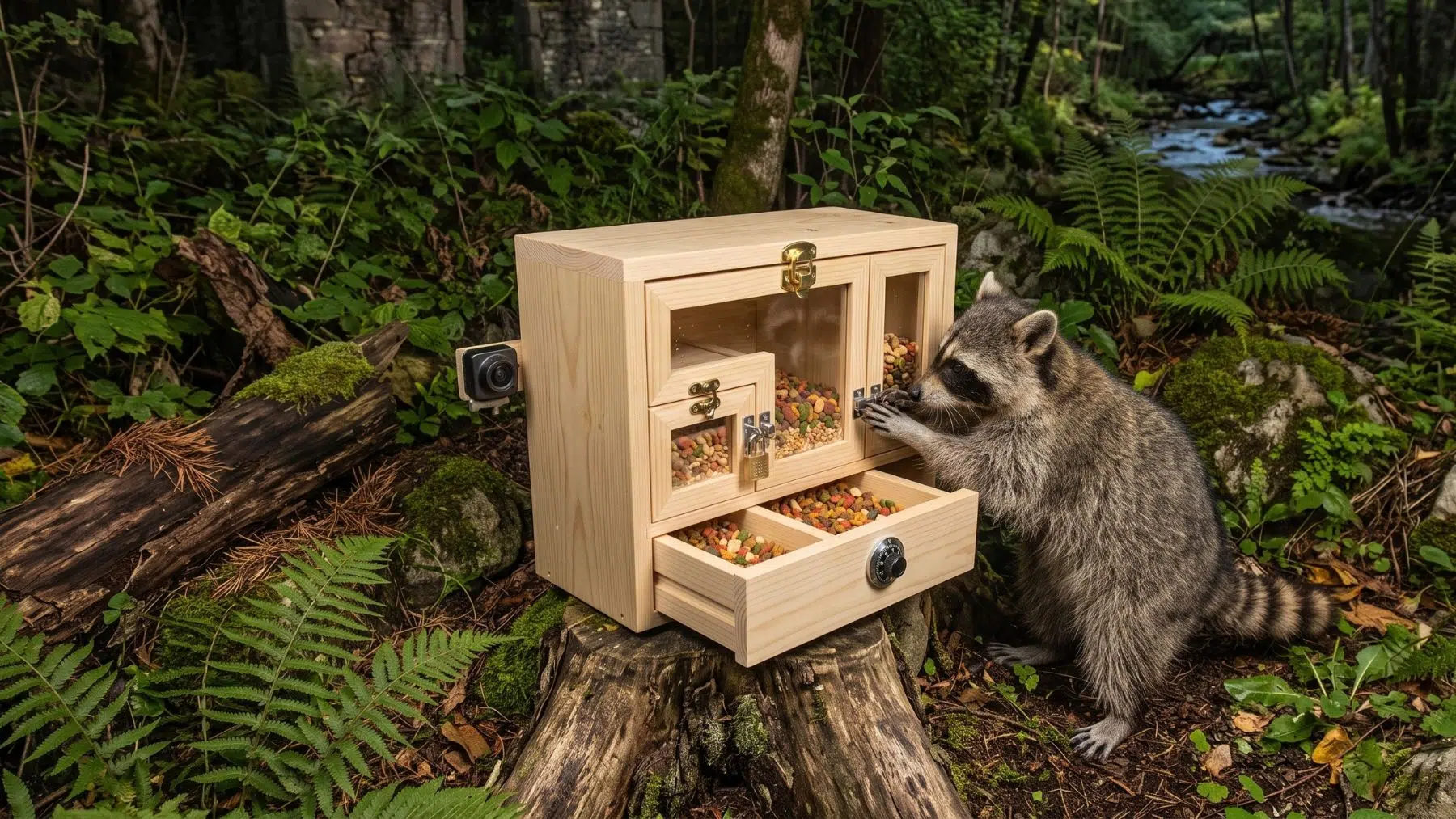
To find out, a team placed puzzle boxes in backyards around Laramie, Wyoming.
Each box looked like a small food safe with latches guarding the treat inside.
The idea was to see whether a wild animal could work out a lock on its own.
The main box had 4 locks on it, a side bolt, a swivel, a pull down bolt, and a rod set in an eye hole.
Every lock rewarded a different kind of thinking to open.
The traps that caught them for tagging used nothing fancier than cat food.
The wild raccoons had never seen any of it before.
Cameras recorded what happened next across many raccoons over two field seasons.
The field researchers tagged each animal so they could tell them apart.
No training, no hints, and no human help at all.
What the box proved about the animal in your yard
The results, published in a major biology journal, surprised even the team.
Roughly one in four raccoons cracked the box, and the winners shared one trait.
That may sound low, but these were wild animals facing a strange object cold.
Successful raccoons never stopped at a single trick, they found several solutions each.
That is flexible thinking, not the dull repetition of one lucky move.
Some worked a latch with a grip no one had trained into them.
Others solved the same lock from an odd angle or body position.
One report noted the differences were bigger between raccoons than within any one of them.
Younger raccoons were often the boldest, while older ones played it safe.
In other words, each animal brought its own style to the problem.
The masked neighbor you never really met
None of this means raccoons are harmless or that you should invite them closer.
They can carry disease and do real damage, and experts warn against feeding them.
The gap between a pest and a problem solver is thinner than it looks.
But the animal most Americans dismiss as a pest carries a remarkable mind.
When a task was easy, the raccoons still tried several routes instead of locking onto one.
That same restless flexibility turns up in other clever animals, from clever crows to octopuses.
The next time one stares back from your bins, it may be sizing up a puzzle.
The masked face at your garden’s edge holds a surprisingly sharp mind.
Dismiss it if you like, but the yard belongs a little to that mind too.
And it still shows up every single night, patient and inventive.
Read the whole thing?
Get the week's signal, not the noise
Our sharpest reporting on energy, climate and nature — free, once a week.