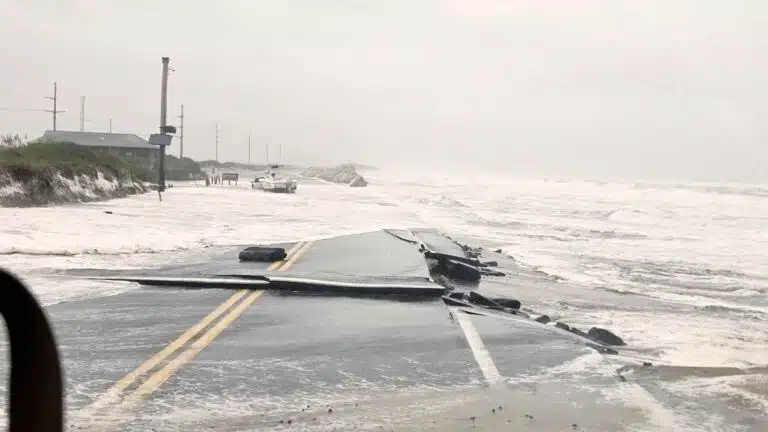
A group of kayakers camped at the mouth of an Alaska fjord woke to water running through their campsite.
Their gear was already gone into the channel.
Miles up that same waterway, a slab of mountainside had just dropped straight into the sea.
What happened next stripped the facing wall of the fjord to bare rock.
So what sent the water that high?
What makes a landslide throw water higher than a skyscraper
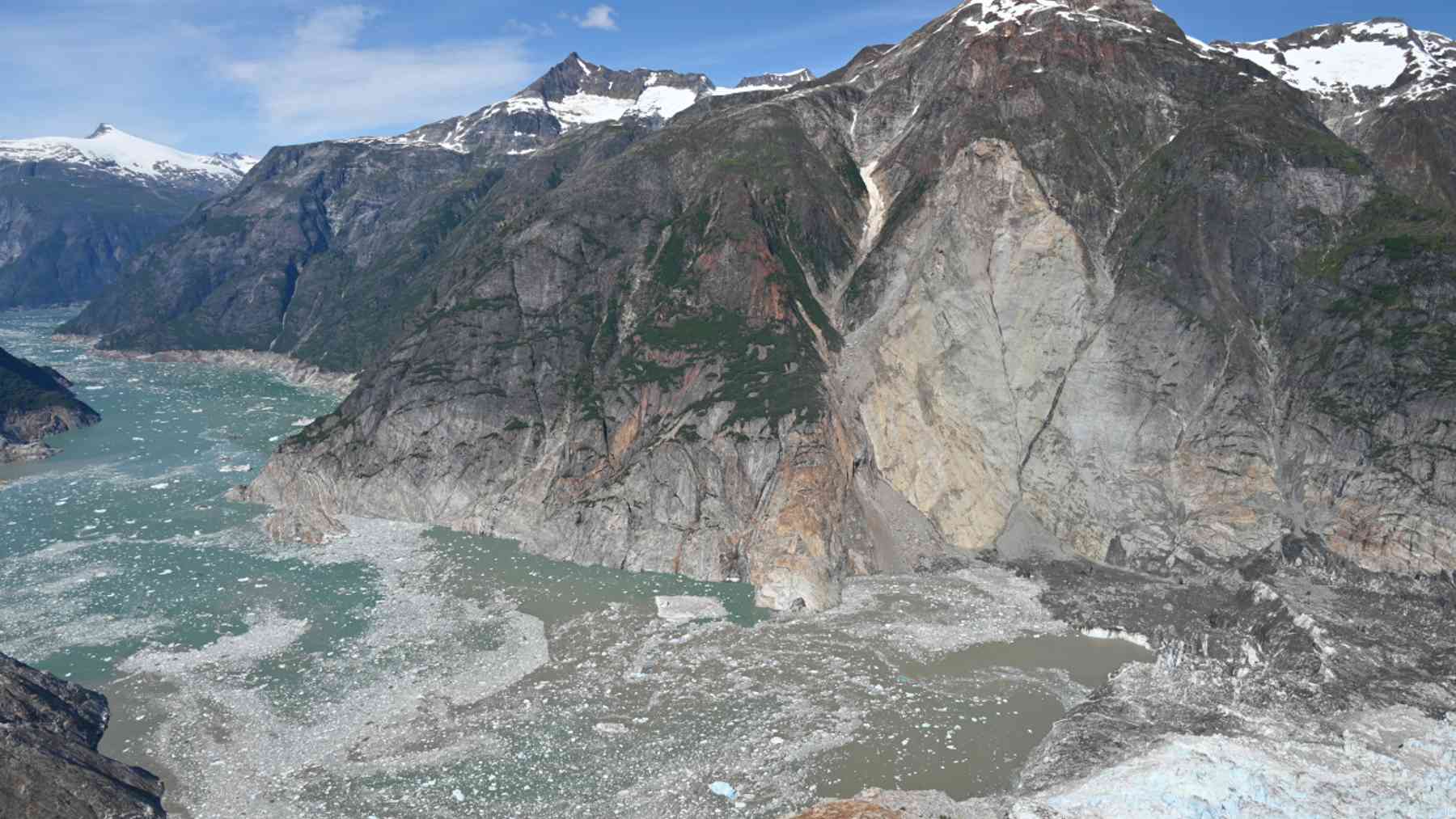
The trigger was simple and violent. At 5:26 on an August morning, more than 80 million cubic yards of rock broke free above Tracy Arm, a narrow glacier carved channel south of Juneau, and fell roughly 3,300 feet onto South Sawyer Glacier and into the fjord below.
That is not a boulder sliding. It is a mountainside dropping almost straight down into a self leveling channel with nowhere for the displaced water to go but up and sideways.
Because the fjord is narrow and deep, the impact had one real outlet. An initial breaking wave about 100 feet short of 400 feet tall moved off at more than 150 feet per second, carrying rock debris, ice and torn vegetation with it. The record water mark left on the facing slope sits about 1,580 feet above sea level, a height greater than the Empire State Building.
That makes it the second highest runup ever recorded, approaching the record of about 1,740 feet set by a landslide tsunami at Lituya Bay, elsewhere on the Alaska coast. Both happened where the steep sides of a relatively narrow channel concentrated the energy of rock falling into water.
A fjord that cruise ships pass through every summer
Tracy Arm is not a forgotten corner of the Alaska coast. In summer it sees, on average, three cruise ships a day, plus other vessels traveling within a few miles of where the slope failed, most bound for South Sawyer Glacier at the head of the channel.
One small ship, the Hanse Explorer, had carried passengers up to photograph that glacier and headed back down the fjord twelve hours before the collapse. More than 20 vessels, including large cruise ships carrying thousands of passengers, typically travel through Tracy and Endicott arms daily during the summer.
None was in Tracy Arm at the time. The study’s authors note the tsunami could have caused casualties had a ship been in the upper fjord. The collapse came early in the day, before vessels had reached that stretch of water.
How scientists pieced it together after the fact
The landslide, on August 10, 2025, produced globally observed long period seismic waves equivalent in size to a moment magnitude 5.4 earthquake. Researchers later worked from seismic data, numerical models and before and after satellite images, and published the first comprehensive analysis, led by Dan Shugar of the University of Calgary, in the journal Science.
Afterward came something stranger. Water trapped between the fjord’s steep walls kept sloshing back and forth in a standing wave, producing a faint global seismic signal with a roughly 66 second period that persisted for up to 36 hours.
Apart from a 2023 landslide tsunami in Dickson Fjord, Greenland, this is the only known landslide induced standing wave to generate a days long, globally observable seismic signal. The Greenland signal ran for nine days, tracked by a satellite built to map ocean elevation.
The warning signs that only came into focus afterward
In the months before the collapse, the glacier at the base of the slope had retreated several hundred yards, pulling away the ice that braced the rock above it. The research team tied the scale of the wave to that rapid retreat, saying the landslide likely would not have produced such a surge without it.
Small earthquakes built in the area for several days beforehand, increasing in rate and magnitude until about an hour before failure. Persistent heavy rain had also been seeping into cracks in the mountainside.
The slope itself never visibly sagged. No one spotted cracks, and no signal was loud enough to trigger an alert.
That combination is now treated as a pattern worth watching rather than a forecast, since no system yet exists that could have flagged this slope in advance. Five cruise lines pulled Tracy Arm scenic cruising from their Alaska itineraries, replacing it with nearby Endicott Arm.
What the fjord looks like now, and what still isn’t known
Aerial and satellite images show a trimline along the far side of the fjord where the tsunami stripped the walls of vegetation, with damage found more than 30 miles from the landslide source. The scar is expected to remain visible on that rock face for generations.
The retreating glacier that set the stage for the collapse fits a broader pattern scientists are tracking, with warnings that the likelihood of similar large events has increased across the North as glaciers retreat and permafrost degrades, a shift echoed by the mountainous country far from any ocean now seeing its own slope failures.
Researchers still cannot say when the next slope like this one will fail, or where. What they have is a documented case connecting a retreating glacier, days of faint tremors and a wave that scoured miles of shoreline in minutes, not unlike the way a shallow fault moved sideways under Panama and still flooded islanders off their land.
The kayakers camped at the mouth of the fjord lost their gear to the wave. The fjord itself is still being watched, one satellite pass and one sensor reading at a time.
Read the whole thing?
Get the week's signal, not the noise
Our sharpest reporting on energy, climate and nature — free, once a week.