School buses are trading diesel for heavy-duty batteries. They are quieter, cleaner, and really efficient.
But these yellow giants are no longer just delivering kids. They have another capability.
When heavy weather hits, they take on a secondary role. In fact, this important job happens when school is entirely out of session.
How are these parked vehicles keeping the lights on when a crisis hits?
How school buses are moving with the clean energy times
America’s largest public transportation fleet is going through a major upgrade.
Nearly 500,000 yellow school buses currently carry 25 million students daily. But 95% of these vehicles traditionally run on diesel fuel.
That reality is shifting as school districts switch to zero-emission electric models. Under the hood, noisy engines are being replaced by big heavy-duty batteries.
A standard electric school bus has a battery capacity of anywhere from 100 to just under 400 kilowatt-hours. That’s up to five times the capacity that your average electric car has.
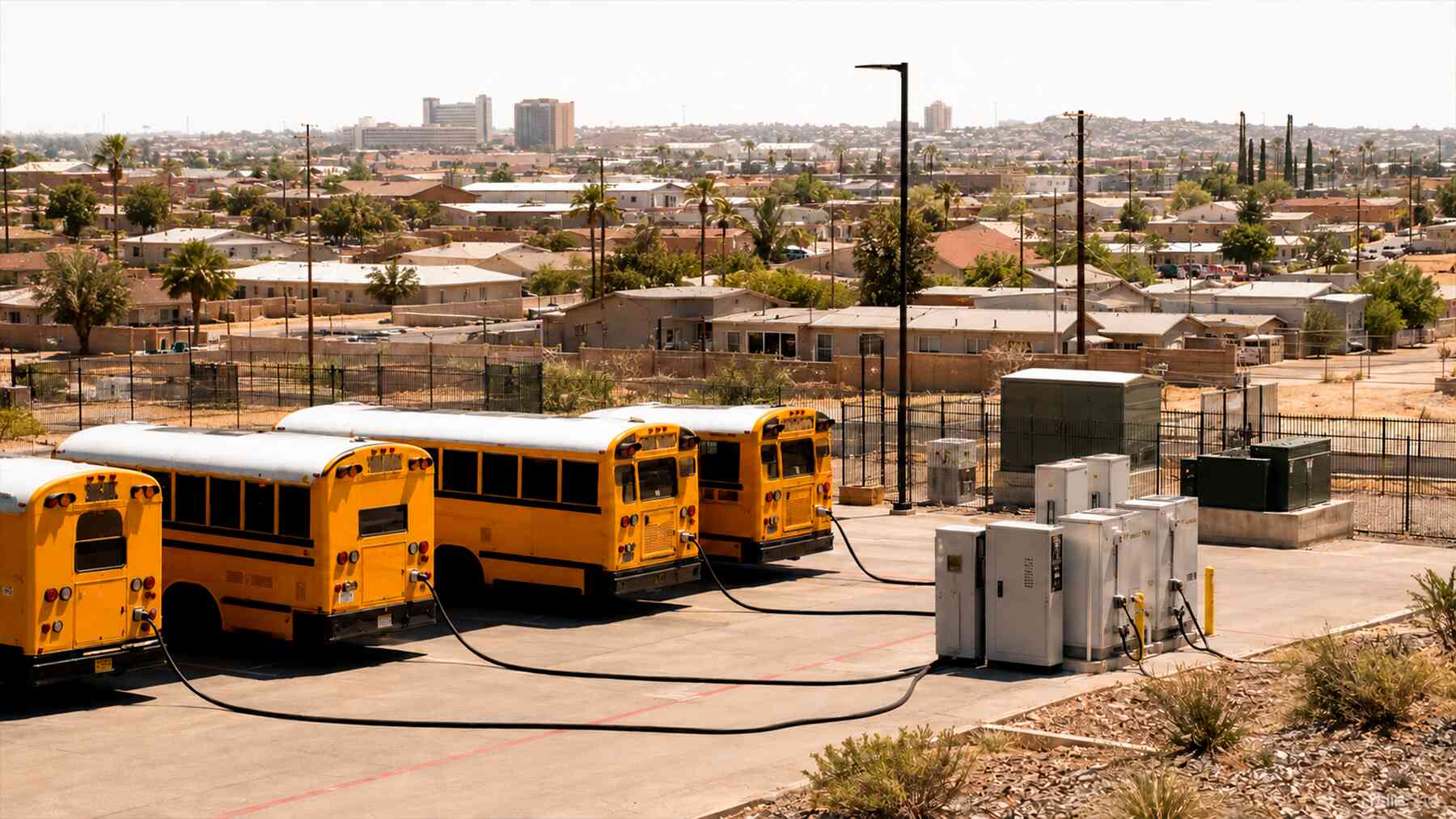
When they are organized in parking lots, they can function like a battery bank.
The vehicles are designed for normal weekly school trips twice a day. But engineers realized that the buses could provide a secondary function.
What happens to all of that stored energy when school is out?
A battery of battery tests to make sure your children are safe
To prove these massive battery banks can handle serious stress, engineers took them to the ultimate testing grounds.
Bad weather is not good for battery efficiency. In freezing temperatures, electric cabins drop to the cold surroundings.
GreenPower Motor Company put their Type A Nano BEAST school bus through rigorous field trials in high-elevation New Mexico communities like Cuba and Shiprock to test whether the children would be safe.
At 7,000 feet, winter temperatures drop into the single digits. GreenPower deployed an innovative cold-weather package featuring heated battery packs and high-efficiency electric cabin heaters.
During standard 30-minute inspections before trips, the bus warmed from 17 degrees to 84 degrees Fahrenheit.
It also maintained zero-emission status without the driving range dropping, which is important.
If these vehicles can manage, store, and protect large volumes of power in winters in the mountains, they are ready for hectic weather.
But what happens when the climate shifts and it’s hot rather than cold?
School buses are now working to save the grid
Now, look at Texas. When summer temperatures redline past 100 degrees Fahrenheit, millions of air conditioners max out the electrical grid.
Utilities face serious risks of blackout. This is where the summer job begins.
Instead of sitting uselessly in parking lots during summer break, hundreds of high-capacity electric school buses are actively helping to boost the grid.
This process uses two-way charging, known as vehicle-to-grid, or V2G, technology. Because these heavy-duty vehicles have batteries exceeding 200 kilowatt-hours, they can store cheap energy when demand is low.
The grid-feeding process goes both ways
When a heatwave arrives and electricity demand spikes, the buses automatically reverse the flow. They feed stored clean electricity back into the local power grid.
When grid operators face critical power shortages, they trigger these connected bus depots to discharge at the same time.
This influx of electricity stabilizes localized grids exactly when clean energy needs supplementing.
The World Resources Institute reports that just 230 V2G-enabled buses can supply eight megawatt-hours of power. That’s enough energy to power 1,600 average American homes for four hours.
By reducing the need for emergency power plants, this system protects the environment. It also earns revenue for local school districts.
As extreme weather pushes modern infrastructure to the limit, could this network of batteries on the road become a blueprint for America’s clean energy future?
Read the whole thing?
Get the week's signal, not the noise
Our sharpest reporting on energy, climate and nature — free, once a week.