
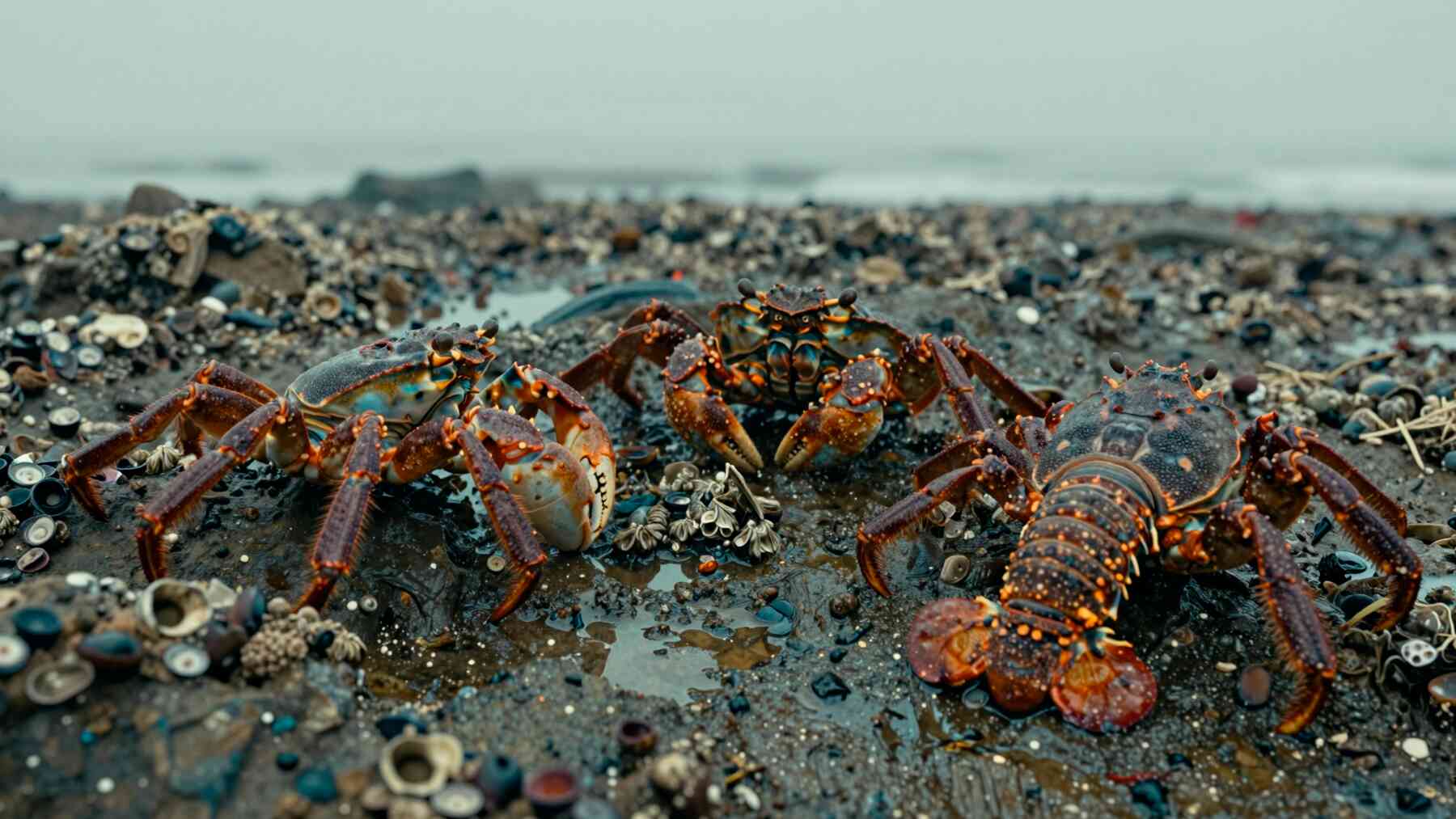
Evolution has a favorite answer. Across millions of years and dozens of unrelated lineages, it keeps arriving at the same one: the crab. Not metaphorically — literally. Multiple crustacean groups that never shared a crab-like ancestor have independently evolved the same broad, low, compact body plan, again and again.
Scientists call this pattern carcinization, and it’s as well-documented as it is strange. True crabs didn’t corner the market on looking like crabs. Several entirely separate lineages got there too — on their own, from different starting points.
The pattern that keeps puzzling scientists
The term “carcinization” comes from the Greek karkinos, meaning crab — the same root behind carcinoma and carcinogen. English zoologist Lancelot Alexander Borradaile coined it in 1916, and it stuck because the pattern itself is so striking. A broad, low, compact body plan — tucked abdomen, widened form, compact structure — has emerged repeatedly across lineages that share no crab-like ancestor.
True crabs didn’t invent this shape exclusively. Crab-like forms evolved independently several times within Anomura — the group containing hermit crabs, king crabs, and squat lobsters — as documented in a 2017 paper in the Biological Journal of the Linnean Society. Carcinization is a genuine scientific phenomenon and, somewhat separately, a beloved internet meme. It can be both.
Convergent evolution: when nature rewrites the same blueprint
Carcinization is one instance of a broader principle: convergent evolution. When unrelated animals face similar environments and pressures, they can independently land on similar solutions. Birds and bats both evolved wings. Birds and mammals both became warm-blooded, even though neither inherited that trait from a shared warm-blooded ancestor.
The same logic applies to the crab body plan. Similar habitats create similar challenges — predators, currents, substrate, competition — and those challenges can push different lineages toward the same useful shape. The crab form looks like a repeatedly “discovered” answer to ecological problems that keep arising across crustacean history. That doesn’t mean every crustacean is destined to become a crab. It means the shape keeps proving useful enough to re-emerge when conditions favor it.
New genomic research sharpens the picture
For a long time, researchers studied carcinization mostly through anatomy. Now there are more tools. A January 2026 study in Animal Cells and Systems analyzed 42 anomuran mitochondrial genomes — including three newly sequenced taxa — to refine evolutionary relationships and test carcinization-related patterns. Time-calibrated analyses placed key divergence events for lithodid and pagurid lineages around the Eocene-Oligocene transition, a period of significant environmental change.
A 2026 eLife preprint added another piece. The iconic sideways walk most people associate with crabs likely evolved just once, from a forward-moving ancestor, near the base of Eubrachyura. The exterior shape may recur across lineages, but not every feature of crab-ness follows the same pattern.
What the fossil record adds — and what it still can’t answer
The fossil record offers a longer timeline. A February 2026 paper in the Journal of Crustacean Biology catalogued the decapod fossil record at 4,225 fossil species, 1,284 genera, and 193 families — diversity peaks appearing in the Late Jurassic, Late Cretaceous, Eocene, and Miocene, periods researchers can cross-reference with genomic divergence estimates.
The same paper flagged carcinization and decarcinization — where lineages move away from the crab form — as questions that still depend on more complete fossil accounting. King crabs make the stakes vivid: spiky and imposing, they descended from hermit crabs. The evolutionary distance between a hermit crab tucked into a borrowed shell and a king crab sprawling across the seafloor is enormous, yet genomic and morphological evidence points directly to that lineage.
Inside the crab: when the exterior shapes the interior
The crab shape isn’t only skin deep. The 2017 Biological Journal of the Linnean Society paper showed that the crab-like exterior connects to internal anatomy, including structures tied to the nervous and circulatory systems. Some internal similarities appear across crab-like lineages. Other organs still differ in shape and size.
That creates a genuine interpretive challenge: some internal anatomical features are structurally dependent on the external body plan, making it hard to separate cause from consequence. Did internal systems drive the shape, or did the shape reorganize the internals?
What’s emerging is a complex mix of ecology, body architecture, developmental constraints, and environmental change. Carcinization isn’t a law of nature — it’s a recurring answer to a recurring question that evolution keeps asking, and keeps answering the same way. When a blind process with no memory or intent keeps arriving at the same solution across millions of years and dozens of lineages, it reveals something real about the relationship between form and function.
Read the whole thing?
Get the week's signal, not the noise
Our sharpest reporting on energy, climate and nature — free, once a week.




