
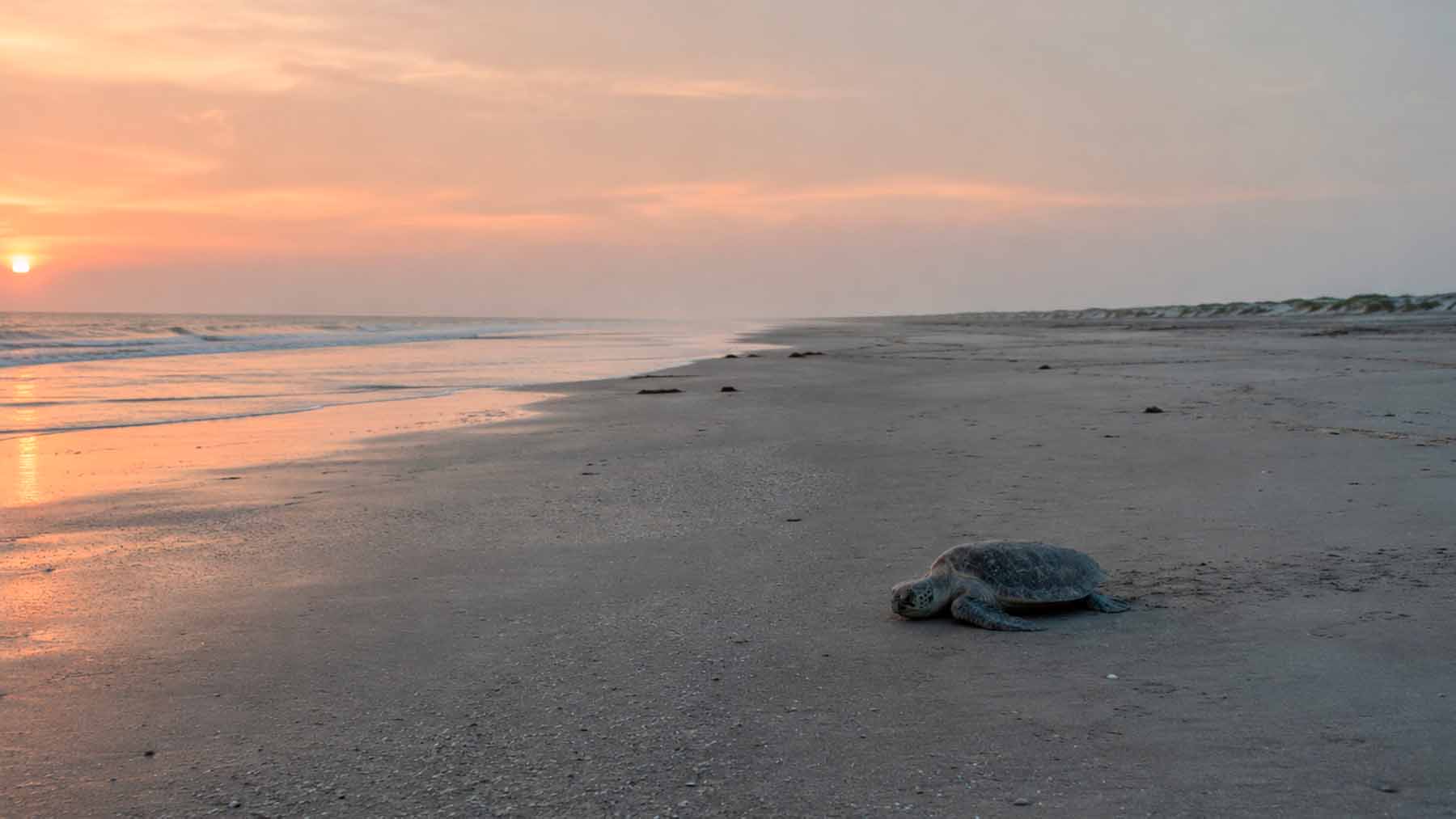
On a single day in 1947, a beach in northeastern Mexico witnessed something almost impossible to imagine: tens of thousands of sea turtles emerging from the Gulf of Mexico at once, covering the sand at Rancho Nuevo in a mass nesting event captured on amateur film.
Decades later, that same beach fell nearly silent.
The Kemp’s ridley sea turtle — the world’s rarest — had been pushed to the edge of extinction. What followed is one of the most dramatic stories of collapse and slow, hard-won recovery in modern conservation history.
A beach that once held tens of thousands
The 1947 footage is grainy and brief, but what it shows is staggering. Thousands upon thousands of Kemp’s ridley sea turtles crawl ashore at Rancho Nuevo, a remote stretch of beach in Tamaulipas, Mexico, blanketing the sand in every direction. Later referenced by the National Oceanic and Atmospheric Administration, the video captured what scientists now recognize as one of the most extraordinary wildlife events ever recorded.
That event is called an arribada — Spanish for “arrival by sea.” During an arribada, female Kemp’s ridleys emerge from the ocean not alone but together, in massive synchronized waves, digging their nests, depositing their eggs, then returning to the water — a ritual playing out on these beaches for millions of years.
Of the seven sea turtle species on Earth, the Kemp’s ridley is both the smallest and the most globally endangered. Rancho Nuevo remains their primary nesting ground to this day.
How a species fell to the brink
What happened after that 1947 spectacle was a slow-motion catastrophe. Egg harvesting was among the earliest and most damaging pressures — arribada events concentrate thousands of nesting females in one place, making collection easy. For decades, eggs were taken in enormous quantities for food, stripping nesting success year after year.
Coastal degradation compounded the damage. As human development expanded along Gulf shores, nesting habitats shrank and fragmented, leaving turtles that survived long enough to reproduce with fewer safe places to do it.
Then there was bycatch. Trawl nets proved especially deadly: turtles caught underwater can’t surface for air and drown before fishers can intervene. The combined toll was catastrophic. Between the 1940s and 1985, the Kemp’s ridley population collapsed by 99%. “They went from over 121,000 nests to 702 nests,” said Katherine Sayler, marine biologist and southeast representative for Defenders of Wildlife. That number — 702 — represents one of the sharpest documented population crashes in sea turtle history.

Thirty years of slow, hard-won recovery
Since the 1990s, the trajectory has reversed. It hasn’t been fast, and it hasn’t been easy, but it has been real. Today, an estimated 7,000 to 9,000 nesting female Kemp’s ridleys exist worldwide, producing tens of thousands of nests globally each year.
That shift didn’t happen by accident. Legal protections under the U.S. Endangered Species Act created enforceable safeguards for the species and its habitat. U.S.-Mexico cooperation established coordinated monitoring and protection programs along critical nesting beaches, while requirements for turtle excluder devices in shrimp trawls cut bycatch significantly. None of it would have held without community involvement alongside those policy changes.
“Because of thoughtful people taking action on their own beaches, conservation organizations, protection under the Endangered Species Act, and international conservation, many of them have rebounded,” Sayler said. The scale of the turnaround isn’t lost on her. “It’s pretty significant in terms of the swing in population abundance,” she added — a quiet understatement from someone who has watched this species claw its way back from the edge.
What resilience looks like in the animal kingdom
When Sayler talks about what she loves most about sea turtles, she keeps returning to one word: resilience. The Kemp’s ridley endured a bottleneck so severe that, under different circumstances, it might simply have been the end.
The story isn’t one of triumph — not yet. The species remains listed as endangered, still facing climate change, continued habitat pressure, and the persistent risk of bycatch. Other sea turtle species around the world are in far worse shape, with fewer protections and less international attention. The Kemp’s ridley recovery is best understood as a proof of concept: coordinated, sustained, multi-decade effort can work. But it requires all of those things to hold — coordination, sustained funding, and time measured in generations rather than grant cycles.
What everyday people can still do
Conservation at this scale can feel abstract. Sayler cuts through that. Her advice is simple and specific: “Keep beaches dark, flat, and clean.”
Light pollution is a serious hazard. Hatchlings instinctively move toward the brightest horizon — in nature, the open ocean — so artificial lights from beachfront buildings and streetlamps can pull them inland instead. Nesting females are equally sensitive to light and disturbance and may abandon nesting attempts on busy, bright beaches entirely.
Beach furniture, tire tracks, and debris can physically block turtles from reaching suitable nesting spots or trap hatchlings on their way to the water. Turning off outdoor lights, clearing beach chairs at night, picking up trash — these aren’t symbolic gestures. They translate directly into better outcomes for nesting turtles, and community-level stewardship has already demonstrated its effectiveness.
As the Kemp’s ridley continues its slow climb back, the next chapter of this recovery will depend, in part, on whether the people who share these coastlines choose to keep showing up.
Read the whole thing?
Get the week's signal, not the noise
Our sharpest reporting on energy, climate and nature — free, once a week.




