Picture a mountain so sheer on every side that the only way to reach its summit is by helicopter or a technical rock climb.
The plateau at the top is barely a mile across, wrapped in cloud, and fractured by crevices plunging more than 300 feet into the rock.
Almost nobody goes up there.
Which is exactly why what lives on that summit has been hiding from science for so long.
A place that time forgot to update
The Guiana Shield is an ancient geological formation spanning much of French Guiana, Suriname, Guyana, and southern Venezuela.
It is one of the most biodiverse regions on Earth, and its flat topped summits are called tepuis.
Each one is essentially its own island in the sky.
The highland plateaus have been largely isolated from one another for millions of years, giving rise to species found nowhere else on the planet.
The region inspired Arthur Conan Doyle’s novel The Lost World, and it earns that name in ways Doyle never imagined.
This particular mountain hosts carnivorous plants, extensive cave systems, and isolated species with millions of years to go their own way.
And yet most of the summits have been visited only a handful of times.
The climb almost nobody makes
The summit of Wei-Assipu-tepui is accessible only by a technical climb or helicopter.
The plateau is about three square kilometers wide, with crevices fractured more than 100 meters into the ground.
A researcher arrived there with a torch, a notebook, and a plan to survey whatever animals the mountain was hiding.
The days up there passed without incident.
The nights were not so calm.
During his time on the summit, the researcher noticed numerous cryptic frogs that only came out after dark, found on the ground, on leaves, under rocks, and in crevices.
To a casual eye they looked like nothing special, small brown shapes vanishing into the dark the moment the light swung their way.
Something the DNA was not expecting
The frogs looked so ordinary that it took laboratory analysis back home to reveal what the mountain had been keeping secret.
DNA testing found between 4.1 and 4.9 percent genetic divergence from the nearest relatives, a gap greater than the distance between other recognized species.
Their colors shifted wildly too, ranging from plain medium brown to chestnut and brownish red.
Two frogs side by side on the same leaf could look like entirely different animals, which is part of why the species stayed hidden so long.
Despite being genetically distinct, these frogs are morphologically similar to another species found on a Venezuelan summit.
The study noted that resemblance as remarkable, precisely because the two are phylogenetically separate members of the same evolutionary clade.
The new frog species with nine passengers
The animal on that misty summit is a new frog species named Stefania maccullochi, formally described in the journal Zoological Letters.
It is known to exist only on the Wei-Assipu-tepui tabletop mountain, on the border of Guyana and Brazil.
Females reach about 2.9 inches in length, with males noticeably smaller at around 2.1 inches.
But the detail that stopped the researcher was not the size or the color.
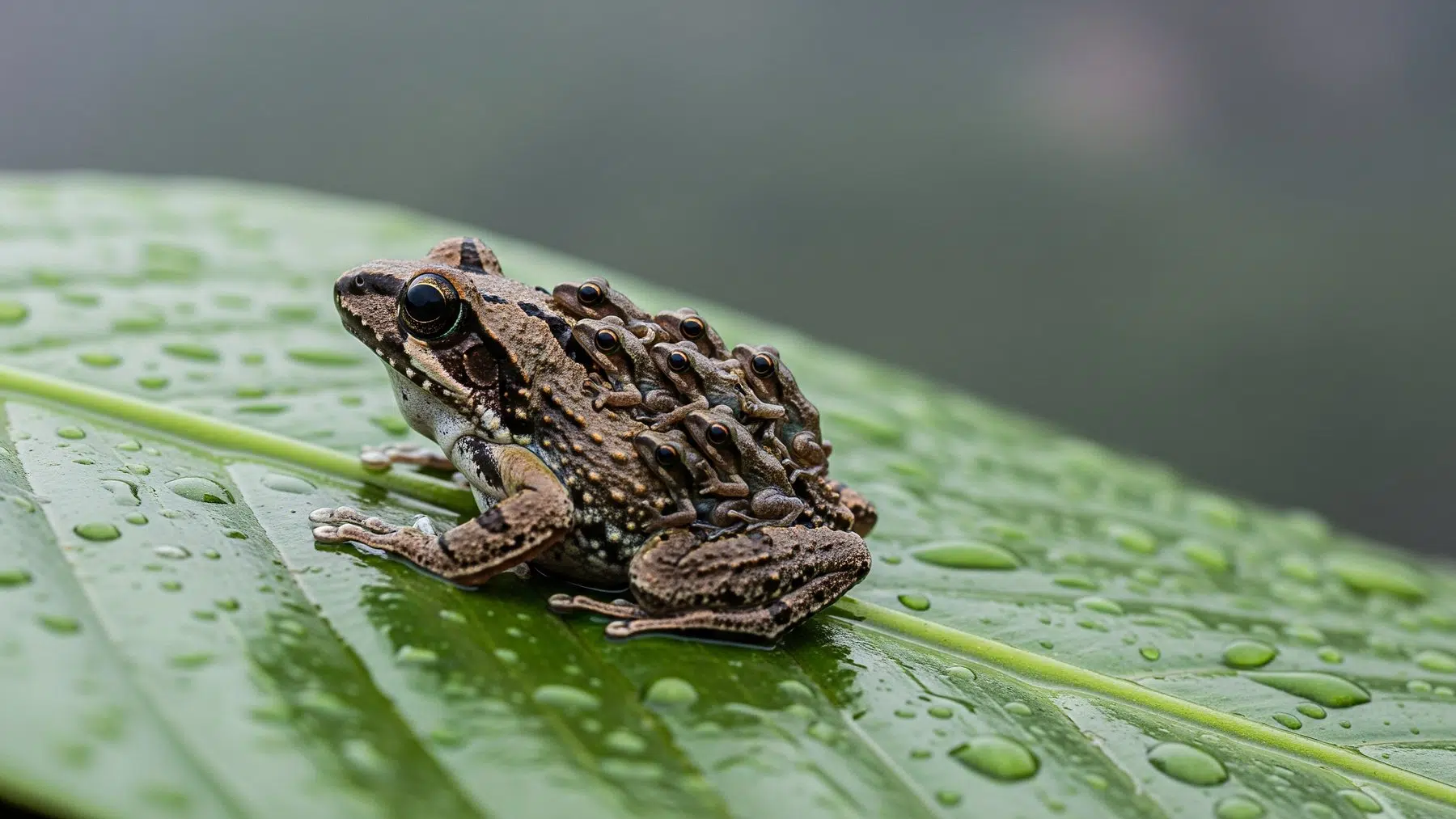
This frog carries its eggs directly on its back, and once hatched, the froglets remain there.
Several females were observed carrying their babies, with one female photographed on a leaf with nine babies riding along.
There is no pond, no clutch of eggs in the water, no tadpole stage at all.
The mother is the whole nursery.
This behavior is part of what makes the Stefania group so remarkable, and among newly named species emerging from old assumptions, these frogs dissolve the line between parent and habitat entirely.
They are not alone in rewriting what we thought we knew: a backyard bird that hammers trees up to 20 times a second turned out to hold its own neurological surprises.
What a mountain this remote is still teaching us
Stefania maccullochi is already listed as critically endangered by the IUCN.
Its entire known world is a plateau barely the size of a few city blocks, reachable only by helicopter.
That isolation is both the reason the species survived in its own evolutionary lane and the reason it faces such a thin margin of safety.
Scientists believe many cryptic species across the Guiana Highlands remain unnamed and undescribed.
The frog that carries her babies like a living backpack is a reminder that the planet’s inventory of life is still very much unfinished.
Some of its most extraordinary chapters are sitting on mountaintops that almost nobody has ever thought to climb.
And some are only a few inches long, brown enough to look like bark, and waiting patiently in the dark.
Read the whole thing?
Get the week's signal, not the noise
Our sharpest reporting on energy, climate and nature — free, once a week.