
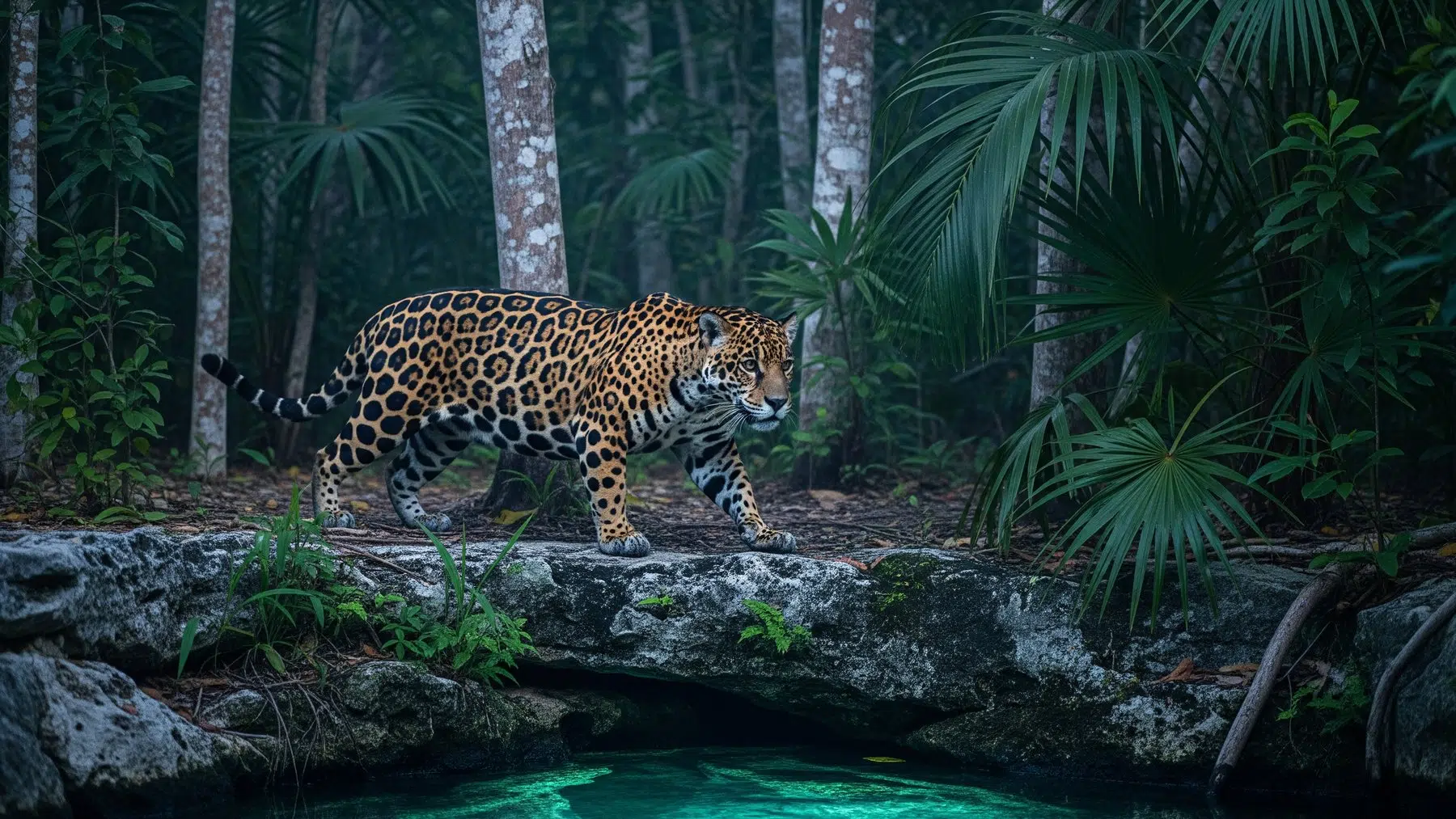
Somewhere beneath the jungles of Mexico’s Yucatan Peninsula, a jaguar stopped at a path it had always used.
The path was gone, replaced by a fence and a concrete viaduct.
Above the jaguar, a $30 billion train was already running.
Below it, in the limestone dark, something else had been lost entirely.
The jungle that hides an entire second world
Most people picture the Yucatan as beaches and ruins baking in the sun.
The real wonder is underground.
The Yucatan Peninsula contains an estimated 10,000 cenotes, water filled limestone sinkholes that serve as the region’s primary freshwater source.
Thousands of these sinkholes interconnect like honeycomb just beneath the ground.
Together they supply drinking water to around 5 million people.
Picture turquoise rivers threading through cathedral chambers of ancient stalactites, none of it visible from the surface.
Blind fish and translucent shrimp drift through flooded tunnels that no sunlight has ever touched.
Some of those tunnels stretch for miles before opening into the next chamber.
This hidden world had survived largely intact for millions of years, until a megaproject arrived above it.
A train that promised not to touch a single tree
The system fully opened in December 2024, costing an estimated $30 billion and creating a grand loop around the Yucatan Peninsula.
That loop runs 966 miles of rail, 34 stations, and more than three dozen trains moving at up to 100 miles per hour.
Supporters called it a gift to an impoverished region.
When proposing the Maya Train project, the former president promised that he would not uproot a single tree.
That promise did not hold.
The project became a national controversy when it drove pillars through sensitive cave ecosystems and cut into the protected rainforest of the Calakmul Biosphere Reserve, often without permits.
Researchers estimate the project caused an estimated 6,659 hectares of forest loss along its route.
And the damage ran deeper than the surface in every sense.
The drill that pierced the ceiling of an underwater world
One of the most striking moments in the controversy came underground.
Biologist and speleologist Roberto Rojo was exploring a cave in Quintana Roo when he heard an industrial drill pierce the ceiling above him.
The drill was sinking a support pillar for the train above.
In total, 120 cenotes were punctured as pillars were installed along the route.
Activists published a video showing that steel piles had corroded and the resulting structural damage allowed tons of concrete to leak into the caves.
That concrete settled into pools where 5 million people draw their drinking water.
Scientists warn the cenote network is so deeply interconnected that damage at one point can ripple across the whole system toward the sea.
Even a small intrusion of sediment or concrete can alter water chemistry across a network that took millennia to form.
The jaguar’s 12 severed corridors
A federal appeals court has now stepped in.
Construction on a key remaining stretch of the Maya Train was halted after the court granted a definitive suspension, ordering the government to preserve the environment and carry out inspections.
At the heart of the ruling is a creature most Americans have only seen in a zoo.
The train cut off jaguar movement in 12 corridors and severed migration patterns for monkeys and other transitory animals.
The jaguar has become the living symbol of what endangered predators lose when a fence cuts an ancient path in two.
Concrete measures must be implemented to guarantee the survival of threatened species, and biological corridors that have been obstructed must be restored, activists say.
Activists called Section 5 the most damaging stretch, citing the destruction of thousands of trees along that corridor alone.
A chance to put something back
The court ruling is significant, but critics note the timing is painful.
The decision comes so late that the lines are already built and surrounding ecosystems are already feeling the impact.
Still, the new government is moving in a direction that carries real hope.
Officials with the Ministry of Environment and Natural Resources reportedly want to remove fencing along the tracks, which currently prevents wildlife crossings.
Undersecretary Marina Robles García is reportedly looking at granting biosphere reserve status to caves and cenotes in Quintana Roo.
That status would give the underground world a legal shield it never had before the first drill bit touched limestone.
The cenote system is also drawing new attention from ecologists who study how small habitats connect into larger living networks.
Restoring even one jaguar corridor would allow young males to range across hundreds of square miles of territory they have not touched in years.
No one yet knows whether the jaguar’s 12 broken corridors can be stitched back together.
But a creature that survived ice ages in this jungle has, at the very least, a court on its side now.
Primary sources: National Geographic on cenote damage from Maya Train construction; Sierra Club on jaguar corridors and ecological impact.
Read the whole thing?
Get the week's signal, not the noise
Our sharpest reporting on energy, climate and nature — free, once a week.




