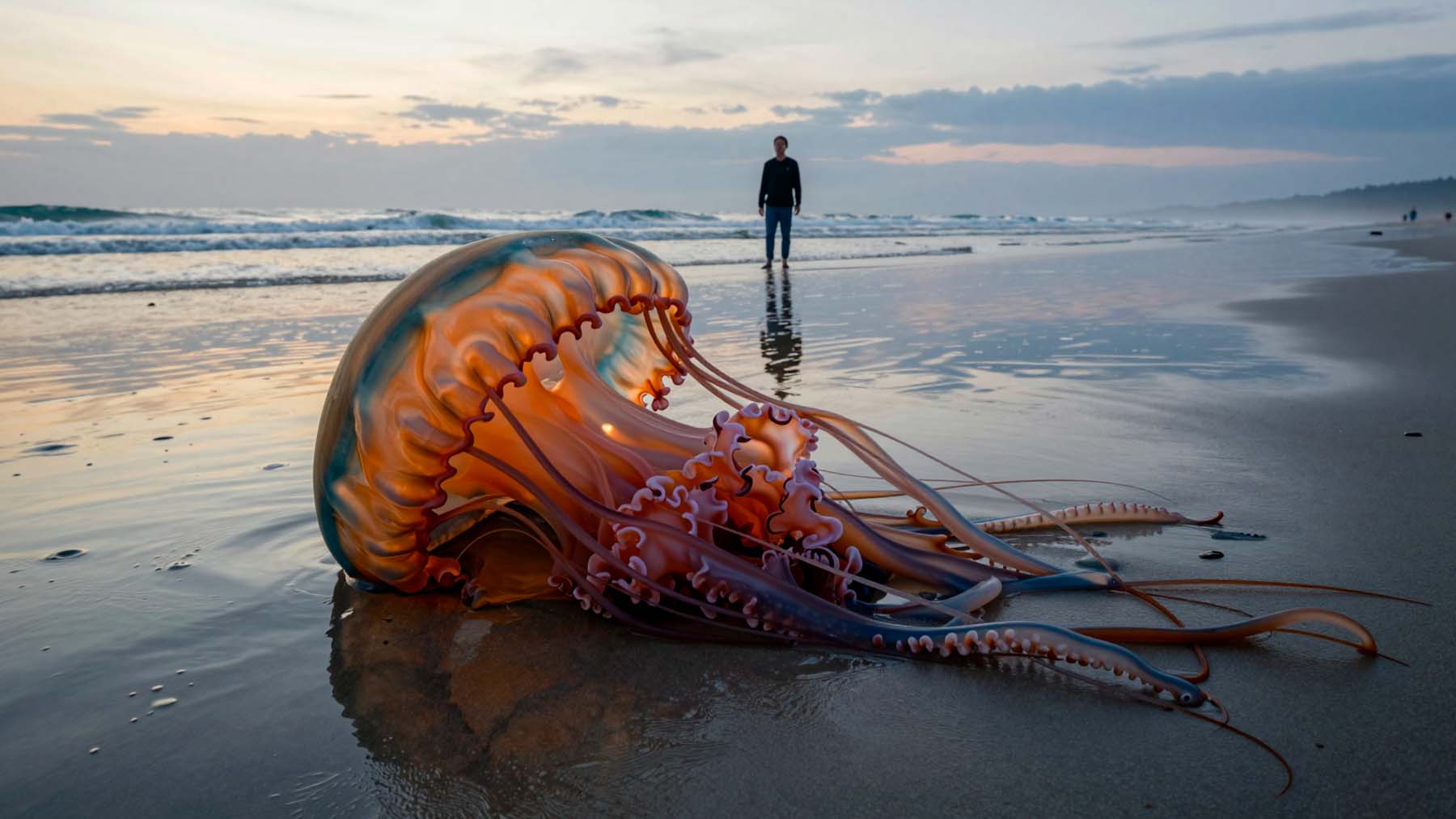
A jellyfish with a bell three feet wide and tentacles stretching over 100 feet has been washing up on Massachusetts beaches — and it isn’t alone. Lion’s mane jellyfish, among the largest creatures in the ocean, are appearing off Cape Cod in numbers that are catching marine observers off guard.
What makes this summer different isn’t just the size of the animals. Sightings began as early as May, weeks ahead of the typical late-spring window, and densities by mid-June were described as exceptionally high. Something is pulling these open-ocean giants closer to shore — and researchers are still working out exactly what.
A creature built for the open ocean — now on your shoreline
The Lion’s mane jellyfish (Cyanea capillata) isn’t a subtle animal. Its bell can reach roughly three feet across, and its tentacles — which can exceed 100 feet in length — make it one of the largest invertebrates on Earth. Those trailing tentacles are longer than a standard school bus, and then some.
Under normal circumstances, you wouldn’t encounter one at the beach. This species typically inhabits open-ocean ecosystems: the Pacific, Atlantic, and Arctic Oceans, along with the Baltic and North Seas. It belongs to deep, cold, expansive water — not the shallow coastal zones where families spread towels and kids wade in.
That’s what makes its current presence off Massachusetts worth noting. Shallow nearshore waters near Cape Cod aren’t the Lion’s mane’s natural territory, and seeing them there in large numbers is something researchers are paying close attention to. One more thing worth knowing: their stings are described as very toxic and painful. Human fatalities are rare, but the experience is not one you want. Those long, nearly invisible tentacles can cause significant discomfort and, in some cases, more serious reactions.
Earlier arrivals, higher densities: what the data shows
The timing this year is what first raised flags. Typically, Lion’s mane jellyfish appear in Massachusetts waters during a late-spring-to-summer window — but this year, reports started coming in as early as May, weeks ahead of schedule.
By mid-June, the numbers had climbed enough to prompt local officials to speak up. The Sandwich Marina Harbormaster in Cape Cod posted a public alert describing the situation directly: “Lion’s Mane jellyfish are currently appearing in unusually large numbers off Cape Cod.” That kind of flag from a harbormaster isn’t routine. It signals that what observers were seeing went well beyond the occasional stray jellyfish drifting into coastal waters.
This isn’t entirely without precedent. The Harbormaster’s post noted that a comparable bloom occurred in 2020. A single unusual event can be written off as a fluke, but two significant blooms within a few years suggests a pattern — possibly one that’s intensifying over time, though researchers haven’t confirmed that conclusion yet.
Ocean currents, temperature, and food: the likely drivers
Unlike fish, jellyfish don’t navigate. They drift. Where they end up depends almost entirely on the currents and winds moving around them — if those conditions push water toward shore, that’s where the jellyfish go.
Experts point to a combination of environmental factors that may be concentrating Lion’s mane jellyfish in nearshore Massachusetts waters. Water temperature shifts and available food sources are both cited as likely contributors, according to the Sandwich Marina Harbormaster’s post, which referenced expert input on the bloom. Warmer or differently stratified water can alter the circulation patterns that jellyfish depend on.
Changes in food availability also play a role. The small fish, fish eggs, and zooplankton that Lion’s mane jellyfish eat can draw them toward areas where prey is more concentrated, including coastal zones. No single definitive cause has been identified. This remains an area of active observation, not settled science, and researchers are still piecing together the contributing variables.
What beachgoers need to know
Tentacles are extremely difficult to see in the water. You may not realize you’re near one until you’ve already made contact — which is reason enough to stay alert.
Distance is your best protection, both from jellyfish in the water and from any that have washed ashore. A beached Lion’s mane isn’t a safe one. Its stinging cells stay active even after the animal has stranded, and touching a jellyfish that looks dead can still result in a painful sting. The New England Aquarium put it simply in a public advisory: “Keep an eye out: lion’s mane jellies can give a pretty painful sting! If you see one washed up on the beach or floating in the water, it’s best to admire it from a safe distance.”
If a sting does happen, rinse the affected area with warm water. Use tweezers to carefully remove any visible tentacles — not your bare hands. Vinegar can help neutralize the sting. Severe or widespread symptoms warrant medical attention.
What to watch for the rest of the season
The summer isn’t over, and the conditions that brought these jellyfish inshore haven’t necessarily changed. Beachgoers along Cape Cod and broader Massachusetts coastal areas should expect Lion’s mane sightings to continue through the season.
If both 2020 and 2025 produced unusually large concentrations of Lion’s mane jellyfish in Massachusetts waters, the years ahead will either reinforce or complicate that pattern. Marine researchers and local harbormaster offices will likely keep tracking reports. The picture they build over the next few seasons could tell us something meaningful about how these open-ocean animals are shifting their range in response to changing ocean conditions — and whether what’s happening off Cape Cod is an anomaly or the beginning of something larger.
Read the whole thing?
Get the week's signal, not the noise
Our sharpest reporting on energy, climate and nature — free, once a week.