Somewhere beneath the mountains of Yunnan, China, a cave drops past 6,500 feet of limestone into near-total darkness — flooded, silent, and largely unexplored. Last August, a team of researchers waded through its shallow waters looking for signs of life.
What they found had never been documented in China before.
Tiny, nearly see-through, and completely blind, the creature drifting among the submerged gravel was a freshwater snail shaped entirely by a world without light. Scientists have now formally described it — and the circumstances of its discovery are as striking as the animal itself.
A creature shaped entirely by darkness
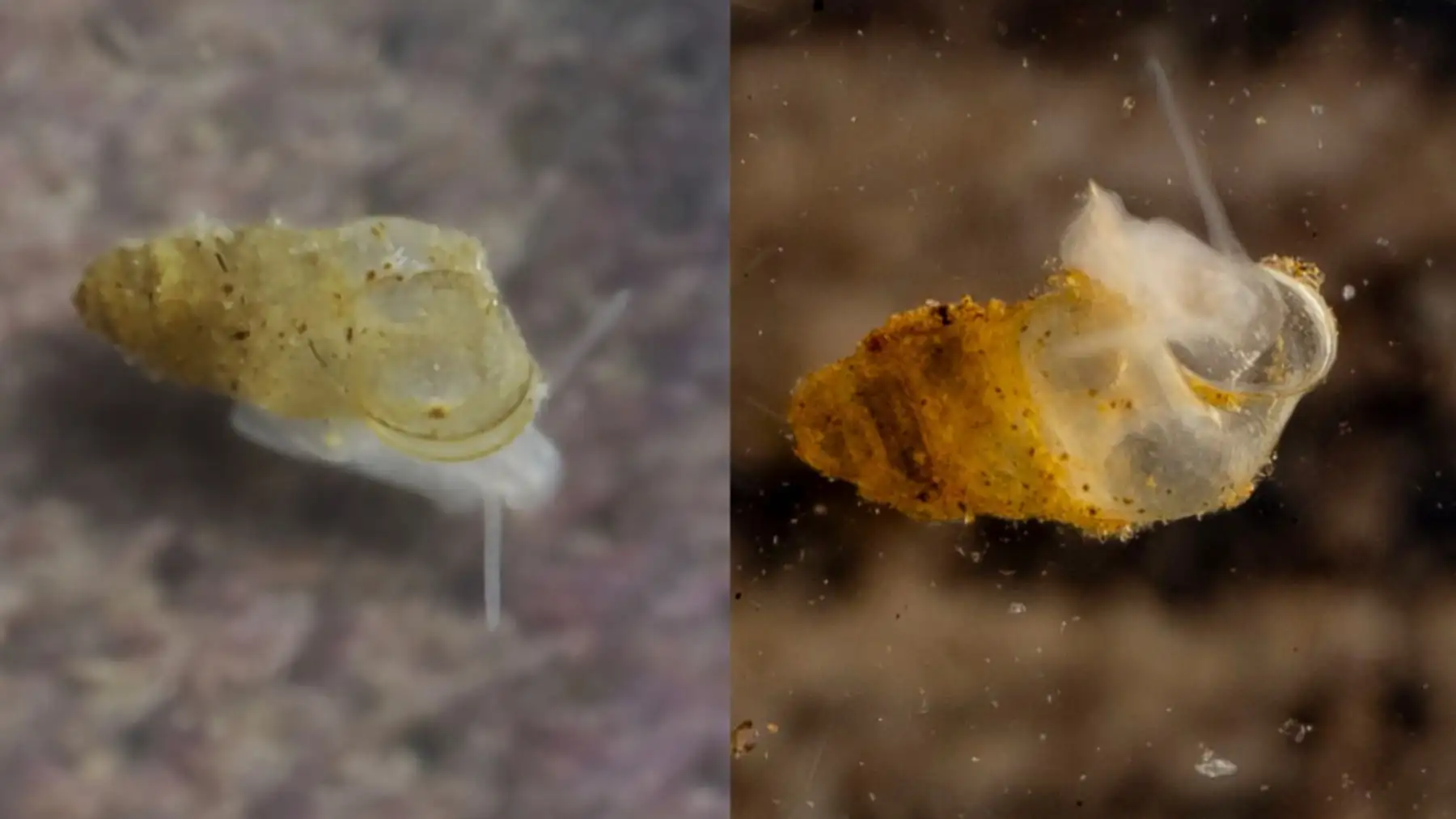
Erhaia dijiang looks like something evolution forgot to finish. Its cone-shaped shell is nearly transparent, its body carries no pigmentation, and where eyes would normally be, there’s simply nothing. Long, slender tentacles extend from its pale form — sensory tools compensating for vision it’ll never need.
These traits aren’t defects. They’re solutions. Eyes are metabolically expensive to build and maintain, and in permanent darkness they offer no return on that investment. Cave-dwelling animals lose them entirely over evolutionary time. What remains is a body tuned precisely to its lightless world.
That sensitivity runs surprisingly deep. In lab conditions, the snails consistently retreated beneath rocks whenever light was introduced — not randomly, but immediately and repeatably. For this animal, light is something to escape.
Its name reflects that strangeness in a fitting way. Researchers named the species after Di Jiang, a faceless mountain god described in the Classic of Mountains and Seas — an ancient Chinese text cataloguing mythological creatures and landscapes. A blind, unpigmented snail with no visible face seemed like a natural match for a deity defined by the same absence.
A record-breaking address: above 6,500 feet underground
The cave where Erhaia dijiang was found sits at 2,765 feet above sea level, making it the highest-altitude cave snail ever recorded within the family Erhaiidae — a distinction that carries real scientific weight.
Until this discovery, it wasn’t clear that freshwater cave snails could colonize limestone systems this far above sea level. The find expands what researchers thought was the possible range of subterranean mollusks, suggesting that underground aquatic habitats at high altitude may be more biologically active than previously assumed.
Inside the cave, conditions are relatively stable. The snails live among submerged gravel and broken rock, in water less than 3 feet deep, with temperature hovering near 20°C — cool, consistent, and cut off from the thermal swings of the surface world above.
Seasonal rains occasionally flush a few individuals toward the cave entrance, but none have ever been found in nearby streams. The snails stay within roughly six feet of the entrance, suggesting a tight fidelity to their underground environment — one they appear unwilling, or unable, to leave.
What the snail eats — and what that reveals about cave food webs
In the lab, researchers watched the snails feed on diatoms — microscopic algae that grow as thin films on rock surfaces. They also accepted fish food provided by the research team, suggesting some dietary flexibility.
Near cave entrances, faint light still penetrates, and that’s enough for photosynthetic organisms to survive. Those algae form a thin but functional base for a food web that can support small invertebrates like cave snails without any connection to the surface ecosystem above.
That web, in East Asia, remains largely unmapped. Subterranean aquatic ecosystems across the region have received relatively little scientific attention, and the documentation gaps are significant. Erhaia dijiang is the first freshwater cave snail formally documented in China — a country with vast limestone cave systems and rich biodiversity had, until August 2025, no recorded species in this entire ecological category.
Only three adults — and a race against an unknown threat
The field survey that produced this discovery also produced a troubling count: three living adults and one empty shell. No juveniles. Nothing else.
Juveniles signal that a population is reproducing and replacing itself. When they’re missing entirely, it may indicate a group too small, too stressed, or too isolated to sustain itself over time. Their absence here is a warning.
The researchers describe the conservation outlook as “far from optimistic.” That’s careful scientific language — but the implication is clear. A species found in a single cave, with only three known adults, could disappear before anyone fully understands it.
Broader cave surveys across China and urgent development of protections for subterranean mollusks in restricted habitats are what the scientists are calling for now. The concern isn’t hypothetical.
Erhaia dijiang isn’t charismatic megafauna. It’s a inch-scale snail in a flooded mountain cave — fragile, ancient, shaped by millennia of darkness. Its existence is a reminder of how much life persists in places we’ve never thought to look, and how quickly that life can vanish once we finally do.
The full study can be checked here: Yue-Ming He, Hong-Quan Xiang, Jin-Mei Yang, Hui Zheng, Suo-Zhu Yang, Yu-Feng Zhou, Jian Zheng. A new eyeless species in Erhaiidae (Gastropoda, Truncatelloidea) from a cave in Yuxi City, Yunnan, China. Subterranean Biology, 2026; 56: 127 DOI: 10.3897/subtbiol.56.188075
Read the whole thing?
Get the week's signal, not the noise
Our sharpest reporting on energy, climate and nature — free, once a week.